
Introduction: Navigating the Explosion of CS Learning Options
You want to learn computer science. But where do you even start? In 2026, the options are endless. You have university programs like Stanford online courses, giant platforms offering Coursera courses, free intro classes through Udemy free courses, and forums where people share advice like the Reddit computer science roadmap.
It is a lot to sort through.
The demand for computer science skills keeps growing. According to The Outlook for Computer Science Education, more students than ever are enrolling in CS programs. In fact, the global e-learning market is expected to hit 400 billion dollars by 2026, based on online learning trends. But having so many choices can actually make things harder. You might feel stuck trying to figure out which path actually works for you.

That is where this guide comes in. We break down the best ICS courses (Information and Computer Science) available right now. Whether you are an engineer looking to level up, a manager building your team’s skills, or a founder trying to make smart tech hires, you need a clear way to compare your options. University degrees, MOOCs, bootcamps, and self-paced platforms all have trade-offs.
This guide gives you a side by side look at what is worth your time and money. For more on picking the right learning path, check out our roundup of best computer courses 2026 for software engineers.
And if you want to keep up with the fast moving world of tech and AI without the noise, consider The AI Newsletter Worth Reading. It delivers clear daily AI updates straight to your inbox.
The Landscape of Computer Science Education in 2026: Academic vs. Online
When you search for ICS courses today, you find two main paths. One is the traditional academic route. You enroll in a university and earn a bachelor’s or master’s degree over several years. The other path is online learning. Platforms like Stanford online courses, Coursera courses, and even Udemy free courses let you learn specific skills on your own time. Both have clear strengths and weaknesses.
Academic Programs: Structure and Credibility
University degrees offer a structured curriculum, access to professors, and a network of peers. You walk away with a credential that employers recognize. But the cost is high. An online bachelor’s degree can cost between $40,926 and $63,405. On campus programs often cost more. And you need to commit three to four years of your life.
Online Learning: Flexibility and Speed
Online learning has exploded in popularity. Over 11.2 million college students in the U.S. have taken at least one online course, according to Online Learning Statistics & Online Education Trends: 2025 & 2026. Many learners like that they can study when and where they want. The cost is much lower too.

A typical bootcamp or specialization might cost a few hundred to a few thousand dollars. You can finish in weeks or months.
But online learning is not perfect. Some students miss the in person support and structure. A recent survey found that 18 to 24% of learners worry about the quality of online courses or struggle to stay motivated.
The Blurring Line
Here is what changed in 2026. The sharp line between academic and online is fading. Top universities now offer full degrees online. Georgia Tech’s online master’s in computer science costs around $7,000 total. At the same time, online platforms like Coursera offer accredited degree programs. So you can get the best of both worlds.
The right ICS courses for you depend on your goals. If you want a deep foundation and a diploma you can hang on the wall, a university degree might be the way. If you need skills fast for a career change, look at bootcamps or structured online courses.
For more on courses that keep you competitive, read our guide on online certifications for software engineering. It breaks down good options for 2026.
Top Academic Computer Science Programs and Their Online Offerings
The previous section gave you the big picture on academic versus online learning. Now let’s look at specific schools. These are the top universities that now offer accredited ICS courses online. They combine the prestige of a big name with the flexibility you actually need.
Georgia Tech OMSCS
Georgia Tech is the gold standard for affordable online CS degrees. Their Online Master of Science in Computer Science costs around $180 per credit hour. Total cost is about $7,000 to $8,000. That is incredibly low for a top 10 computer science program. You get the same diploma as on campus students. You can find honest student reviews in this Reddit discussion on other online MS in CS programs. It also covers UT Austin, UIUC, and CU Boulder options.
Harvard Extension School
Harvard offers a fully online master’s in computer science through its Extension School. Each course costs $3,580. You complete 11 online courses plus one 3 week on campus summer session. Total cost is about $43,000. The program takes 2 to 5 years depending on your pace. You need an undergraduate degree in CS, math, or a related field. Get the full details at the Computer Science Master’s Degree Program at Harvard Extension School.
Stanford and Other Prestigious Names
Stanford offers online CS courses and a full online master’s. But here is the catch. You pay the same tuition as on campus students. That can easily exceed $60,000. MIT does not offer a fully online master’s, but their MITx courses on edX give you access to world class content for a fraction of the cost. And courses on platforms like Coursera and edX now offer accredited degree pathways from partner universities.
Stevens Institute of Technology
Stevens ranks well in online computer science programs. Their Online Master’s in Computer Science costs $24,000 total. That is $800 per credit. The program was ranked in the top 20 by U.S. News in 2026. Stevens also boasts a 99% employment rate for graduates. Check the Online Master’s in Computer Science at Stevens for the latest deadlines and tuition details.
The Rise of Micro-Credentials
A big trend in 2026 is micro-credentials and graduate certificates. These are shorter programs focused on one area. Think AI, cybersecurity, or cloud computing. You complete 3 to 5 courses and earn a certificate. Many top universities offer these, including Johns Hopkins, Stanford Online, and Coursera partner schools.
Why does this matter for your ICS courses search? Because micro-credentials let you upskill without a multi-year commitment. They cost less too. And many of them stack into a full master’s degree later if you decide to go deeper.
Which Academic Path Suits You Best?
The right choice comes down to three things: your budget, your timeline, and your career goal.
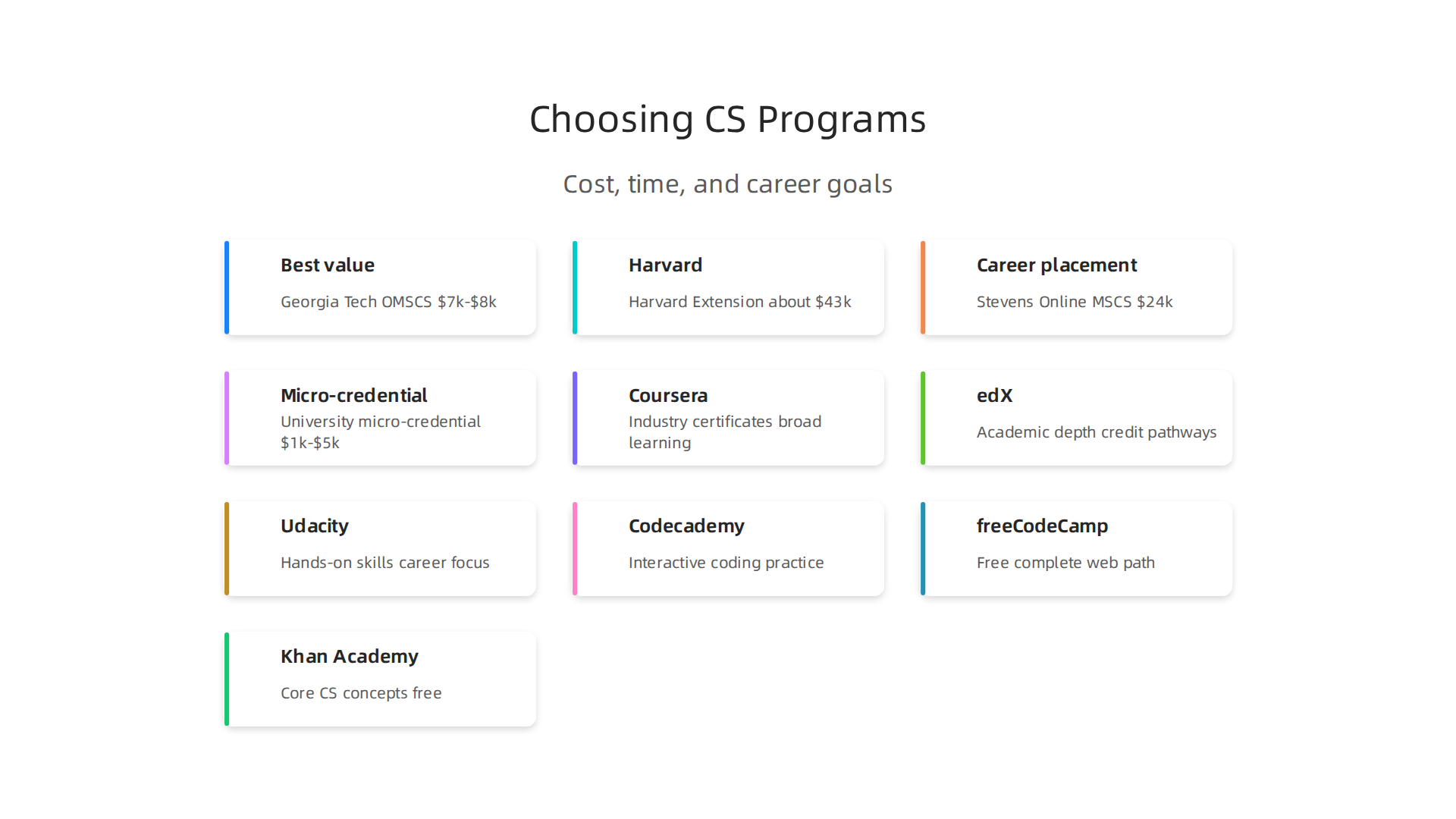
| Your Goal | Best Option | Estimated Cost |
|---|---|---|
| Full degree, best value | Georgia Tech OMSCS | $7,000 to $8,000 |
| Harvard name on your resume | Harvard Extension | About $43,000 |
| Strong career placement | Stevens Online MSCS | $24,000 |
| Quick upskilling | University micro-credential | $1,000 to $5,000 |
If you want a full degree with maximum prestige and minimum cost, Georgia Tech OMSCS is the clear winner in 2026. If you need focused skills fast, look at graduate certificates from a reputable university.
For more help matching programs to your career stage, read our guide on computer certification courses in 2026. It breaks down options from top providers and shows you what works best at each level.
Massive Open Online Courses (MOOCs) and Specializations: Coursera, edX, Udacity
So you know about the big university degrees. But what if you want to learn a specific skill fast without spending years or thousands of dollars? That is where Massive Open Online Courses, or MOOCs, come in. These platforms let you take high-quality ICS courses from top universities and companies. You can go at your own pace, and many courses are free to audit.
In 2026, three platforms stand out: Coursera, edX, and Udacity. Each works a little differently.
Let’s break down what they offer and how to pick the right one for your goals.
Coursera: The Broad Library
Coursera partners with over 200 universities and companies. You can find courses from Stanford, Duke, Google, IBM, and Meta. The catalog is huge. You get over 10,000 courses covering everything from beginner programming to advanced machine learning.
Most courses let you audit for free. That means you watch videos and read materials without paying. If you want a certificate or graded assignments, you pay. A subscription called Coursera Plus costs $59 a month or $399 a year. That gives you access to most courses and professional certificates.
Many people start with free Coursera courses to test the waters. If you are brand new to coding, this is a safe and cheap way to begin. You can find a 2026 comparison of Coursera vs edX vs Udacity for software developers that breaks down the trade-offs in more detail.
edX: The Academic Heavyweight
edX was founded by Harvard and MIT. Its courses lean academic. You get deep, rigorous content. Many courses are from top schools like MIT, Harvard, and Berkeley. The platform also offers MicroMasters programs. These are graduate-level series that can count toward a full degree later.
Like Coursera, edX lets you audit most courses for free. Verified certificates cost between $50 and $300 per course. There is no flat subscription for everything. You pay per course or per program.
If you care about university prestige and want content that feels like a real classroom, edX is a strong choice. It also offers some of the best stanford online courses and other elite university options.
Udacity: The Tech Workshop
Udacity is different. It focuses only on tech fields like AI, data science, cloud computing, and programming. Its Nanodegree programs are project-based. You build real projects and get feedback from industry experts. Career services like resume reviews and coaching are included.
The cost is higher. A Nanodegree costs $249 a month or about $846 for a four month bundle. That is more than Coursera or edX. But you get hands-on support. This makes Udacity a good fit if you want to switch careers and need accountability.
One thing to know: Udacity does not have many free courses. There are some free introductory courses, but the real value is in the paid Nanodegrees.
What About Udemy Free Courses?
Udemy is another platform worth mentioning. It is not a MOOC platform in the same way. Anyone can create a course. Quality varies a lot. But there are many udemy free courses and cheap paid ones. If you have a tight budget, Udemy can be a useful supplement. Just read reviews carefully before buying.
Which Platform Should You Choose?
The answer depends on your style and budget.
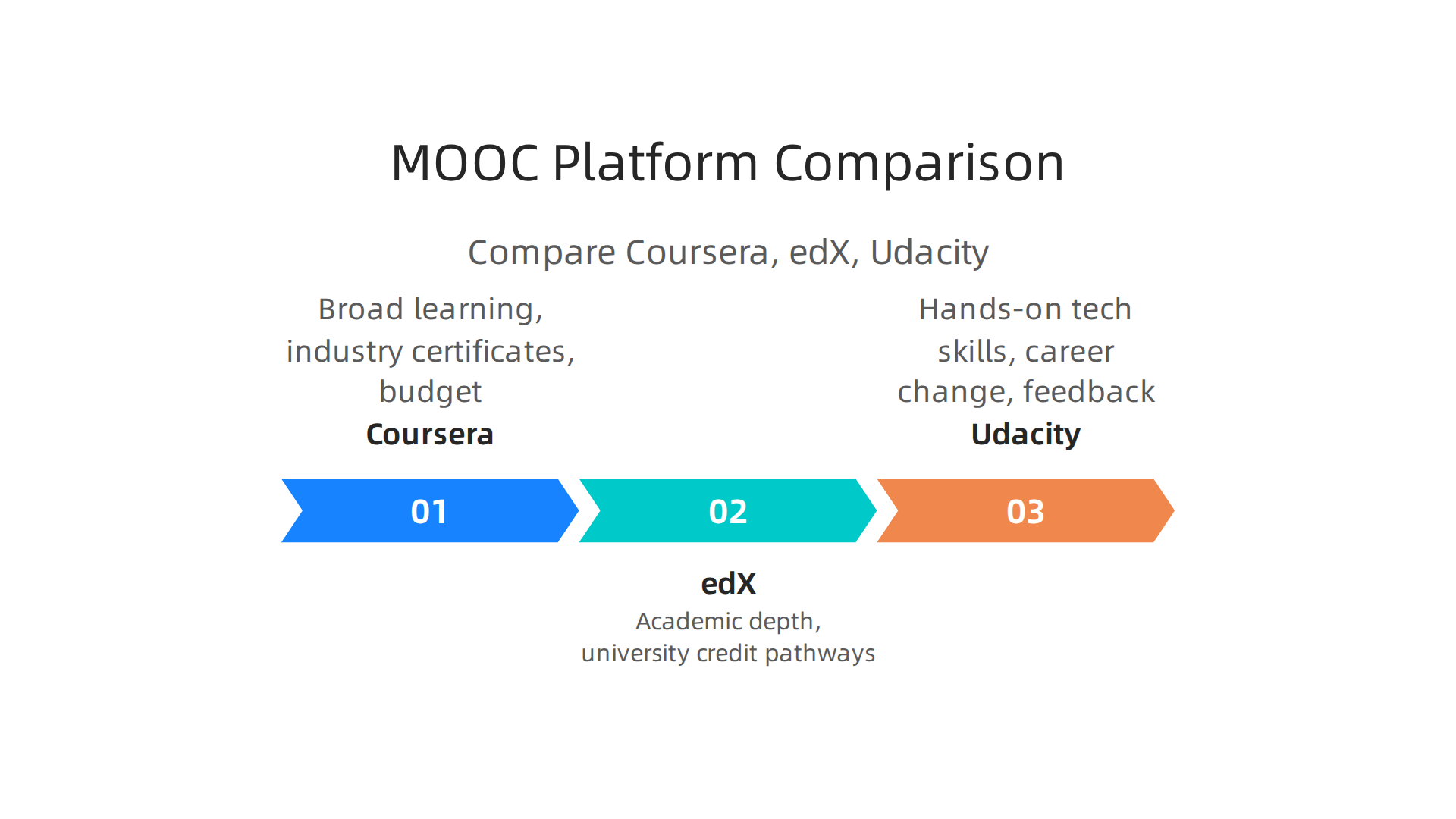
| Platform | Best For | Typical Cost |
|---|---|---|
| Coursera | Broad learning, industry certificates, budget friendly | $59/month (Coursera Plus) or free audit |
| edX | Academic depth, university credit pathways | Free audit; $50 to $300 per certificate |
| Udacity | Hands-on tech skills, career change, project feedback | $249/month or ~$846 for 4 months |
If you learn well on your own and want a ton of options, start with Coursera. If you want top academic names and deeper theory, go with edX. If you need someone to review your code and keep you on track, Udacity is worth the extra money.
For more guidance on picking the right training for your career level, check out our guide to the best computer courses in 2026. It covers these platforms plus bootcamps and certification paths.
No matter which platform you choose, MOOCs let you learn essential ICS courses without quitting your job or going into debt. The hardest part is just starting. So pick one course, audit it for free, and see where it takes you.
Self-Paced Learning Platforms: Codecademy, freeCodeCamp, Khan Academy
MOOCs are great for structured courses from big universities. But sometimes you just want to open a browser and start typing code right away. That is where self-paced learning platforms shine. They focus on doing, not just watching.
Codecademy: Learn by Typing
Codecademy is built around interactive lessons. You read a short explanation, then write code directly in the browser.

The platform checks your work instantly and gives you feedback. This makes it one of the most beginner-friendly ways to start learning ics courses.
Studies show that this hands-on method helps beginners learn faster. A 2026 review of Codecademy for beginners found that its interactive environment reinforces concepts through practice. You start writing real code on day one. That builds confidence fast.
Codecademy offers structured paths for web development, data science, and computer science. The free tier gives you access to many courses. The Pro plan, which costs about $20 a month, adds projects, quizzes, and real-world scenarios. For someone who wants to learn Python or JavaScript quickly, Codecademy is a solid starting point.
freeCodeCamp: Completely Free, Project Focused
freeCodeCamp is a nonprofit organization. Everything on it is free. There are no paid tiers. You earn certifications by completing interactive challenges and building projects. The curriculum focuses heavily on web development: HTML, CSS, JavaScript, databases, and more.
What sets freeCodeCamp apart is its project requirement. To earn each certification, you must build five projects from scratch. This forces you to apply what you have learned. Many people have landed jobs at companies like Google and Microsoft after completing the freeCodeCamp curriculum, the team reports.
If you are on a tight budget and want a complete path into web development, freeCodeCamp is one of the best free resources available.
Khan Academy: Foundational Concepts, Not Deep Code
Khan Academy takes a different approach. It teaches computer science concepts using visual lessons and simple exercises. You learn about algorithms, data structures, and how computers work. But the coding practice is limited.
For beginners who want to understand the "why" behind programming before diving into syntax, Khan Academy is excellent. But if your goal is to build full applications or land a developer job quickly, you will outgrow it fast. Use it as a warmup, not a main course.
Which One Should You Use?
| Platform | Best For | Cost |
|---|---|---|
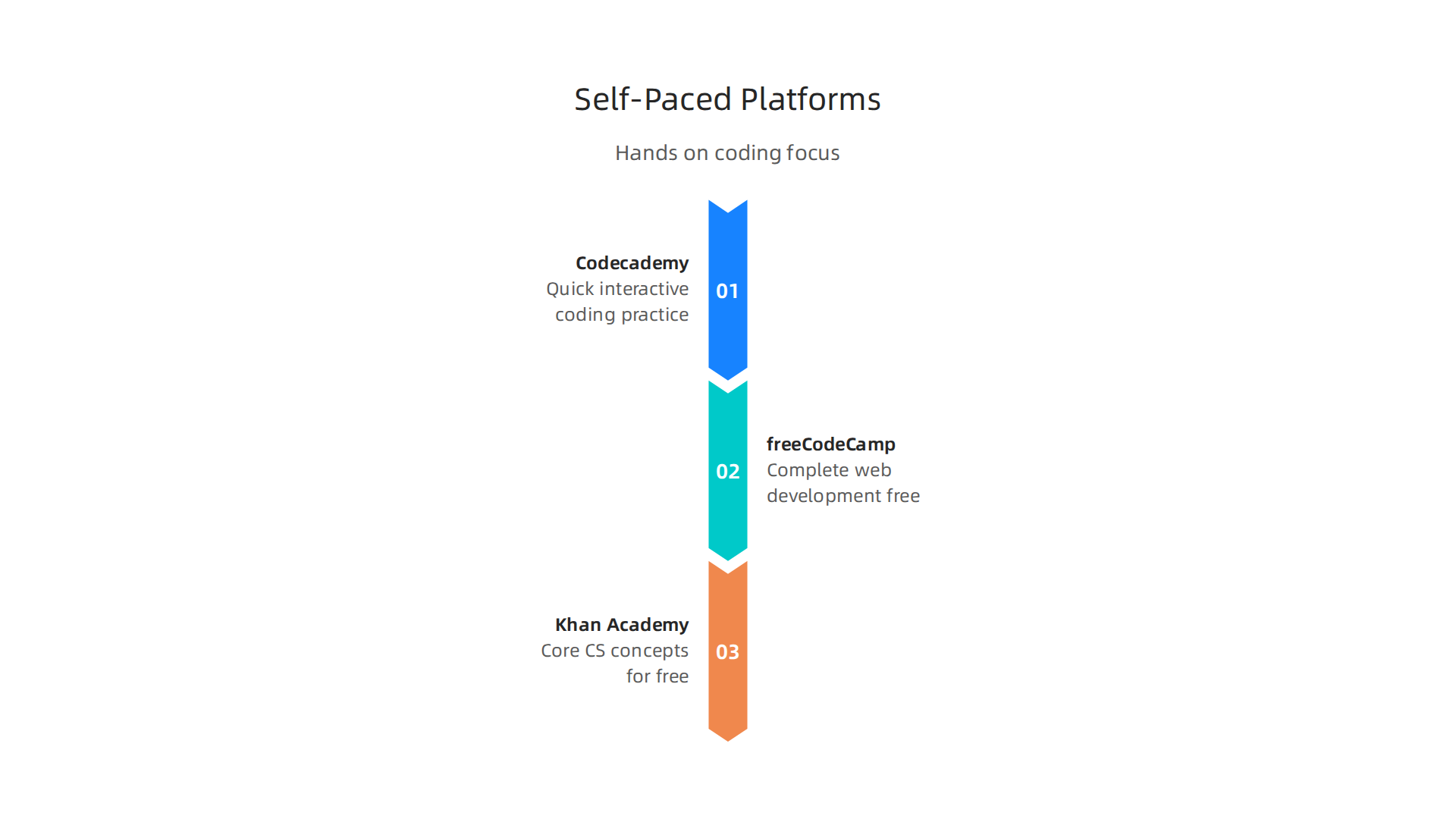
| Codecademy | Quick, interactive coding practice | Free tier; Pro ~$20/month |
| freeCodeCamp | Complete web development path at no cost | Completely free |
| Khan Academy | Understanding core CS concepts for free | Completely free |
Each platform fills a different need. Codecademy is great for getting your hands dirty fast. freeCodeCamp gives you a full curriculum with real projects. Khan Academy helps you build a mental model of how code works.
For a broader look at what training paths fit your career stage, check out our guide to the best computer courses in 2026. It maps these platforms alongside bootcamps and certification options.
No matter which you choose, the most important step is to start typing. Pick one platform, open a lesson, and write your first line of code. That alone is a win.
Emerging Trends: AI-Powered Learning and Micro-Credentials
Once you start coding, the learning experience itself is evolving fast. Two big trends in 2026 are reshaping how we take ICS courses: AI-powered tutoring and micro-credentials.

Both make learning more personal and more valuable for your career.
AI Tutors That Adapt to You
Remember when online courses just showed you the same video as everyone else? That is changing. Platforms like Khan Academy and Coursera now use AI tutoring systems that watch how you learn and adjust on the fly. For example, Khan Academy’s Khanmigo acts like a personal tutor. It explains concepts, asks you questions, and gives hints when you get stuck. Coursera Coach does similar work for its course library. These tools are already showing strong results. A recent guide to AI in education notes that AI tutoring can double learning in less time compared to traditional active learning.
This means you do not waste time on things you already know. The AI skips ahead. And if you struggle with a topic, it slows down and gives you more practice. For anyone taking ICS courses, this is a game changer. You get a learning path that fits you perfectly.
Micro-Credentials: Small Badges, Big Proof
The other big shift is micro-credentials. Instead of earning one giant degree, you can earn small digital badges that prove specific skills. Platforms like Credly let you collect these badges and display them on your LinkedIn profile or resume. Employers in 2026 are paying attention. They know a badge from a trusted platform means you actually built the skill, not just watched a lecture.
This ties into competency-based education. That means you can test out of material you already know and jump straight to what you need to learn. If you already understand loops in Python, you skip that module and move to data structures. You earn your credential faster because you are not repeating old content.
For software engineers, micro-credentials are a practical way to show expertise in narrow areas like cloud computing, AI development, or cybersecurity. To learn more about how these smaller certifications stack up in the job market, check out our guide to online certifications for software engineering that keep you ahead in 2026.
Putting It All Together
AI tutors make learning more efficient. Micro-credentials make your skills visible. Together, they mean you can learn ICS courses faster and prove what you know without a full degree. And because the field moves so fast, staying current is key. To keep up with how AI is changing learning and tech, subscribe to The AI Newsletter Worth Reading. It delivers clear daily updates so you never miss a trend.
The way we learn is smarter now. Take advantage of it.
How to Choose the Right Learning Path for Your Career Goals
So you are ready to start learning. But where do you actually go? With so many ICS courses out there, the choice can feel overwhelming. The good news is that the right path depends mostly on one thing: where you are in your career right now.
If you are brand new to tech and want a deep foundation, a computer science degree is still a strong option. It takes more time and money, but it gives you theory, math, and a broad view of computing. Employers often trust the degree for roles like software engineer or systems architect. However, if you already have a degree in another field or just want to switch jobs fast, a coding bootcamp might fit better. Bootcamps run 3 to 6 months and focus on practical skills. A study from Rice University shows that 72% of employers believe bootcamp graduates are just as job ready as degree holders. That is a big vote of confidence.
For smaller skill gaps, look at MOOCs (massive open online courses). Platforms like Coursera, Udemy, and edX offer single courses or specializations. You can take a Stanford online course on machine learning or grab Udemy free courses to fill in a specific gap. These are cheap, flexible, and let you learn exactly what you miss. The tradeoff is that they do not carry the same weight as a degree or bootcamp certificate on a resume.
A practical move many professionals take is a blended approach. They start with a few Coursera courses to test the waters. Then they commit to a bootcamp for job ready skills. Later, they return to university for a master’s degree if they want long term growth. This way you get fast results without sacrificing depth.
To make a smart choice, think about three things: cost, time, and recognition. A degree costs thousands and takes years.

A bootcamp costs less but still demands months of full focus. A single MOOC might cost nothing and take weeks. Match these to your current situation.
If you are still unsure, start with a free or cheap course to explore the field. Check out the Reddit computer science roadmap for honest reviews from real learners. And for a bigger picture of which courses actually boost your career, read our guide to the best computer courses for software engineers at every career level. It breaks down options by experience level so you can find your next step quickly.
Your career goals change over time. Your learning path should change too. Pick the option that fits today, and you will keep moving forward.
Summary
This guide helps you navigate the crowded landscape of information and computer science (ICS) learning options in 2026 by comparing traditional degrees, online university programs, MOOCs, bootcamps, and self-paced platforms. It explains the strengths and weaknesses of each path — from structured, credentialed university degrees to flexible, skill-focused MOOCs and project-driven providers like Udacity — and highlights cost and time trade-offs using real examples (Georgia Tech OMSCS, Harvard Extension, Stevens). You’ll learn which formats suit career-starters, career-changers, and managers hiring technical talent, how micro-credentials and AI tutoring are changing learning outcomes, and practical rules for choosing a path based on budget, timeline, and employer recognition. The guide also offers advice on starting small (audit a course), building a portfolio with project platforms like freeCodeCamp, and stacking short certificates toward larger credentials if needed. After reading, you’ll be able to compare top options, estimate costs and duration, and pick a learning path that aligns with your immediate career goals and long-term plans.