

Introduction
Have you ever watched a software project go off the rails because teams misunderstood each other?

Maybe a developer built something technically perfect, but it missed the mark on what the business actually needed. That gap between code and context costs time, money, and trust. Here’s the thing: as systems grow more complex, those misunderstandings only get worse. That’s where context engineering comes in.
Context engineering is an emerging discipline that focuses on systematically capturing and using contextual information to make software smarter and more aligned with real-world needs. It’s not just about writing better prompts for AI. As one source puts it, context engineering is "the systematic discipline of designing, implementing, and maintaining systems that provide AI language models" with the right information at the right time Packmind.
In 2026, this practice is quickly becoming essential for modern software teams.
Think of it as a bridge between technical implementation and business intent. When you apply context engineering, you reduce costly misunderstandings and build systems that actually understand the "why" behind each requirement. This article will break down the core concepts, show you the practical benefits, and share implementation strategies you can use on your own projects.
If you want to stay ahead of these fast-moving trends, consider getting fresh insights delivered daily with The Deep View Newsletter. It’s a smart way to keep your knowledge current without information overload.
And if you’re looking for more foundational knowledge on software design, check out our guide on how to bridge the AI to human gap in your code. It pairs nicely with the context engineering concepts we’re about to explore.
What is Context Engineering?
So what does context engineering actually mean? Let’s break it down simply. Context engineering is the practice of systematically gathering and using information about a system’s surroundings to make better decisions. Think of it as giving your software a full picture of what’s happening, not just a single instruction.
According to one source, context engineering is "the systematic discipline of designing, implementing, and maintaining systems that provide AI language models" with the right context IntuitionLabs.

But it’s not just for AI. It draws from older fields like context-aware computing, requirements engineering, and systems design.
The goal is to capture four main types of context:
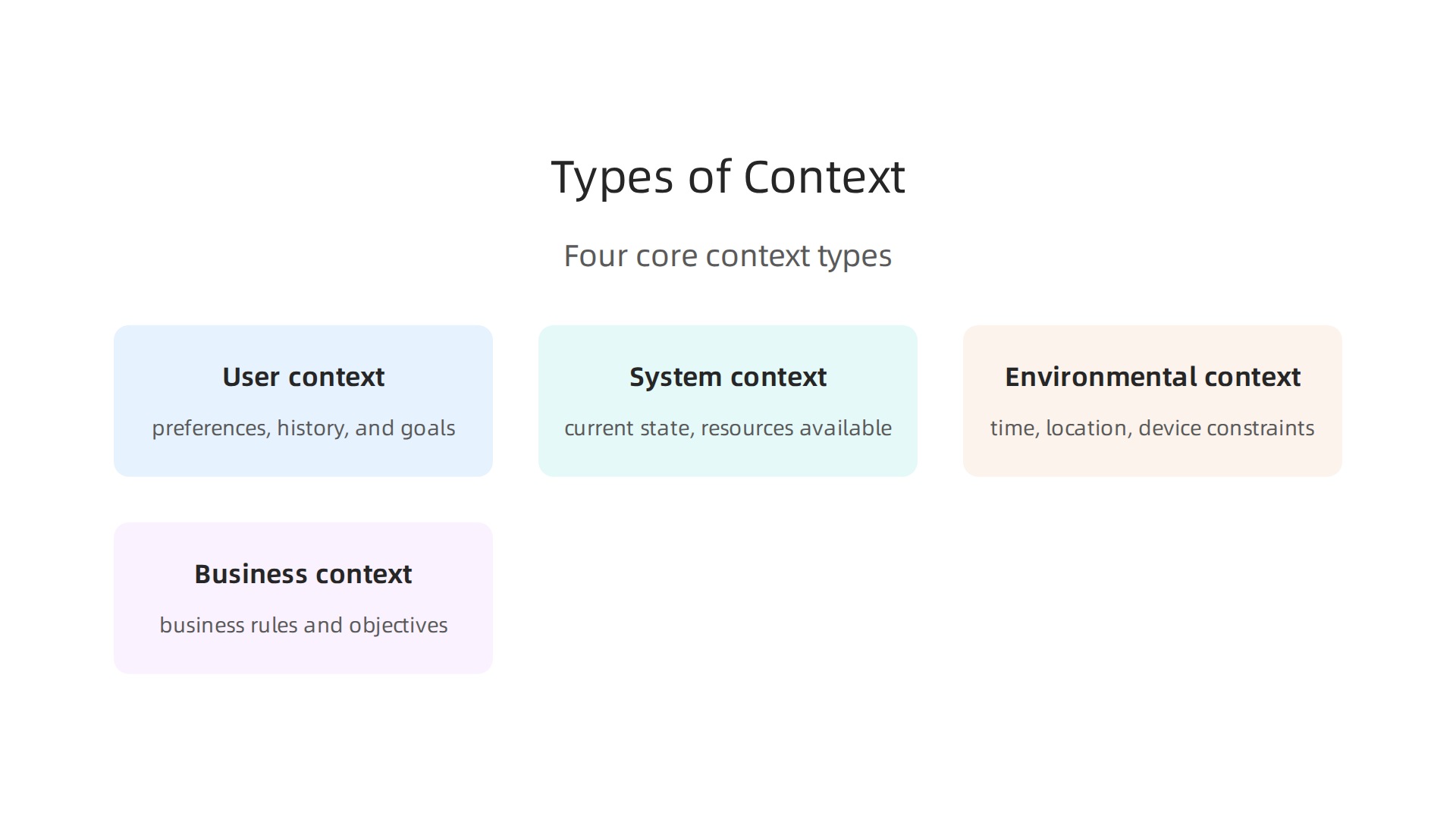
- User context: Who is using the system? What are their preferences, history, and goals?
- System context: What is the current state of the software? What resources are available?
- Environmental context: Where is the system running? What are the time, location, or device constraints?
- Business context: Why does this feature matter? What are the business rules and objectives?
By modeling these layers, you build systems that can adapt intelligently. For example, a smart assistant that knows your calendar, location, and meeting history can give better suggestions than one that only reads the current message.
Context engineering is moving beyond static prompts. As one article explains, it’s about "designing the environments in which AI systems discover, synthesize, and create knowledge" Nate’s Newsletter. That shift is happening fast in 2026. More teams are treating context as a first-class design element, not an afterthought.
If you work with complex software, understanding system context is crucial. We have a guide on modern cloud operations that dives into managing system environments effectively. It pairs well with the context engineering mindset.
Also, to stay updated on these trends, many professionals turn to daily briefings like The Deep View Newsletter for quick, actionable insights.
Why Context Engineering is Critical in Agile and DevOps
Agile and DevOps teams move fast. That’s the point. But speed without shared context can cause trouble. Teams often build features that look right on paper but miss the real need. Why? Because assumptions stay hidden.
Context engineering fixes this. It gives teams a shared view of what they are building and why.

When everyone knows the user context, system context, and business goals, sprint planning gets sharper. Rework drops. According to a 2026 guide on best practices, context drift is a top cause of misaligned features and wasted effort Packmind. The same idea applies to any Agile team.
By making implicit assumptions explicit, context engineering helps product owners, developers, and testers stay on the same page. Instead of guessing, you have a clear picture of the environment and constraints. That saves cycles and reduces friction between teams.
Another key benefit? Better alignment with business goals. The DevOps culture in 2026 puts a big focus on shared responsibility DEVOPSdigest.
Context engineering gives teams the tools to practice that every day.
If you want to improve team communication and reduce misunderstandings, check out our guide on bridging the AI to human gap in your code. It covers similar ideas about making context visible.
And if you want daily updates on how context engineering and other trends shape software development, the The Deep View Newsletter delivers quick, actionable insights straight to your inbox.
Core Principles of Context Engineering
Now that you see why context engineering matters for Agile and DevOps teams, let’s look at the core principles that make it work.
These ideas will help you build a solid foundation for capturing and using context across your projects.
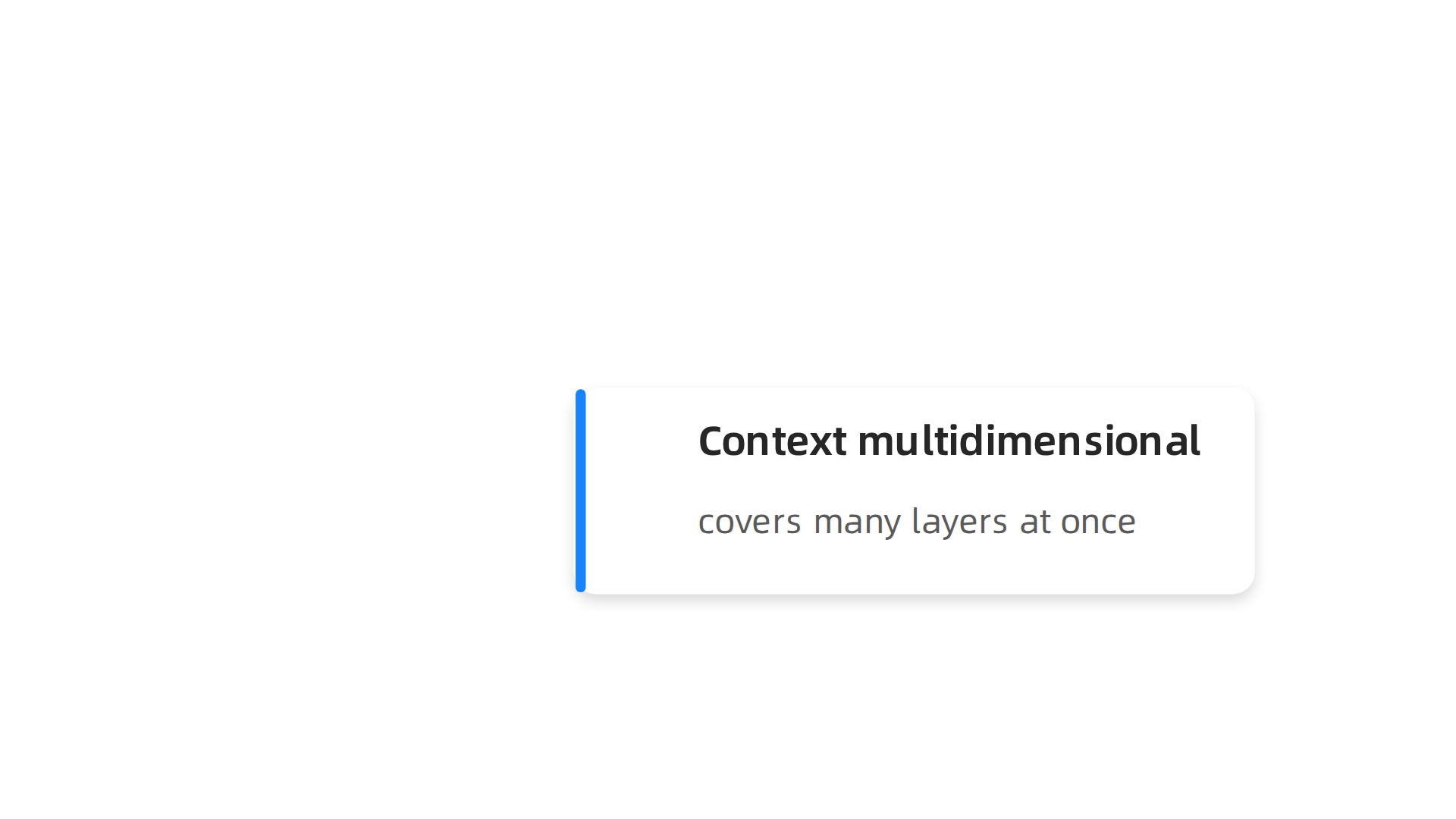
Principle 1: Context is multidimensional
Context isn’t just one thing. It covers many layers at once. Think about the user, the task they want to do, the device they are using, the environment around them, and even social factors like team norms or company culture. A good context model looks at all these dimensions together. For example, a developer writing code on a crowded train needs different help than one sitting at a quiet desk. In 2026, experts describe context engineering as the discipline of designing systems that understand these rich layers of information Packmind. When you capture the full picture, your AI tools and your teammates make smarter decisions.
Principle 2: Context must be captured continuously, not just at design time
Many teams make the mistake of gathering context once during planning and then forgetting about it. But real projects change all the time. New requirements pop up. User behavior shifts. Bugs appear. Context engineering treats context as a live stream, not a snapshot. You need to keep updating your context models as the project evolves. This continuous capture helps prevent the drift we talked about earlier. According to a 2026 guide on context design, moving beyond static prompts into dynamic ecosystems is a key trend SDG Group. By refreshing context regularly, you keep everyone aligned.
Principle 3: Context models should be reusable and extensible across projects
Nobody wants to start from scratch every time. The best context models are built to be reused. You design them in a way that allows you to take pieces from one project and apply them to another. For example, a model that captures user preferences from a previous app can be extended for a new product with similar users. This saves time and reduces errors. It’s like having a library of context patterns you can pull off the shelf. The field of context engineering in 2026 emphasizes these reusable patterns to lower token costs and improve accuracy Maven. Building extensible models from the start sets you up for long term success.
These three principles give you a practical starting point. Next, we’ll explore how to apply them in real projects with concrete examples.
If you want to go deeper on how context engineering helps you and your AI tools work better together, check out our guide on how to bridge the AI to human gap in your code. It covers practical ways to make your context visible to both people and machines.
And if you want daily insights on context engineering and the latest in AI, the The Deep View Newsletter delivers clear, actionable updates straight to your inbox.
How to Implement Context Engineering in Your Team
Knowing the core principles is one thing. Putting them into action is another. In 2026, the gap between understanding context engineering and actually doing it is where most teams get stuck.
Here is a simple three step process that any Agile or DevOps team can start using this week.
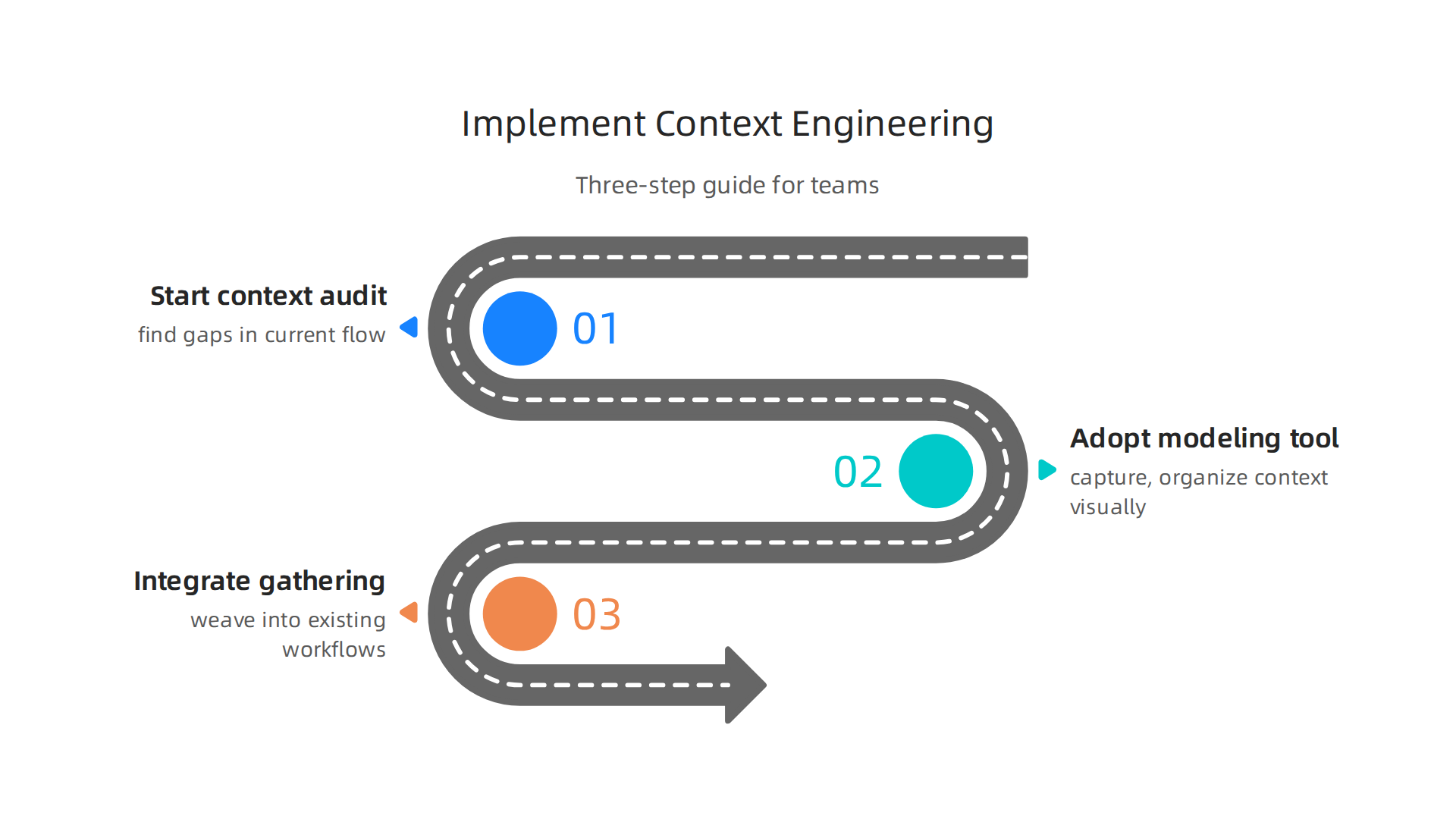
Step 1: Start with a context audit
You cannot fix what you do not see. So begin by finding the gaps in your current information flow. Ask your team simple questions. Where do developers lose time looking for answers? When do handoffs between teams get messy? Where does your AI assistant give wrong or useless responses?
This is called a context audit. You look at your daily workflows and identify the spots where context goes missing. For example, maybe your bug reports never include the environment details your developers need. Or your user stories skip the "why" behind a feature. Write these gaps down.
The 2026 best practices for context engineering suggest starting small and fixing the most painful gaps first Packmind. You do not need to overhaul everything at once.
Step 2: Adopt a context modeling tool
Once you know where the gaps are, pick a tool that helps you capture and organize context. A simple context map works well for most teams. You draw out who needs what information and when. A decision tree can help for more complex flows where the context changes based on user actions.
The idea is to make context visible and structured instead of relying on memory or hallway conversations. According to the 2026 guide on context engineering, moving from static prompts to structured context models is a key shift for reliable systems Sombra. Start with pen and paper. Refine with a shared document. Only then consider specialized tools.
Step 3: Integrate context gathering into your existing workflows
This is where the rubber meets the road. Do not add context engineering as a separate task. Weave it into the processes you already use.
For example, during story mapping, add a small section for "context notes." Ask questions like: What device is the user on? What is their environment? What happened right before this action? During sprint planning, spend five minutes updating context models based on what you learned last sprint.
A strong DevOps culture in 2026 emphasizes shared context and rapid feedback loops Refonte Learning. When context becomes part of your natural workflow instead of an extra chore, your team actually uses it.
For a deeper look at making context visible to both people and machines, check out our guide on how to bridge the AI to human gap in your code. It covers practical templates and team exercises.
Want to stay on top of these strategies as they evolve? The Deep View Newsletter delivers daily AI and context engineering insights straight to your inbox. No fluff, just usable updates.
Tools and Technologies for Context Engineering
You have your process down. But what tools actually help you model and keep context fresh? In 2026, a wave of specialized platforms has arrived to make context engineering less abstract and more hands on.
Context modeling and analysis tools
Dedicated tools like Context Mapper and open source libraries now let you visually map out information flows. You can draw which pieces of context move between team members, systems, and AI agents. The top platforms include LangChain, Mem0, Zep, Letta, and Langfuse each with different strengths in memory management, retrieval, and evaluation. Atlan’s 2026 comparison breaks down their features and pricing side by side.

These tools help you move from static prompts to dynamic, structured context that updates as your project evolves. The deepset AI guide calls this designing the right informational environment for AI agents.
AI powered context extraction
Your AI assistant can now read user feedback, system logs, and chat histories to pull out relevant context automatically. Instead of manually updating context maps, you let machine learning find patterns and flag gaps. Anthropic’s engineering team highlights strategies for curating the right tokens during inference reducing guesswork for developers.
Integration with your existing stack
The best tools plug straight into the IDEs and project management software you already use. You might add a context engineering plugin to VS Code or connect a context module to your Jira workflow. The goal is to make context visible without breaking your rhythm. The 2026 state of context engineering report notes that teams should evaluate tools based on accuracy, latency, and maintainability not just features.
For a deeper look at making context visible to both people and machines, check out our guide on how to bridge the AI to human gap in your code. It covers practical templates and team exercises.
Want to stay on top of these tools as they evolve? The Deep View Newsletter delivers daily AI and context engineering insights straight to your inbox. No fluff, just usable updates.
Case Studies: Context Engineering in Software Design
Theory is one thing, but seeing context engineering in action makes it real.

Here are three real-world examples from 2026 that show how teams apply these ideas to ship better software, avoid costly mistakes, and keep their users happy.
SaaS company cuts feature bloat by 30%
A SaaS company in the project management space was piling on new features every quarter. Users were overwhelmed, and the product felt cluttered. Their engineering team turned to context engineering to fix the mess. They mapped out every piece of context a user brings to the tool, like their role, team size, and common workflows. Then they modeled which context actually drove usage. The result? They cut 30% of unused features and focused development on what people really needed. As the Taskade field guide on context engineering notes, understanding the five layers of context helps teams avoid building things nobody asks for.
IoT team improves device interoperability
An Internet of Things (IoT) team was struggling to make smart sensors from different manufacturers talk to each other. Each device had its own data format and assumptions about the environment. By modeling environmental context, things like temperature ranges, network speed, and physical location, they built a shared context layer. The sensors could then negotiate how to share information without custom code for every pair of devices. The deepset AI guide calls this designing the right informational environment. For IoT teams, that environment includes real-world conditions that change by the minute. The result was a system that worked out of the box with new devices, a huge win for integrated engineering.
Fintech startup avoids regulatory pitfalls
A fintech startup handling peer-to-peer payments knew compliance was make-or-break. They used context engineering to capture regulatory context from the start. Their system tracked jurisdiction, transaction size, user identity, and consent flags in a structured context model. When a new regulation hit Europe, they updated a single context map instead of rewriting code across dozens of services. The Anthropic engineering team highlights that curating the right tokens during inference reduces guesswork. For this startup, curating the right tokens meant keeping compliance context front and center. They avoided fines and passed audits easily. Managing cloud infrastructure for compliance also requires solid context practices. If you are building systems like this, check out how your AWS console isn’t enough anymore for modern cloud operations.
These examples prove that context engineering works across different domains. It is a practical way to align your software design with the real world. Want to stay on top of similar case studies and tools? The Deep View Newsletter delivers daily updates on AI and context engineering straight to your inbox. No fluff, just usable insights.
Common Mistakes and How to Avoid Them
Even after seeing great case studies, teams still stumble. Context engineering is powerful, but only if you avoid a few common traps. Here are three mistakes I see again and again, plus simple ways to dodge them.
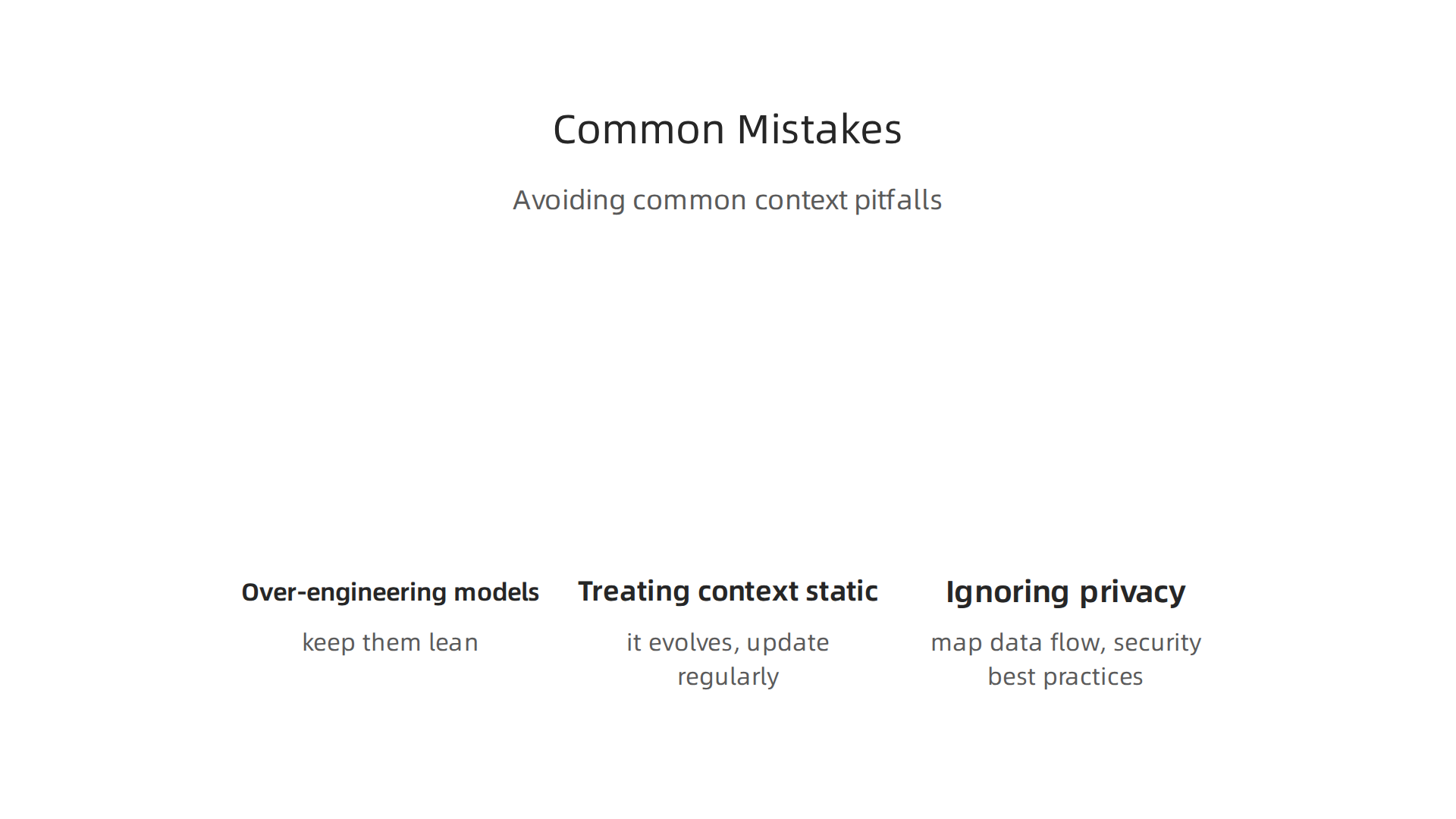
Mistake 1: Over-engineering context models – keep them lean.
It’s tempting to throw every possible data point into your context model. User age, favorite color, last login, phone model, pet’s name. Stop. More is not better. As the State of Context Engineering in 2026 report points out, most agent failures come from overloading prompts with too much instructions and retrieved context. Keep your model focused on the few pieces of context that actually drive decisions. Ask: "What does the system absolutely need to know to do its job right now?" Cut everything else.
Mistake 2: Treating context as static – it evolves.
Context is not a one-and-done thing. User roles change. Regulations update. What was true last quarter may be wrong today. Teams that write their context models once and forget them end up with stale, broken systems. The shift from simple prompting to proper context engineering is constant. Build regular reviews into your workflow. Treat context models like living documents. Update them as your product and users change. Your software will stay relevant and reliable.
Mistake 3: Ignoring privacy and security implications of context data.
Context data is often personal. It can include user locations, payment details, or internal business secrets. Treating it carelessly leads to breaches and broken trust. A single misstep in how you store or share context can sink a product. Thankfully, there are plenty of resources to help you handle this right. For example, understanding cloud operations security in 2026 gives you the foundation to protect your context data. Also, real-world examples from teams that hit context engineering pitfalls show just how fast things go wrong when privacy is an afterthought. Always map your data flow and follow security best practices from day one.
Avoid these mistakes and your context engineering will stay lean, current, and safe. Want more daily insights like this to keep your skills sharp? The Deep View Newsletter delivers clear AI and engineering updates straight to your inbox every day. No fluff, just what you need.
Real-World Applications: Context Engineering Across Domains
Now that you know how to avoid common mistakes, let’s look at where context engineering is making a real difference today. Teams in healthcare, e-commerce, and automotive are using it to build smarter, safer systems. The shift from bare prompt writing to proper systems engineering of context is already happening across these fields.
Healthcare: Context-Aware Clinical Decision Support
Doctors rely on AI to suggest treatments, but the system needs context to be trusted. Context engineering helps clinical support tools consider patient history, current symptoms, lab results, and even doctor preferences. This leads to more accurate recommendations. The use of integrated engineering in healthcare means these systems learn from each interaction. For a deeper look at how AI and humans can work together, check out our guide on bridging the AI to human gap in your code. For more on this, the team at Indigo.ai explains how context engineering powers conversational AI in healthcare and other fields.
E-Commerce: Personalized Shopping Experiences
Ever notice how an online store seems to know what you want? That is context-driven personalization. E-commerce agents use context engineering to analyze browsing history, cart activity, and purchase patterns. They adjust offers and recommendations in real time. But it is easy to get this wrong. A great example is the pitfalls of context engineering for an e-commerce agent, showing how poor context can lead to bad suggestions. Learning from these mistakes helps teams refine their models.
Automotive: Context-Aware Autonomous Driving
Self-driving cars need to understand their environment instantly. Context engineering helps them process data from cameras, sensors, and maps to make safe decisions. Weather, traffic, and road conditions all become part of the context model. As Packmind notes in their 2026 definition, context engineering is what allows AI to adapt to changing environments. Without it, autonomous systems would be dangerous.
These examples show just how versatile context engineering is. Want to stay ahead of these trends and get daily insights delivered to your inbox? The Deep View Newsletter gives you clear, actionable AI and engineering updates every day.
The Future of Context Engineering
What comes next for context engineering? The trends we see in 2026 point to a future where it becomes a standard skill for every software professional. No longer a niche topic, it will be taught in university courses and coding bootcamps. As Gartner predicts, by the end of 2026, 75% of developers will spend more time orchestrating and architecting than writing code from scratch. That shift means understanding how to design context is as important as knowing a programming language. If you want to future proof your career, staying current with online certifications for software engineering can help you build these skills.
AI itself will make context engineering more dynamic. Instead of hard coding context rules, systems will adapt in real time based on user behavior, environment, and goals. According to the State of Context Engineering in 2026, teams are already comparing approaches based on accuracy, latency, and cost. The next step is full real time adaptation where the AI learns and adjusts on the fly.
And the way we interact with these systems is changing too. Large language models will let you query context in plain English. You will simply ask the system what it knows about a user or situation, and it will explain its reasoning. This makes integrated engineering more accessible to non experts.
Context engineering is on its way to becoming a standard practice. Want to stay ahead of these trends and get daily insights? The Deep View Newsletter delivers clear AI and engineering updates every day.
Summary
Context engineering is the practice of capturing and managing the different kinds of situational information—user, system, environmental, and business—so software and AI systems make better, more aligned decisions. This article explains the core principles (multidimensional context, continuous capture, and reusable models), shows a simple three-step implementation process (context audit, modeling tool, workflow integration), and reviews the tools and AI techniques now available in 2026. You’ll also see real-world case studies from SaaS, IoT, and fintech that illustrate concrete benefits like reduced feature bloat, improved interoperability, and easier compliance. The guide warns against common traps—over-engineering, stale context, and privacy mistakes—and offers practical ways to avoid them. Finally, it maps where context engineering is already being applied (healthcare, e-commerce, automotive) and why the skill will become standard for engineers moving forward. After reading, teams will know how to start small, pick appropriate tools, and fold context practices into existing Agile and DevOps workflows.