
Introduction
If you work in software engineering, you know the feeling. There is a new AI coding tool every week. Your cloud vendor adds more services constantly. And your team is under pressure to ship faster without breaking things. Staying current in 2026 can feel like drinking from a fire hose. Information overload is real. And it slows down good teams.
Engineering managers struggle to pick the right stack. CTOs need to cut through the hype to make smart bets. And developers just want to build great software without distractions.
But what if you had a trusted partner to help you filter the noise?

That is where UIUC technology services come in. The University of Illinois Urbana-Champaign is not just a top school. It is a powerhouse for real-world tech innovation. Through strong code org partnerships like the extended IBM Discovery Accelerator Institute (running through 2031), UIUC is working on the hardest problems in AI, quantum computing, and cloud infrastructure. These programs are built to create breakthroughs that companies can actually use.
For B2B tech leaders, this is a huge opportunity. UIUC offers more than just research papers. They provide real infrastructure and deep expertise through programs like the NCSA Industry Partner Program. Your company can tap into top-tier high-performance computing resources without building everything from scratch.
Maybe you are thinking about an online computer science degree to upskill your team. Or maybe you want to explore enterprise-grade online learning platforms for a strategic edge. UIUC has practical solutions ready to go.
In this article, we will walk you through the specific services UIUC offers, the partnership models that drive real results, and how you can use this academic collaboration to meet your own engineering goals. If you want clear, daily insights on AI and tech without the clutter, subscribe to The Deep View Newsletter for free . It is the easiest way to stay ahead in 2026.
The Role of University Technology Services in Bridging Research and Industry
So here’s the real problem for most engineering teams. You know that the next big breakthrough in AI or cloud infrastructure is probably happening inside a university lab. But you also know that getting access to that research is hard. The papers are dense. The timelines are long. And your competitors are not waiting around.
That is exactly why uiuc technology services exist. They act as a middle layer between cutting edge academic research and the practical needs of companies like yours. Think of them as a bridge. On one side, you have world class researchers with supercomputers and massive datasets. On the other, you have your team trying to ship products. University tech services make that connection possible.

One of the biggest advantages is that universities are neutral ground. Competitors can collaborate on pre-competitive problems like building better AI infrastructure or more efficient quantum algorithms without worrying about intellectual property conflicts. That is a rare and valuable space. For example, the renewed IBM Illinois partnership through the code org partnerships program runs through 2031 and focuses on integrating quantum and high performance computing IBM Discovery Accelerator Institute renewal. This kind of collaboration lets companies like IBM get early access to new ideas and talent while the university benefits from real world validation.
UIUC’s portfolio is deep. Through the NCSA Industry Partner Program, your company can tap into high performance computing clusters, AI and machine learning platforms, and specialized data services. You do not need to build a supercomputer from scratch. You just need a partnership that gives you access. The university also offers browser based access to HPC resources via Open OnDemand, making it easy for your engineers to run complex simulations right from their browser.
What does this mean for you as a B2B tech leader? It means faster R&D cycles, access to fresh talent, and a direct line to research that can inform your product roadmap.
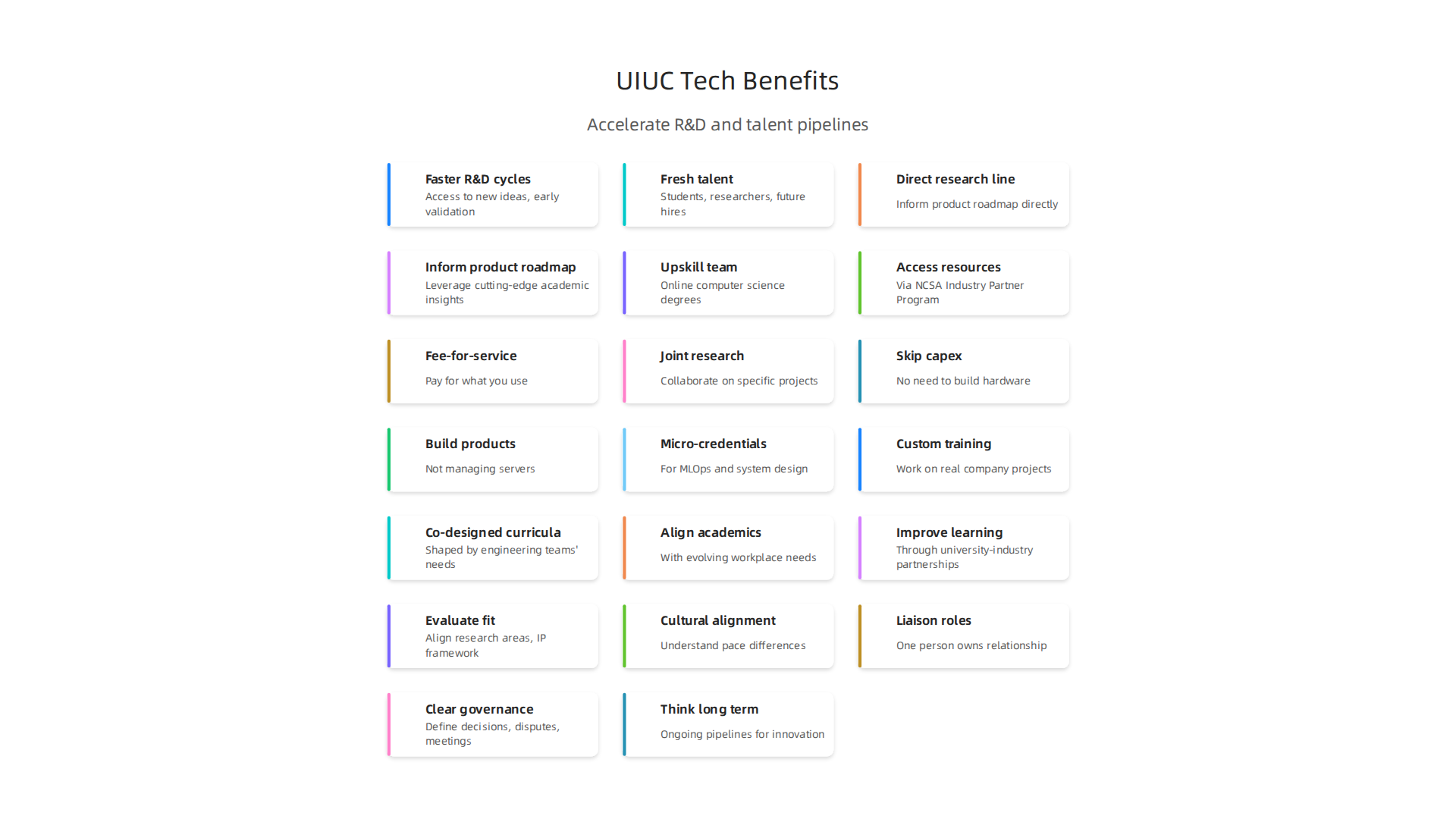
It also opens up opportunities to upskill your team through an online computer science degree or other online learning platforms offered by UIUC.
If you are serious about staying ahead, start by exploring how these services fit your specific goals. And to get daily, noise free updates on the tech trends that actually matter, subscribe to The Deep View Newsletter for free . It is the easiest way to cut through the hype in 2026.
High-Performance Computing and Cloud Resources
Your engineering team probably needs serious computing power to train AI models or run complex simulations. But building your own supercomputer is expensive and slow. That is where the uiuc technology services really shine.
UIUC operates some of the largest high performance computing clusters in the country. The National Center for Supercomputing Applications (NCSA) runs specialized systems like the Delta and Nightingale clusters. These machines are built for AI, machine learning, and heavy simulation workloads. The Nightingale cluster, for example, is designed to handle sensitive data securely, which is a big deal for industries like healthcare and finance NCSA three new supercomputing resources.
Here is the best part. You do not have to own any of this hardware. Through the NCSA Industry Partner Program, you can access these resources through fee-for-service deals or joint research agreements. That means you pay for what you use and skip the capital expense.
And if your company already runs on AWS or Azure, no problem. UIUC supports cloud bursting and hybrid models. Your team can spin up jobs on campus clusters when you need extra capacity, then seamlessly move workloads back to your cloud environment. This flexibility is exactly what many enterprises are looking for as AI moves from experiments to production Deloitte AI infrastructure compute strategy.

The Illinois Campus Cluster Program also gives you access to computing and data storage resources without the hassle of managing your own infrastructure Research Computing Solutions at UIUC. Your engineers can focus on building products, not babysitting servers.
If you want your team to make the most of these cloud and HPC resources, consider building their skills. Our guide on online certifications for software engineering covers programs that teach cloud architecture and distributed computing.
Getting access to world class computing power is one thing. Knowing how to use it strategically is another.

To stay informed on the trends that actually matter in 2026, subscribe to The Deep View Newsletter for free and get daily insights straight to your inbox.
Data Platforms and AI/ML Infrastructure
Raw computing power is great. But your AI model is only as good as the data you feed it. That is where the uiuc technology services for data and AI infrastructure come into the picture.
UIUC does not just give you supercomputers. They give you curated datasets, annotation tools, and managed ML pipelines. These tools help your team skip the boring data prep work and get straight to building.
Take the Nightingale cluster we mentioned earlier. It is purpose built for handling sensitive data. This means you can train AI models on private healthcare or financial datasets without worrying about security NCSA new supercomputing resources.
UIUC also partners closely with cloud providers. This allows your engineering teams to scale AI training easily from proof of concept to production. As Deloitte notes, enterprises are moving AI from experiments to real world deployment, and they need flexible infrastructure to do it Deloitte AI strategy.
What does this look like in practice? Engineering teams can use these platforms for natural language processing, computer vision, and predictive analytics. Think chatbots that understand context, systems that spot defects in manufacturing, or engines that forecast demand.
As AI projects grow, your team needs to keep their skills sharp. Our article on AWS DevOps certification in 2026 covers how to manage these complex pipelines.
The world of AI and data infrastructure moves fast. To keep your team ahead of the trends that actually matter, subscribe to The Deep View Newsletter for free and get daily insights directly in your inbox.
How Educational Partnerships Accelerate Skill Development and UpsKilling
You have the supercomputers. You have the data pipelines. But do your people have the skills to actually make sense of it all? That is the real bottleneck in 2026. The tools are getting easier to use, but the gap between what teams know and what they need to know keeps growing.
UIUC tackles this problem head on. Through uiuc technology services designed for workforce development, the university offers micro-credentials, custom corporate training, and co-designed curricula in software engineering and AI.
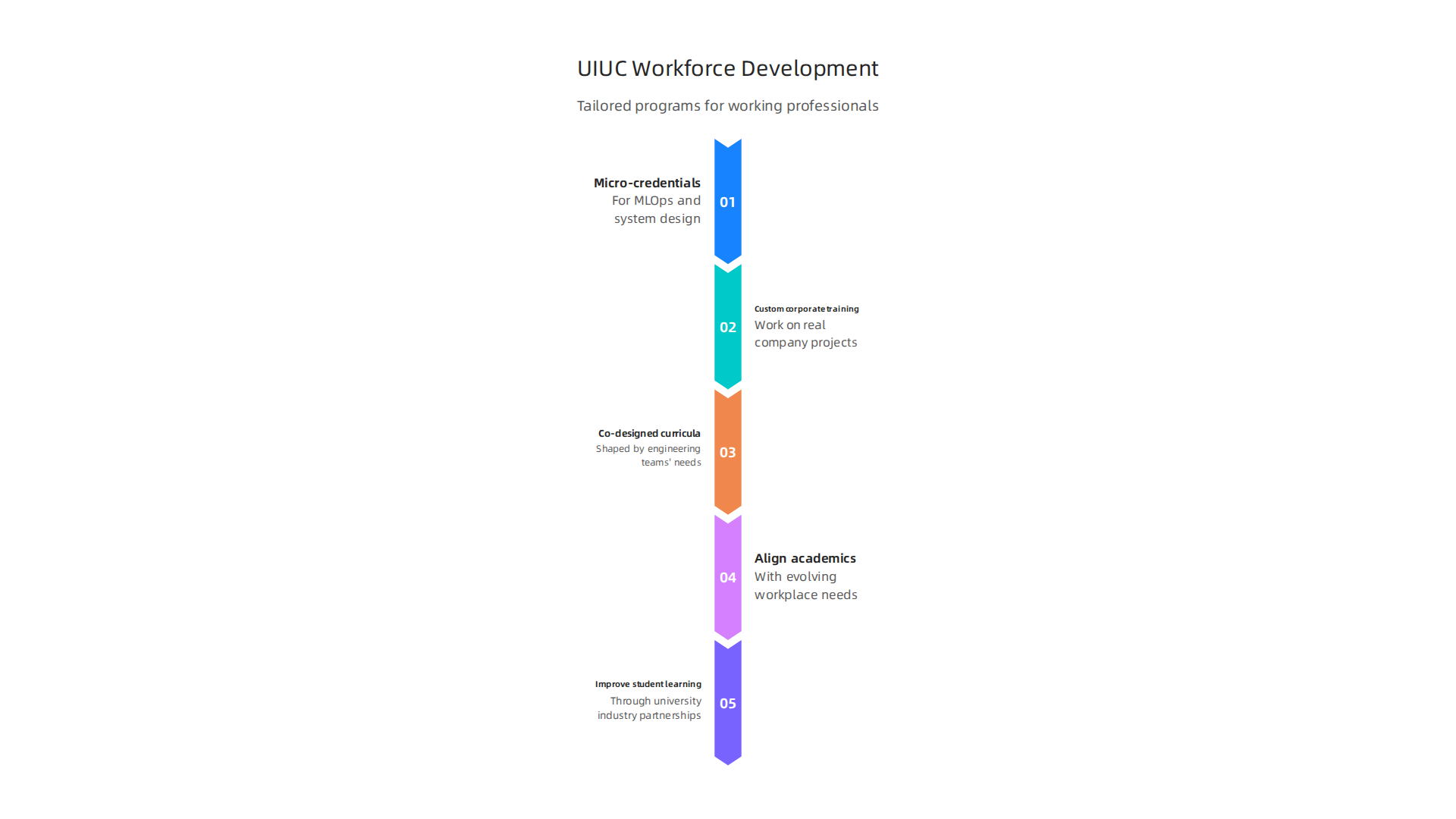
These programs are built for working professionals who do not have time to go back to school full time.
Research shows that university industry partnerships are one of the most effective ways to close skill gaps. A systematic literature review of these partnerships found that they consistently improve student learning and help companies stay competitive tandfonline.com. UIUC takes this approach seriously. They work directly with engineering teams to shape the curriculum, so you learn exactly what your job demands today.
What skills are in highest demand right now? Pluralsight data shows that cloud computing, DevOps, and AI are the top fields where tech professionals are upskilling in 2026 Pluralsight. The LSE also ranks AI, data science, cloud and DevOps engineering, and cybersecurity as the most sought after careers this year LSE.
UIUC’s partnership programs directly target these areas. They offer micro-credentials in MLOps and system design. They run custom corporate training sessions where your team works on real projects from your company. Students get hands-on experience. Professionals get continuous learning without leaving their jobs. The IIE notes that universities are increasingly partnering with employers to align academics with the rapidly evolving needs of the workplace IIE.
If your engineering team needs to get better at managing complex cloud pipelines, our guide on passing the AWS DevOps certification in 2026 covers the practical skills you will actually use.
The bottom line: infrastructure alone is not enough. You need people who know how to deploy, monitor, and optimize modern systems. Educational partnerships like UIUC’s are the fastest way to build that talent internally.
Stay ahead of the skills your team will need next. Subscribe Free to The Deep View Newsletter and get daily AI and engineering insights that help you make smarter decisions.
Collaborative Research Models: From Lab to Production
Training your team is one thing. But what if your company could help shape the very technology your engineers use tomorrow? That is the promise of collaborative research models. Instead of just consuming knowledge, you get to co-create it.
Joint research projects let companies and universities pool resources to explore both foundational and applied technologies. A systematic literature review of university industry partnerships shows that these collaborations improve learning outcomes and help companies stay ahead of the competition tandfonline.com. The key is that both sides invest. Your company brings real world problems and funding. The university brings deep expertise and fresh thinking.
There are a few common models that work well in 2026. Sponsored research is the most straightforward. Your company pays for a specific project and gets early access to results. Consortia are groups of companies that pool money to fund a research center. Each member gets a seat at the table. Innovation hubs create a physical space where researchers and engineers work side by side.
UIUC’s Research Park is a perfect example. It hosts over 100 companies, from startups to global tech giants. Teams from these companies work directly with UIUC faculty and students on projects that matter to their business. The park also runs corporate affiliate programs that give companies a structured way to collaborate long term. This is not a one time workshop. It is a relationship that keeps giving.
The IIE notes that universities are increasingly partnering with employers to align research with the rapidly evolving needs of the workplace IIE. In practice, this means your DevOps team might help design a new cloud monitoring tool alongside researchers. Or your AI engineers could co-author a paper on a better recommendation algorithm. That research then moves straight into your production pipeline.
If you are looking for a deeper learning path alongside these partnerships, an online computer science degree can give your team the theoretical foundation they need. And online learning platforms like Coursera or edX offer quick courses to bridge specific gaps. But for building the next big thing, nothing beats a collaborative research model.
To see how that works in action, check out our guide on passing the AWS DevOps certification in 2026. It covers the kind of hands-on skills that come straight from real world projects.
Want to stay on top of how research and industry are merging? Subscribe Free to The Deep View Newsletter and get daily AI and engineering insights that help you make smarter decisions.
Measuring Impact: Productivity Gains and Innovation Outcomes
So you have built a collaborative research partnership. Now comes the hard part. Proving it was worth the investment. Without clear metrics, it is tough to defend your budget at the end of the year.
The good news is that teams in 2026 have better tools than ever to measure what matters. The key is to look at both productivity gains and innovation outcomes.

Start with development speed. Measure how long it takes to go from an idea to production code. The 2026 Software Engineering Benchmarks Report from LinearB provides industry baselines for these cycle times linearb.io. Compare your numbers before and after a university collaboration. A drop in cycle time is a clear win.
Other important numbers include new patent filings, talent acquisition costs, and code quality improvements. The DX team recommends 16 developer productivity metrics that top companies actually use getdx.com. These include deployment frequency, change failure rate, and mean time to recovery. They give you a full picture, not just speed.
Companies using programs like UIUC technology services often report faster onboarding for new hires straight from the university pipeline. That directly cuts talent acquisition and training costs. You are not just saving money. You are gaining fresh ideas from people who already understand your stack.
To track these metrics effectively, your team needs a strong foundation in modern practices. An online computer science degree can help bridge theory and practice. For hands-on skills in monitoring and deployment, check out our guide on passing the AWS DevOps certification in 2026.
Measuring the full impact is an ongoing process. It takes discipline and the right data. But when you can show real numbers, getting budget for the next partnership becomes much easier.
Want to stay updated on the latest benchmarks and methods? Get free updates from The Deep View Newsletter.
Strategic Considerations for CTOs and Engineering Leaders
You have the metrics, and you can already see the productivity gains. Now the real question is: how do you build a partnership that lasts? The numbers only tell part of the story. CTOs and engineering leaders need to think carefully about the structure from day one.
First, evaluate partnership fit. Not every university program is right for your team. You need to look at research areas that align with your product roadmap.
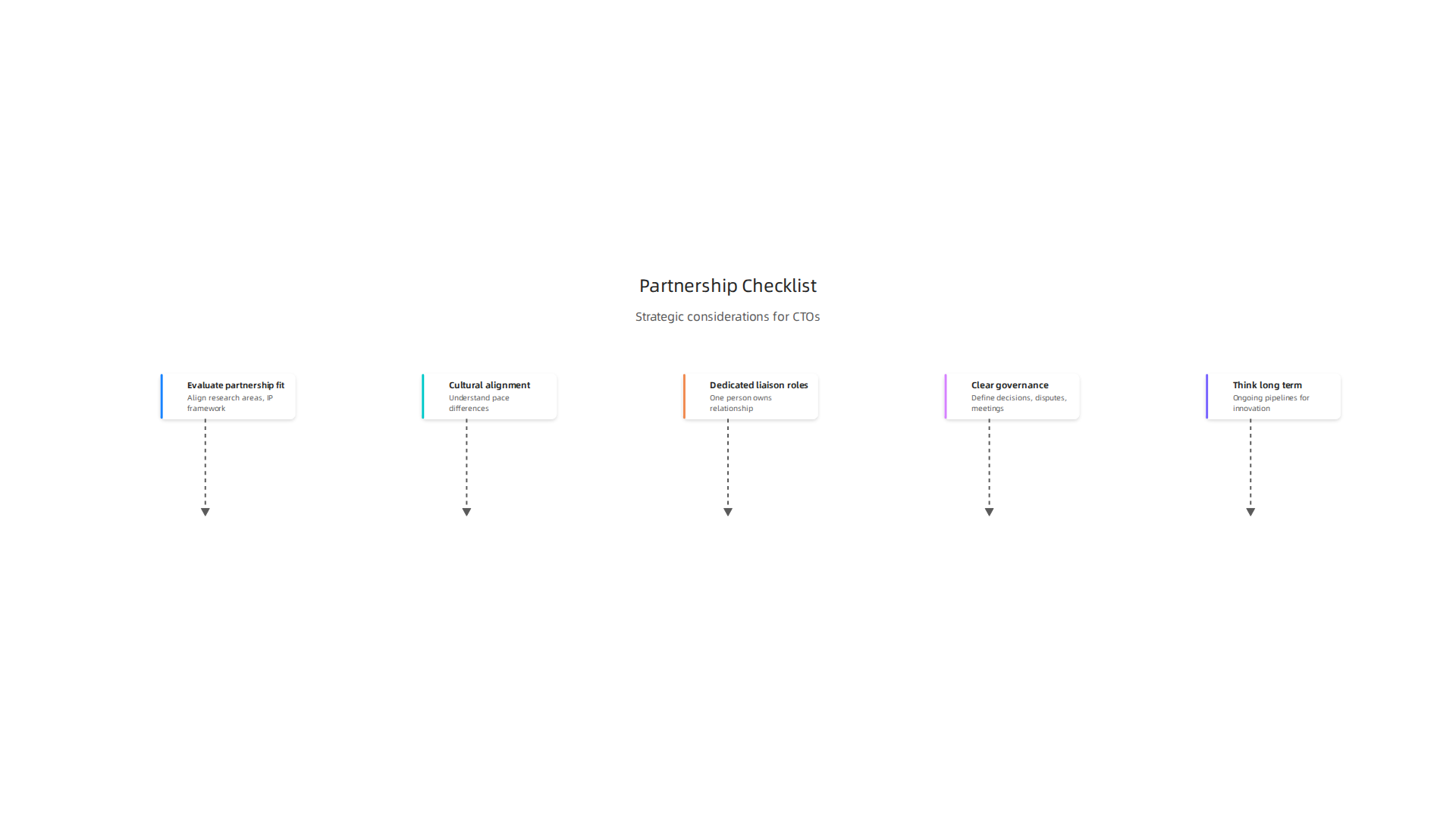
You also need to understand the IP framework each school uses. Some universities are more flexible with commercial licensing. Others protect their research tightly. Before you sign anything, ask tough questions about ownership of code and patents. The article on CTO interview questions suggests looking for leaders who can spot red flags in vendor or partner agreements early. That same skill applies to academic partnerships.
Cultural alignment matters just as much. Your engineering team probably moves fast and ships often. A university lab may work on semester timelines. That mismatch can cause friction. Make sure both sides understand the pace going in.
Second, put the right people in place. Successful partnerships need dedicated liaison roles. One person on your side who owns the relationship. One person on the academic side who does the same. This is not a side project for a busy engineer. It needs real time and authority. Set up clear governance from the start. Define how decisions get made, how disputes get resolved, and how often you meet. The CTO Academy technology leadership guide emphasizes designing constraints and guardrails for teams. That principle applies to relationships with outside partners too.
Third, think long term. The best academic collaborations are not one-off projects. They are ongoing pipelines for innovation. Co-develop a roadmap for technology adoption with your partner. If they are working on something like uiuc technology services for cloud infrastructure, plan how that will integrate into your stack next year, not just today. That kind of forward thinking turns a partnership into a strategic advantage.
Your own team also needs to stay sharp. A team that understands modern practices is better equipped to absorb new ideas from academia. Investing in an online computer science degree for key engineers can close the gap between theory and practice. For specific skills, our guide on the AWS DevOps certification in 2026 is a great starting point for hands-on learning.
Building a research partnership takes more than a signed agreement. It takes strategy, structure, and commitment. But when you get it right, it fuels innovation for years.
Stay ahead of the latest partnership models and industry benchmarks. Get free updates from The Deep View Newsletter.
Summary
This article explains how UIUC technology services connect university research to industry needs so engineering teams can move faster and build better products. It describes access options to high-performance computing and hybrid cloud bursting, plus data platforms and secure clusters for sensitive AI workloads. The piece outlines workforce development offerings—micro-credentials, corporate training, and co-designed curricula—that close skill gaps and accelerate onboarding. It also lays out collaborative research models (sponsored projects, consortia, innovation hubs) that let companies co-create applied technology and bring advances into production. The article covers practical ways to measure impact with developer productivity and innovation metrics, and it gives strategic advice for CTOs on fit, IP, governance, and long-term planning. Readers will learn how to evaluate, start, and manage university partnerships so they get measurable R&D and talent benefits.