

Introduction – Why Specialization Matters More Than Ever
Here’s a question you might be asking yourself in 2026. How do you stand out in a tech job market that keeps changing faster than ever?
The old advice was simple. Learn a bit of everything and you will always find work. But that strategy is fading fast. Companies today do not want generalists who can do a little coding, a little testing, and a little project management. They want specialists. They want people who can solve specific, high-value problems from day one.
And one of the most rewarding paths you can take right now is becoming a part time bi developer.
Think about what that actually means. Business intelligence is the engine behind every smart business decision in the modern world. Every dashboard a CEO checks in the morning. Every sales forecast that determines next quarter’s budget. Every customer insight that shapes a product roadmap. That is BI at work. And the people who build and maintain those systems are in high demand.
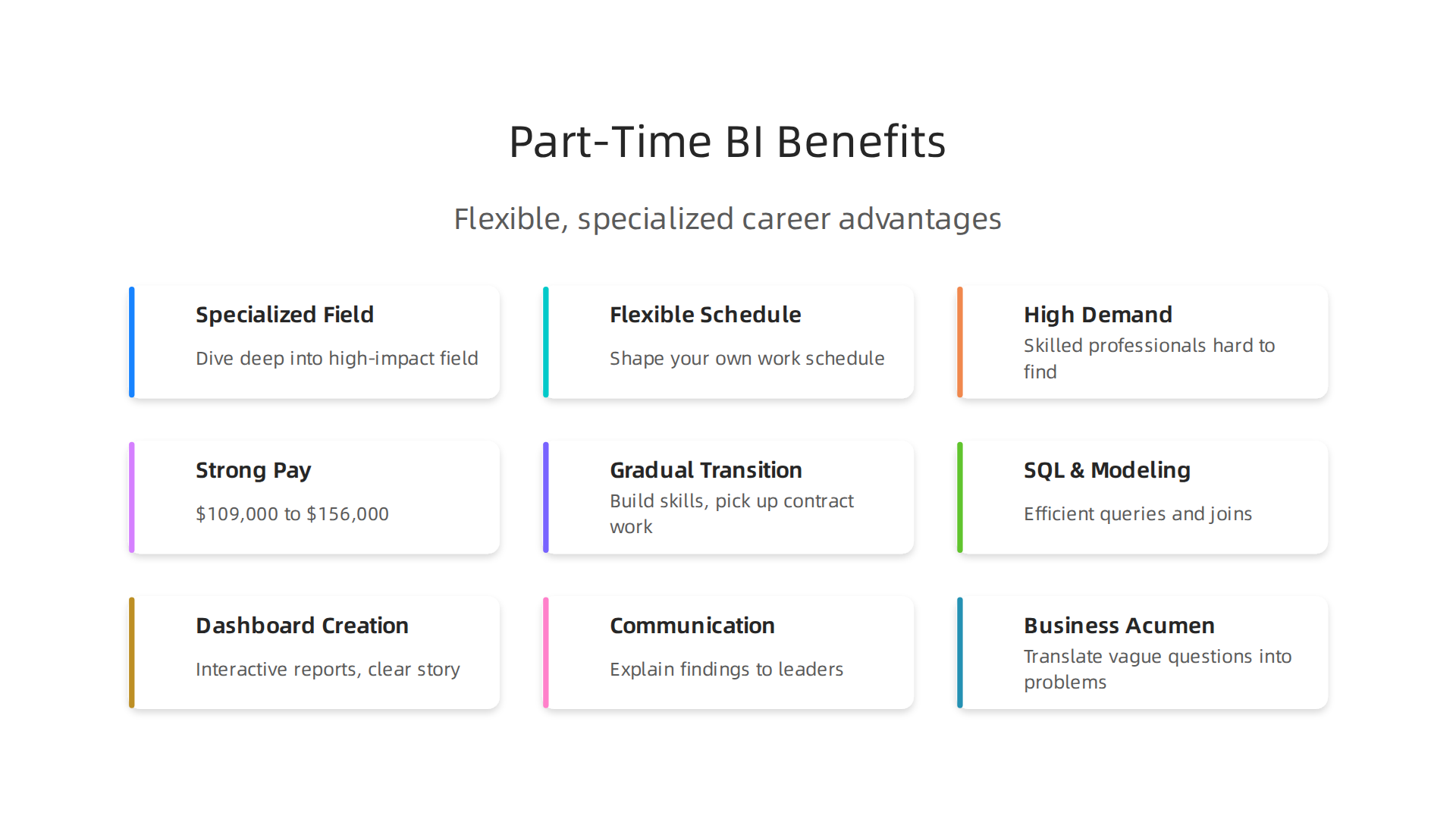
A part time bi developer gets the best of both worlds. You dive deep into a specialized, high-impact field. And you get the flexibility to shape your own schedule.
Whether you are a parent juggling school drop-offs, a freelancer managing multiple clients, or an engineer easing into semi-retirement, this role fits.

The data backs up the opportunity. The global BI market continues to grow rapidly, and skilled professionals are hard to find. In fact, the demand for BI developers is projected to grow significantly through 2026 and beyond. Companies across healthcare, retail, SaaS, and finance all need people who can turn raw data into clear, actionable insights. And they are willing to pay well for it. According to updated salary data, business intelligence developers can earn between $109,000 and $156,000 depending on experience level.
But here is what makes the part time bi developer path especially smart in 2026. You do not need to quit your current job to start. You can build skills gradually, pick up contract work on the side, and transition at your own pace. The demand for part time and freelance BI talent is strong on platforms like Upwork and in global contract markets.
If you are serious about future-proofing your career, now is the time to specialize. And BI is one of the smartest specialties you can choose.
In this article, we will walk through exactly what it takes to succeed as a part time BI developer. You will learn the core skills you need, how to build a portfolio that lands clients, where to find the best opportunities, and how to negotiate rates that reflect your value. Whether you are a seasoned developer looking for a change or someone just starting their tech journey, this roadmap will help you get there.
Before we dive into the details, there is one resource I recommend keeping in your back pocket. The tech landscape shifts daily, and staying informed is half the battle. The AI Newsletter Worth Reading delivers clear, daily AI and tech updates straight to your inbox.
It is a simple way to stay ahead of the curve without the noise.
Now, let us get into the skills that will actually get you hired.
The Rise of Specialized BI Development: Why Companies Are Hiring
Before we get into the specific skills you need, it helps to understand why companies are suddenly so eager to hire specialized BI developers on a part‑time or contract basis. The truth is, business intelligence has transformed from a nice‑to‑have add‑on into a core business function. Every department, from marketing to operations, now expects real‑time dashboards and data‑driven insights. And they want those insights delivered by people who live and breathe BI, not by generalists who split their time across ten different responsibilities.
The numbers back up this shift. According to the latest job outlook for business intelligence developers, demand for BI professionals is projected to grow by 21% from 2018 to 2028.
That is significantly faster than the average for all occupations. And in 2026, that growth shows no signs of slowing. Companies are posting hundreds of part‑time Power BI developer roles on platforms like Indeed, many offering hourly rates that translate to six‑figure annual equivalents.
Why do companies prefer hiring specialists rather than training existing employees? The answer is speed.
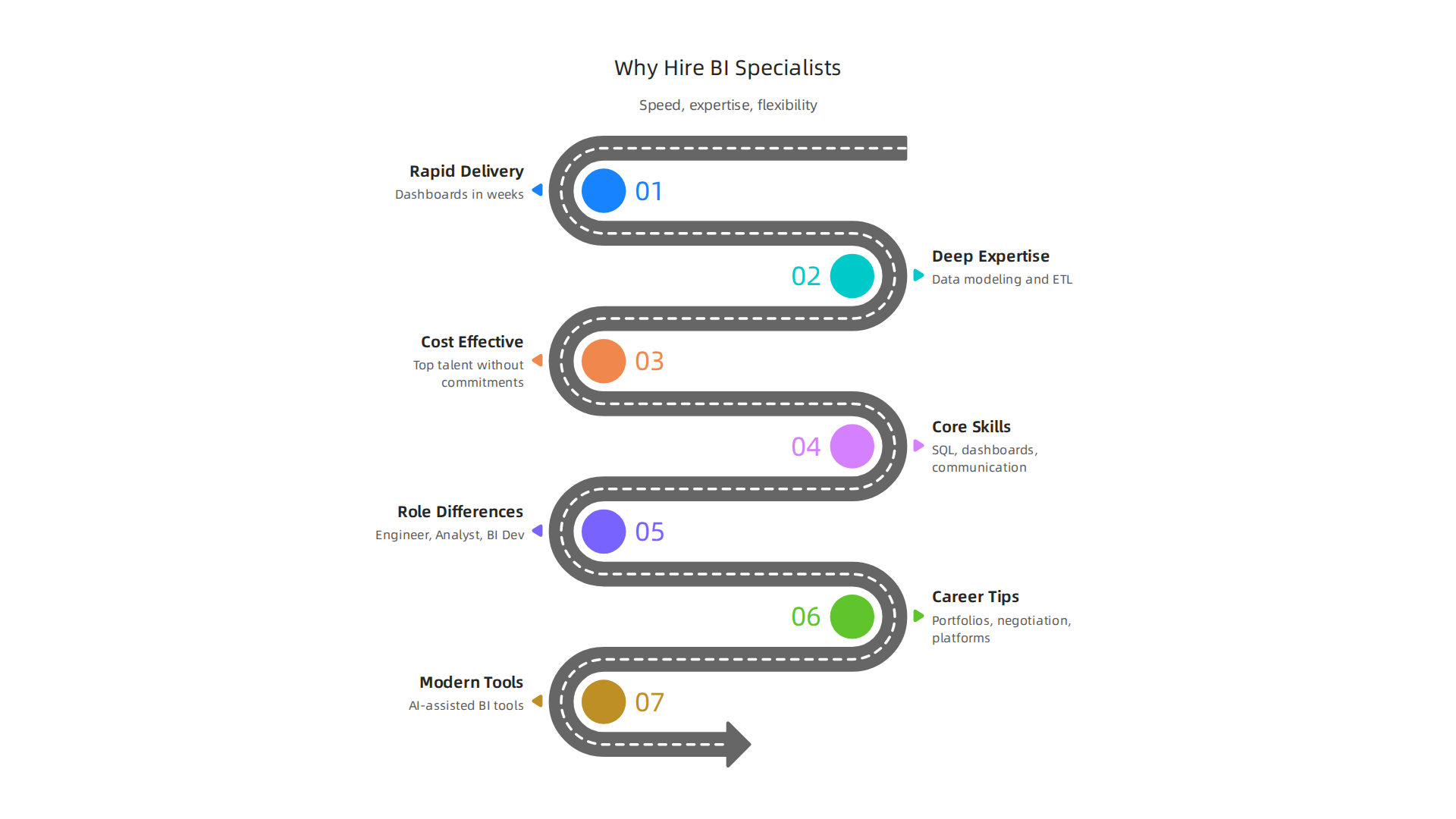
When a company needs a dashboard to support a critical product launch or a quarterly review, they cannot wait months for a generalist to learn the tools. They need someone who can architect a data model, write efficient DAX or SQL, and deliver a production‑ready dashboard in a few weeks. That is exactly what a part‑time BI developer provides: deep expertise on a flexible schedule.
This trend also reflects a broader change in how companies build their tech teams. Instead of hiring every specialist full‑time, organizations now patch together a mix of full‑time core staff and freelance experts. It is more cost effective and gives them access to top talent without long commitments. If you look at the developer job market 2026 transformation, you will see that specialized contract roles are one of the fastest growing segments.
Think about how this compares to other roles. A typical full stack developer job description asks for frontend, backend, database, and DevOps skills all in one person. That is a lot to master. A BI developer, on the other hand, focuses on a narrower stack: data modeling, ETL processes, visualization, and storytelling with data. That focus makes it easier to become genuinely excellent, and companies are willing to pay a premium for that excellence.
In fact, BI development sits at the intersection of several types of engineering. It blends data engineering (building pipelines), analytics engineering (cleaning and modeling data), and software engineering (writing maintainable code). That mix of skills makes it one of the most versatile and valuable disciplines in the tech world today.
So when you choose to become a part‑time BI developer, you are not just picking up a side gig. You are stepping into a role that companies actively search for. The demand is real, the pay is strong, and the flexibility is hard to beat. Next, let us look at the exact skills that will help you land your first client.
Core Skills for a Part-Time BI Developer: What Employers Actually Want
So what specific skills do companies look for when they need a part time bi developer? The good news is the list is focused. You don’t need to master every programming language or cloud service. Employers care most about three areas: SQL and data modeling, dashboard creation, and the ability to communicate insights clearly.
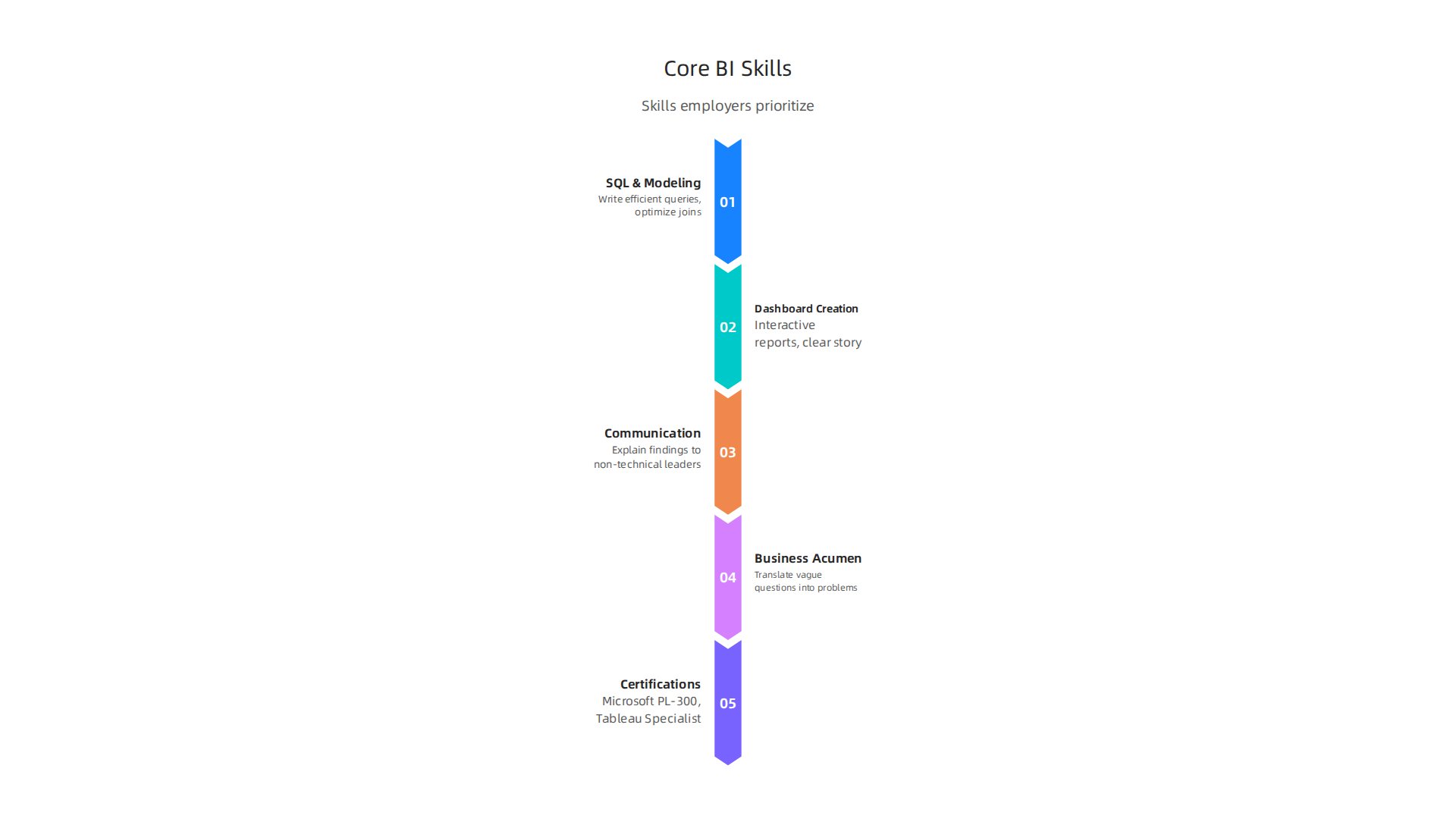
SQL and data modeling are non‑negotiable. If you cannot write efficient queries, optimize joins, and shape raw data into clean tables, most hiring conversations end before they start. According to one detailed look at what hiring managers actually test, SQL fluency is the bedrock for BI developers. You need to understand how businesses store data, how to transform it using ETL or ELT processes, and how to build a star schema that supports fast dashboards. Data modeling is the bridge between messy source data and meaningful reports. Without it, your dashboards will be slow, confusing, or simply wrong.
Dashboarding and visualization skills come next. Employers want someone who can take a data model and turn it into interactive reports that tell a clear story. This means proficiency in at least one major platform: Power BI, Tableau, or Looker. The essential Power BI skills list from Coursera highlights data modeling, visual report creation, and understanding KPIs as core competencies.
But beyond the tool itself, you need to know which chart to use, how to design for clarity, and how to ask the right questions of stakeholders. A dashboard that looks pretty but answers the wrong question is useless.
Soft skills separate good BI developers from great ones. The LinkedIn article I mentioned earlier emphasizes that business acumen and communication are the top differentiators in interviews. Can you translate a vague question like "show me sales performance" into a precise analytical problem? Can you explain your findings to non‑technical leaders who have limited time?

The ability to tell a story with data and manage stakeholder expectations is often cited as the skill that lands senior roles. This is also where the types of engineering you work with matter: you sit between data engineers, analytics teams, and business leaders. Comfort working across all three is a huge advantage.
Certifications give you a fast credibility boost. While a strong portfolio is the best proof, vendor certifications carry real weight. The most valued ones include Microsoft Certified Power BI Data Analyst Associate (PL‑300), Tableau Desktop Specialist, and Google Professional Data Engineer. If you are looking to expand your resume, consider exploring online certifications for software engineering that include these BI‑focused credentials. They signal to hiring managers that you have tested knowledge, not just self‑taught experience.
One final note: the tech landscape changes fast, especially with AI tools now built into BI platforms like Power BI Copilot. To stay competitive, you need to keep learning. A good way to do that is to follow trusted daily updates on AI and tech trends. The AI Newsletter Worth Reading delivers clear, actionable insights that help you spot emerging skills before they become requirements. It is a small habit that keeps your part time BI developer career on the cutting edge.
BI Developer vs Data Analyst vs Data Engineer: Understanding the Overlap
If you’re exploring a part time bi developer role, you’ve likely seen these three titles used almost interchangeably. They all work with data, but each role has a different focus. Understanding the overlap helps you know where you fit and how to pitch yourself.
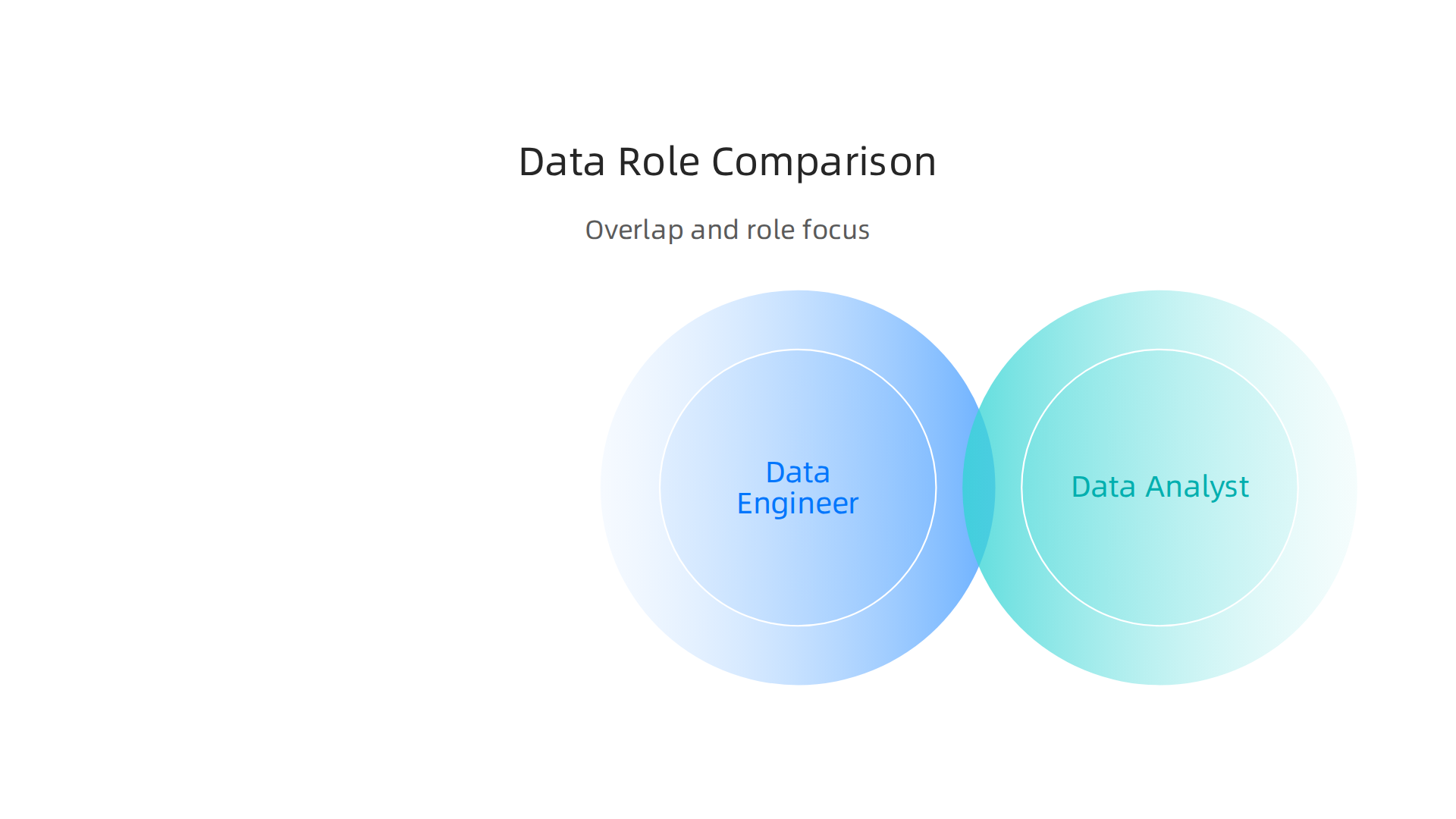
Data engineers build the systems. They design data pipelines, manage cloud storage, and ensure data flows reliably from source to destination. Their work is behind the scenes and technical.
Data analysts find the story in the numbers. They write queries, explore trends, and produce one-off reports or presentations to answer business questions. They communicate directly with decision makers.
BI developers sit right between the two. You take the clean data from engineers and turn it into dashboards, reports, and semantic layers that business users can rely on daily. You automate recurring reporting. A difference between data analyst and BI developer discussion on Reddit explains that a BI developer’s output is a self-service dashboard while a data analyst’s output is insights from one-off analysis. That makes the BI role ideal for someone who wants to build and maintain systems rather than answer every ad-hoc question.
For a part time bi developer, the lines often blur. You might do a bit of everything: write SQL to clean data, design a dashboard, and then explain the results to a stakeholder. That flexibility is actually your biggest selling point. Small companies and startups love someone who can handle the whole pipeline.
Knowing these differences helps you tailor your resume and portfolio. If a job description asks for a data analyst but the real need is building dashboards, you can position yourself as a part time bi developer who bridges that gap. The transformation of skills and roles in 2026 shows that companies increasingly value cross-functional talent like this.
When you look for part-time BI developer gigs, emphasize your ability to handle both data modeling and stakeholder communication. That combination is rare and valuable. So don’t worry if your role feels a little undefined. That’s normal for part-time work. The clearer you are about where you fit, the better you can land the opportunities that play to your strengths.
Building a Part-Time BI Development Career: Portfolios, Platforms, and Negotiation
Landing a part time bi developer role takes more than just knowing SQL and Power BI. You need to prove you can deliver results, find the right opportunities, and set yourself up for fair pay. Let’s break down the three most important moves you can make.
Build a portfolio that shows real work. Your resume might list skills, but a portfolio proves them. Create dashboards that solve actual business problems. Show data pipelines you built and reports that saved someone time. Interactive projects are best because hiring managers can click around and see your thinking. You don’t need a ton of projects. Two or three strong ones showing different skills (data modeling, visualization, user experience) are enough to get noticed.
Know where to find part-time work. The best platforms for part time bi developer jobs fall into two groups. General freelance sites like Upwork and Fiverr Pro have lots of small projects.
You can start there to build experience. But if you want better pay and vetted clients, specialized platforms are a smarter move. Niche marketplaces like Toptal connect you with companies that already expect high quality. One helpful list of freelance Power BI developer platforms explains that Toptal offers hourly, part-time, and full-time contracts for top developers. You can also check job boards like FlexJobs and Indeed. FlexJobs has a growing section of remote Power BI jobs including part-time listings. For more strategic thinking about your career path, the tech jobs 2026 blueprint covers skills and salary trends across the industry.
Negotiate scope and rate like a pro. When you land a part-time gig, be clear about what you will deliver.

Define the number of dashboards, update frequency, and how you handle ad-hoc requests upfront. This prevents scope creep. For rates, check what other part-time BI developers charge. Research from Remote Rocket Ship shows average salaries for junior BI developers are around $74,000 per year, which translates to roughly $35 to $40 per hour for part-time work. Adjust based on your experience and the complexity of the project. Always ask for a contract that spells out hours, payment terms, and deliverables.
A strong portfolio plus smart platform choices plus clear negotiation will set you up for a steady stream of part-time work.
The tech world changes fast. Staying informed helps you make better career moves. That’s why we recommend The Deep View Newsletter. You get clear daily AI updates that keep you ahead of trends affecting data and BI roles. It’s a quick read and totally worth your time.
Tools and Technologies for the Modern BI Developer: 2026 Stack
The tools you choose as a part time bi developer can make or break your efficiency. The 2026 stack has shifted hard toward cloud-native solutions and self-service platforms. Here is what you need to know.
Cloud-native data warehouses are now the standard. Forget on-premise solutions. Modern BI work runs on platforms like Snowflake, BigQuery, and Azure Synapse. These systems scale automatically and handle large datasets without you managing servers. As a freelancer, you want tools that let you focus on analysis, not infrastructure. The list of most in-demand tech skills for 2026 confirms that cloud platforms like AWS, Azure, and Google Cloud are essential for any data professional today. Add Snowflake or BigQuery to your resume and you instantly become more hireable.
AI-assisted BI tools are becoming a key differentiator. Power BI and Tableau now include built-in AI features. Power BI Copilot lets you ask questions in plain language and get charts in seconds. Tableau Pulse does the same with natural-language summaries. These tools let you deliver insights faster, which matters when you bill by the hour. The latest hiring insights for BI developers in 2026 show that familiarity with AI-assisted analytics features like Copilot and Einstein is now a strong differentiator for candidates. If you can demonstrate these skills, you stand out from the crowd.
Open-source options keep costs low for freelancers. Not every client needs a full Microsoft or Tableau license. Open-source tools like Metabase and Apache Superset offer solid dashboarding and reporting capabilities without the price tag. You can host them yourself or use a cloud version. They connect to dozens of databases and handle most common reporting needs. The comparison of open-source BI tools for 2026 highlights Metabase and Superset as strong free options for teams watching their budget. This is a great way to serve smaller clients without eating into your profit.
Your core skills still matter most. No tool replaces SQL fluency, data modeling, and visualization design. Build those first. Then layer on cloud and AI skills. If you want to structure your learning, the detailed Power BI developer roadmap with SQL skills is a solid starting point.
Mastering this 2026 stack will help you win more clients and deliver faster results. Pick two or three tools, learn them deeply, and you will be ready for almost any part-time project that comes your way.
Strategies for Success as a Part-Time BI Developer: Time Management and Client Relationships
Working as a part time bi developer means you are running your own small business. You handle the work, the deadlines, and the relationships all at once. It can feel like a lot. But with a few simple strategies, you can keep everything running smoothly and grow your client base over time.
Master your time with smart scheduling. When you juggle two or three clients, your calendar fills up fast. The trick is time blocking. Set aside specific hours each week for each client. Use a shared calendar or project management tool so everyone knows when you are available. Also lean on async communication. Instead of real time meetings, use recorded updates, shared dashboards, and well written messages. This saves hours each week. Your clients get what they need, and you keep your focus deep on the actual work. Many successful part time BI developers use this approach to handle multiple projects without burning out.
Focus on long term client relationships. One off projects are fine, but repeat work is where the real stability lives. Deliver on time, communicate clearly, and check in even when nothing is urgent. When clients trust you, they come back with new requests. They also refer you to others. A single strong relationship can lead to years of part time work. Make it a habit to send a short monthly update showing what you have done and what you see coming next. This keeps you top of mind and shows that you care about their business, not just the invoice.
Stay current with BI trends to stay in demand. The field moves fast. A tool you mastered last year might be outdated next year. Subscribe to a few high quality newsletters and join online communities where BI developers share tips. Spend just 15 minutes a day skimming new posts or reading one article. This small habit keeps your skills fresh and helps you offer value that other freelancers miss. For a broader view of where the industry is headed, check out this tech jobs 2026 blueprint for skills salaries and growth. It will help you see which skills to add next.
As you build your reputation, more work will come your way. And to make sure you never fall behind on the latest AI and BI developments, consider subscribing to The AI Newsletter Worth Reading. It delivers clear daily updates that help you stay sharp and ready for your next project.
Summary
This article explains why becoming a part-time BI developer is a high-value, flexible career move in 2026 and lays out a practical roadmap to get there. It covers the market forces driving demand for specialists, the specific technical and soft skills employers hire for (SQL, data modeling, dashboarding, communication), and the modern 2026 toolstack including cloud warehouses and AI-assisted BI features. You’ll learn how BI differs from related roles, what certifications and portfolio pieces boost credibility, and where to find part-time and contract work. The guide also shows how to negotiate rates, avoid scope creep, and manage multiple clients with time-blocking and async communication. Readers finish with concrete next steps: build two to three strong projects, choose a focused toolset, keep learning with targeted courses or certifications, and pursue vetted freelance platforms for better pay. Overall, it’s a compact playbook for transitioning into or growing a sustainable part-time BI practice without quitting your day job.