

Introduction: Why Quantum Computing Companies Matter in 2026
Quantum computing is finally leaving the lab and entering the real world. In 2026, the global quantum computing market is already valued at nearly $2 billion, with projections showing it could reach $7.3 billion by 2030. That is a huge jump, and it means quantum computing companies are no longer science fiction. They are building real hardware, writing real software, and helping industries solve problems that normal computers just cannot handle.
Why should you care? If you are a software engineer, engineering manager, or tech leader, understanding this landscape is critical for your career and your company’s strategy.

Quantum computers will change how we approach cryptography, drug discovery, logistics, and even AI. The companies leading this charge are attracting billions in investment from governments and private investors alike. Knowing who they are and what they do gives you a huge advantage when planning your next project or skill set.
This article gives you a clear, structured look at the top quantum computing companies in 2026. You will learn about their technology approaches, real use cases, and realistic timelines. No hype, just facts.
If you want to stay ahead of curve in AI and tech trends, the The Deep View Newsletter delivers clear daily updates straight to your inbox. It is a smart way to cut through the noise.
Staying current in this fast-changing field also means investing in your own skills. Check out online certifications for software engineering to keep your knowledge sharp while quantum computing reshapes the industry.
Quantum Computing Market Overview and Key Players
The quantum computing market is growing faster than many people expect. In 2024, the industry was valued at about $1.42 billion, and by 2030 it could reach as high as $7.3 billion, according to a market analysis from BCC Research. Other reports project even higher numbers, with some estimates going up to $20 billion. No matter which forecast you trust, the direction is clear. This market is expanding at a compound annual growth rate of around 35 percent.
In 2026, the global quantum technology industry hit $1.9 billion in revenue, and it is on track to double by 2028, according to the QED-C State of the Global Quantum Industry report. That kind of growth attracts serious investment from governments, venture capital, and enterprise customers.
So who is leading the charge? You can group the key players into three buckets.
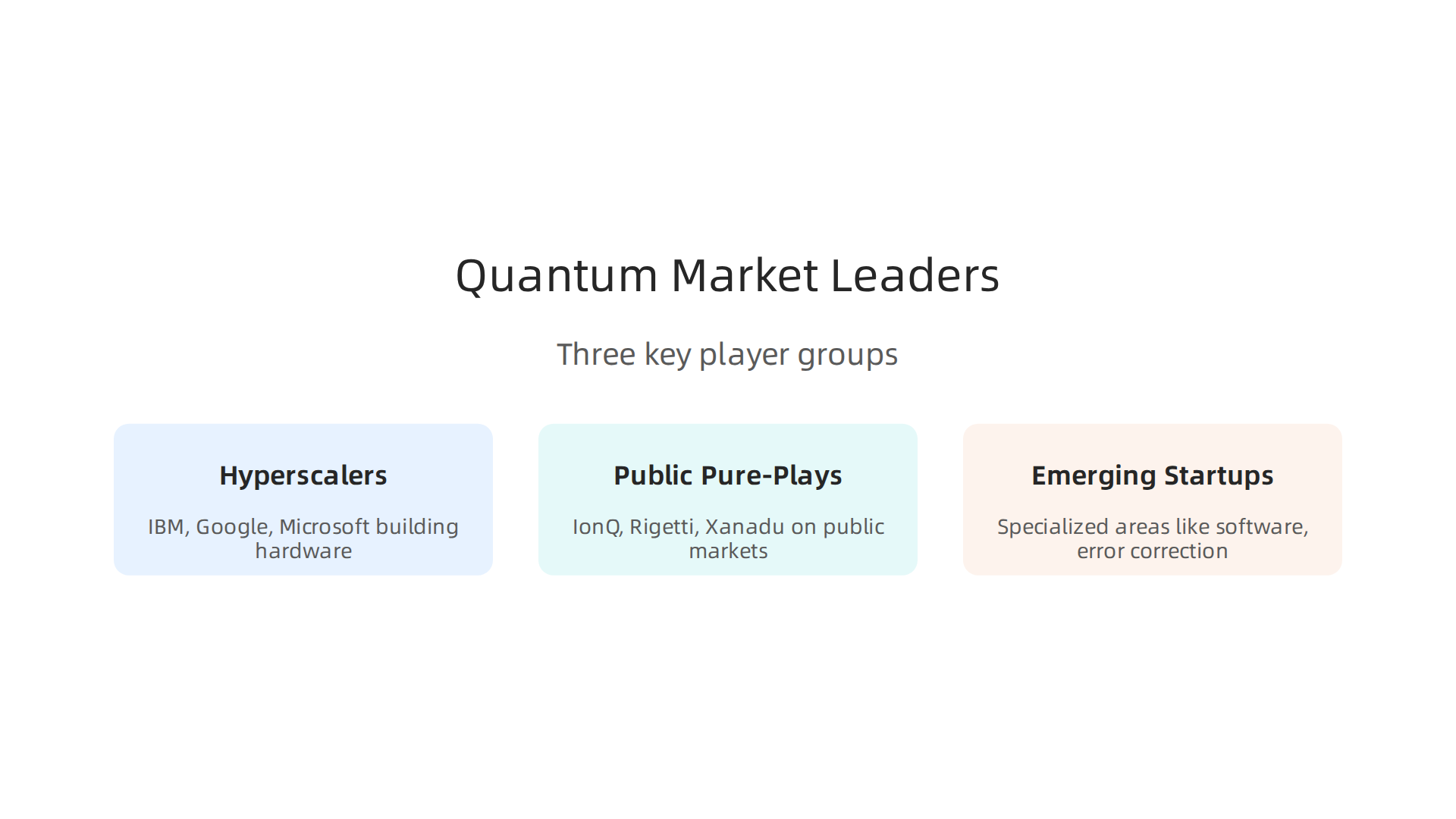
Hyperscalers. IBM, Google, and Microsoft are building quantum hardware and offering cloud access to their systems. They have deep pockets and large research teams.
Public pure-plays. Companies like IonQ and Rigetti focus only on quantum computing. They trade on public markets and report their progress every quarter. A major moment in 2026 came when Xanadu Quantum Technologies went public, as this analysis breaks down.
Emerging startups. Smaller companies are working on specialized areas like quantum software, error correction, and specific use cases such as drug discovery or cryptography.
The competitive landscape is also shaped by market consolidation and strategic partnerships. Companies are forming alliances to share technology and speed up development. Some are buying smaller startups to fill gaps in their stack. This mix of competition and collaboration is pushing the whole field forward faster.
Keeping up with these rapid changes can feel overwhelming. That is why thousands of tech leaders turn to a trusted daily update. If you want clear, bite-sized news on quantum computing and AI without the hype, you should try The Deep View Newsletter. It delivers smart insights straight to your inbox every day.
And as the industry evolves, staying skilled is just as important. Check out online certifications for software engineering to keep your knowledge sharp while quantum computing reshapes the tech world.
Top Public Quantum Computing Companies in 2026
If you are looking to invest or simply track the leaders, you need to know which quantum computing companies are publicly traded.
Here is a look at the top names and the metrics that matter.
Public Pure Plays: IonQ, Rigetti, and D-Wave
These companies focus only on quantum computing. That gives you direct exposure to the sector without the noise of other business units.
- IonQ uses trapped ions for its qubits. In 2026, it continues to post strong performance in qubit fidelity and has expanded its commercial partnerships.
- Rigetti Computing builds superconducting processors. Its qubit counts have been doubling every one to two years, according to a performance analysis.
- D-Wave Systems specializes in quantum annealing, a different approach than gate-based computing. It is publicly traded and has a growing customer base for optimization problems.
A major milestone in 2026 was Xanadu Quantum Technologies going public, adding a photonic quantum player to the public markets.
Tech Giants Keep Pushing Hard
IBM, Google, and Microsoft are not pure plays, but they invest billions in quantum research. They offer cloud access to their machines and release regular hardware updates.
- IBM continues to lead in qubit count. Its latest processors can run circuits with thousands of operations, as noted in the 2026 Quantum Computing Guide.
- Google showed exponential error suppression with its 105-qubit Willow chip, a major step toward useful fault-tolerant quantum computing.
- Microsoft focuses on topological qubits and Azure Quantum services.
Metrics That Actually Matter
Raw qubit count alone is not enough. You also need to look at error rates and quantum volume. A system-level benchmark called quantum volume combines qubit count, fidelity, connectivity, and compiler performance. Industry reports in 2026 show that quantum volume is a better comparator than simple qubit numbers.
Tracking qubit counts across companies is easier with resources like the Qubit Counts Status Report, which updates regularly. The field is moving fast: in May 2026 alone, measurable gains in error-corrected qubits were reported by multiple labs, as covered by Remio AI.
Commercial Partnerships Drive Growth
These companies are not just building hardware. They are forming partnerships with banks, pharmaceutical firms, and cloud providers. Those deals bring real revenue and validate the technology.
Keeping track of all the moves from these quantum computing companies can be a full-time job. That is why thousands of tech professionals rely on a short daily update. You can get clear, trusted coverage with The Deep View Newsletter. It lands in your inbox every day, no hype, just the facts.
And as quantum computing reshapes the industry, staying skilled on the software side is just as important. Check out this guide on AWS cloud operations in 2026 to keep your infrastructure knowledge sharp while the quantum revolution unfolds.
Private Quantum Computing Startups to Watch
Publicly traded companies get the most attention, but some of the boldest work in quantum computing is happening inside private startups.

These companies are chasing fault-tolerant machines and niche applications that could reshape industries. If you want to understand where the field is really heading, keep an eye on these names.
PsiQuantum is building a photonic quantum computer. Its approach uses light particles instead of electric circuits, which could make scaling to millions of qubits easier. The company has raised over a billion dollars and is targeting the first useful fault-tolerant system later this decade.
Quantinuum spun off from Honeywell and specializes in trapped-ion qubits. In 2026 it continues to push record fidelities, and its quantum volume scores are among the highest in the industry. The company recently announced partnerships with major cloud providers to make its hardware more accessible.
Alice & Bob, a French startup, uses cat qubits. This design naturally suppresses certain types of errors, which could speed up the path to error-corrected quantum computing. The company closed a significant Series B round in early 2026.
Venture capital is flowing heavily into this space. The global quantum computing market was worth $1.92 billion in 2025 and is projected to hit $45.6 billion by 2035, according to Vantage Market Research. Much of that early investment is going to private startups working on the hardware breakthroughs we covered in May 2026.
These companies are not just building more qubits. They are designing systems that can actually run useful algorithms without constant errors. That is the definition of fault-tolerant quantum computing, and it is the prize everyone is chasing.
Keeping track of private funding rounds, technical milestones, and partnership deals can feel overwhelming. That is why thousands of tech professionals start their day with The Deep View Newsletter. It delivers clear daily updates on AI and quantum developments, no hype, just the facts.
And if you want to keep your own skills sharp while the quantum revolution unfolds, check out this guide to the best Google courses in 2026 for advancing your tech career.
Quantum Computing Technology Approaches: Superconducting, Trapped Ion, Photonic, and More
Not all quantum computers are built the same way. In fact, the race to build a useful machine involves several competing technologies.
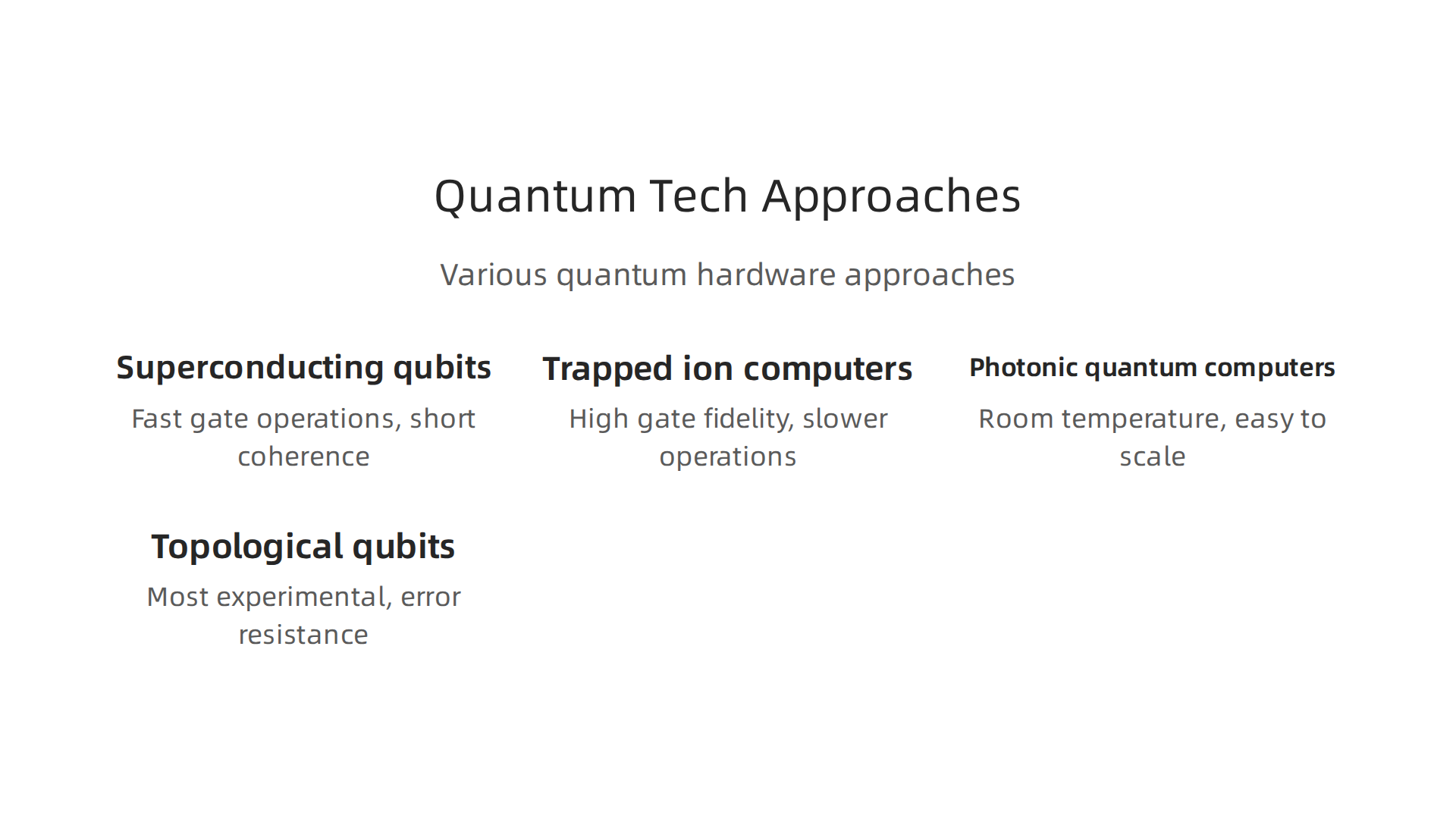
Each approach has its own strengths and trade-offs, and the right choice often depends on the problem you want to solve.
Superconducting qubits are the most common type used today. Companies like IBM and Google have built large processors with hundreds of qubits. These systems offer fast gate operations and benefit from years of semiconductor manufacturing experience. But they come with a serious weakness: short coherence times. The qubits lose their quantum state quickly, which makes error correction harder. According to Microsoft Quantum, superconducting qubits remain the leading platform for near-term experiments, but scaling up without introducing more errors is a major challenge.
Trapped ion computers take a different route by using individual atoms held in place by electric fields. IonQ and Quantinuum are the big names here. Trapped ions offer very high gate fidelity and can connect qubits in flexible ways. Research from Duke University shows that ion trap systems outperformed superconducting ones on benchmark tests thanks to better qubit connectivity. The trade off is speed. As PRISM EuroQCI notes, trapped ion operations are slower, which can limit throughput for certain algorithms.
Photonic quantum computers use particles of light instead of solid matter. This lets them run at room temperature and connect naturally with fiber optic networks. PsiQuantum and Xanadu are pushing this approach because it could be easier to scale. As Quondela explains, photonic systems resist decoherence and don’t need extreme cooling, which removes some big engineering hurdles.
Topological qubits are the most experimental but also the most promising for error resistance. Microsoft is betting on this approach, which stores information in a way that is naturally protected from errors.
If it works, it could skip many of the error correction steps other technologies need.
Each technology has its champions. The quantum computing companies pursuing these different paths are all racing toward the same goal: a fault-tolerant machine that can solve real problems. For professionals in product development services, understanding these trade offs is essential for planning future capabilities.
Keeping track of which approach is winning can be confusing. That is why thousands of tech professionals start their day with The Deep View Newsletter. It delivers clear daily updates on AI and quantum developments, no hype, just the facts.
And if you want to keep your own skills sharp while the quantum revolution unfolds, check out this guide to the best online certifications for software engineering that keep you ahead in 2026.
Quantum Computing Use Cases in Finance and Pharma
Why are big banks and drug makers pouring money into quantum research? Because some problems are too hard for even the fastest classical computers.

Quantum computing companies are now helping them solve those problems.
In finance, the key use cases are portfolio optimization, risk analysis, and fraud detection. A quantum computer can run millions of possible investment scenarios in parallel, finding the best mix of risk and return much faster than today’s methods. JPMorgan Chase and Goldman Sachs are already testing quantum algorithms for real trading and risk models. According to Origin Quantum, these early experiments could reshape how financial institutions manage uncertainty.
Over in pharma, the impact could be even bigger. Drug discovery is all about simulating how molecules interact with each other and with proteins. That is a nightmare for classical computers because the number of possible interactions explodes. Quantum computers, however, can model these systems naturally. Pfizer and Roche are working with quantum computing companies to simulate complex chemical reactions, which could cut years off the timeline for new medicines.
This is not some magic AI or a distant human or AI debate. It is real science that product development services teams should start tracking right now. The quantum computing companies leading these efforts are racing to deliver practical tools.
Keeping up with which firms are making real progress can feel overwhelming. That is why thousands of professionals start their day with The Deep View Newsletter for clear, no-hype updates on quantum and AI breakthroughs.
And if you want to build skills that complement these advances, our guide on AWS SageMaker in 2026 shows how to train and deploy machine learning models at scale.
Quantum Computing Use Cases in Logistics and Cybersecurity
Finance and pharma are not the only industries where quantum computing companies are making waves. Logistics and cybersecurity are two more areas where the tech is starting to prove its worth.
Let us start with logistics. Moving packages, managing fleets, and planning supply chain routes involve an insane number of variables. Classical computers hit a wall when you try to optimize more than a few hundred vehicles. Quantum-inspired algorithms, however, can handle thousands at once. According to BQP Simulations, companies that switch to these methods see fleet and routing costs drop 15 to 30 percent. That is not just a small improvement. It is a huge deal for any business that ships products.
Big names are already testing the waters. Volkswagen uses quantum algorithms for real time route optimization in city traffic. DHL has partnered with quantum computing firms to rethink its global supply chain. Airbus uses quantum for predictive maintenance on its aircraft. Amazon applies it to robot route planning inside its warehouses. These are not far off experiments. They are happening right now in 2026.
So what about cybersecurity? Here is the thing. The same quantum power that solves logistics puzzles can also break the encryption that protects almost everything online. That is why post quantum cryptography is becoming urgent. Governments and companies are racing to develop new security standards that can resist attacks from future quantum computers. Any serious product development services team needs to start thinking about this today. Waiting until the threat is real would be a mistake.
This is not magic AI or some human or ai debate. It is practical engineering that will reshape supply chains and security systems over the next few years. If you want to build skills in this fast moving space, staying current is everything. Thousands of tech professionals rely on The Deep View Newsletter for clear daily updates on quantum breakthroughs and cybersecurity shifts.
And if you are looking to level up your own qualifications, checking out the latest online certifications for software engineering can help you stay ahead of the curve.
The Future Timeline for Quantum Computing: From NISQ to Fault-Tolerance
So where are we really with quantum computing companies right now? The machines we have today are called NISQ devices.
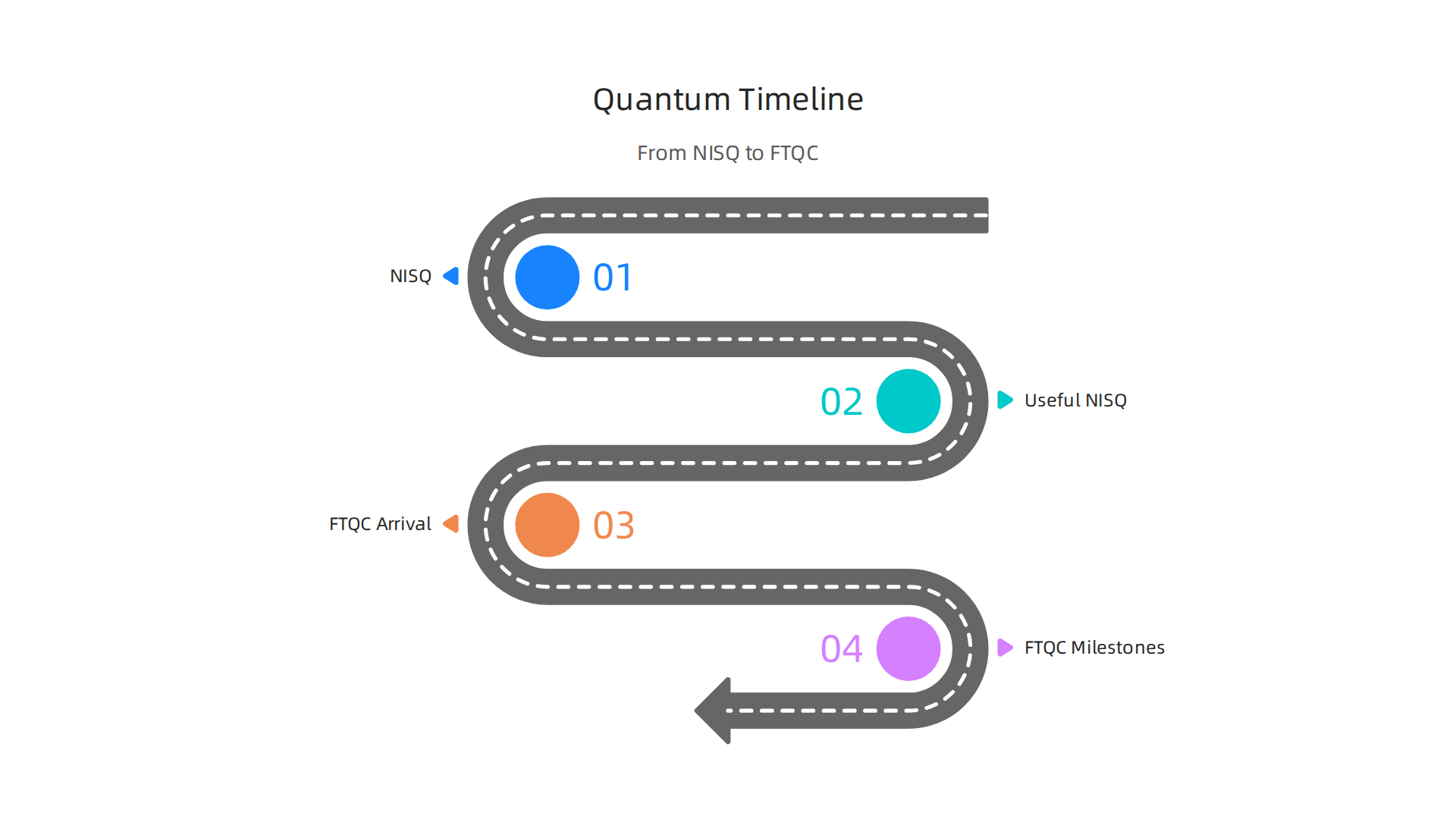
That stands for Noisy Intermediate Scale Quantum. They are noisy because qubits are fragile and make errors easily. And they are intermediate scale because they have only a few hundred physical qubits at most.
Even so, these limited machines can already do useful things. For example, quantum inspired algorithms running on classical hardware can drop fleet and routing costs by 15 to 30 percent, according to BQP Simulations. Big logistics players like Volkswagen and DHL are testing these methods today. That is NISQ in action. Not perfect, but practical for specific optimization tasks.
The real prize is fault tolerant quantum computing, or FTQC. This is when we have machines that can correct their own errors and run complex algorithms reliably. Most experts expect FTQC to arrive between 2030 and 2035. When that happens, quantum computing companies will need to hit some big milestones. They need 1000 or more logical qubits. Each logical qubit is made from many physical qubits and error correction schemes. They need breakthroughs in hardware stability. And they need to show clear quantum advantage across several industries.
These timelines matter for software engineers today. If you start learning quantum algorithms and error correction now, you will be ready when the hardware catches up. The shift from NISQ to FTQC will change how we build encryption, optimize supply chains, and train AI models. This is not magic AI or some human or ai debate. It is a predictable engineering roadmap.
Want to keep your skills sharp as this timeline unfolds? Check out the latest Google courses in 2026 that will advance your tech career. And for daily updates on breakthroughs like these, thousands of engineers trust The Deep View Newsletter to stay ahead.
Preparing for Quantum: Skills, Tools, and Resources for Software Engineers
So how do you actually get started preparing for the quantum era? The good news is you do not need a physics degree.

You just need the right learning path and some hands-on tools.
Start with the core quantum algorithms: Shor’s algorithm for factoring numbers and Grover’s algorithm for searching databases. These are the classics that prove quantum computers can beat classical machines. Once you understand them, move to quantum programming frameworks. The most popular right now are Qiskit from IBM, Cirq from Google, and Amazon Braket and Azure Quantum from the big cloud providers. A detailed 2026 comparison of these tools can help you pick the best one for your background.
Next, get your hands dirty with simulators and real quantum hardware. You do not need to own a quantum computer. Cloud services from IBM, Amazon, and Microsoft give you free access to simulated and real qubits. IBM even introduced new profiling tools in 2026 to help developers debug workloads across quantum and classical resources.
To stand out, focus on two differentiators: quantum error correction and hybrid quantum-classical algorithms. Error correction is the key to making qubits reliable. Hybrid algorithms combine classical and quantum steps, letting you solve practical problems even with today’s noisy machines. These topics will separate you from engineers who only know the basics.
The entry barrier has never been lower. Online courses, free simulators, and cloud credits let you learn without spending a dime. And as you build these skills, keep your overall career sharp by exploring the best options from established providers. A great way to stay ahead is to check out this list of the best online certifications for software engineering in 2026, which includes quantum-adjacent courses.
Want daily updates on quantum breakthroughs and the tech trends that matter? Thousands of software engineers trust The Deep View Newsletter to cut through the noise and deliver clear, actionable insights straight to their inbox.
Summary
This article maps the quantum computing company landscape in 2026, explaining who the major players are, which technologies they use, and what real-world problems they already help solve. It covers hyperscalers (IBM, Google, Microsoft), public pure-plays (IonQ, Rigetti, D‑Wave, Xanadu) and high-potential private startups (PsiQuantum, Quantinuum, Alice & Bob), and it explains why raw qubit counts are less useful than system-level benchmarks like quantum volume. You’ll get a clear walkthrough of the main hardware approaches—superconducting, trapped ion, photonic, topological—plus concrete industry use cases in finance, pharma, logistics, and cybersecurity. The piece also lays out the expected timeline from noisy intermediate-scale (NISQ) devices to fault-tolerant machines and what milestones matter for that transition. Finally, it gives practical next steps for software engineers: which algorithms and cloud tools to learn, how to get hands-on with simulators and cloud hardware, and which skills will pay off as quantum moves into production. After reading, you’ll know where to watch for progress, how to judge vendor claims, and how to prepare your team and career for the coming wave of quantum-enabled systems.