

Introduction
You do not need to be a software engineer to build machine learning models anymore. In 2026, that statement is more true than ever. No-code ML platforms have changed the game. They let anyone with a good idea build AI tools using simple drag-and-drop interfaces and plain natural language.

This shift is huge. The no-code machine learning market is already valued at nearly $2 billion in 2026. Experts predict it will hit $5.5 billion by 2030. The broader no-code AI platform market is expected to grow past $44 billion by 2033. These are not small numbers. This is a real revolution in how we create technology.
But here is the thing. Just clicking buttons is not enough to get great results. The real skill you need in 2026 is learning how to talk to these AI models effectively. That skill is called prompt engineering.
Good prompt engineering is what separates a useful AI tool from a frustrating one. It is the bridge between your domain knowledge and the machine’s output. If you want to get serious about no-code ML, you need to master this. Taking a Google prompt engineering course is a great way to start. And if you are looking to build a long-term career around these skills, grabbing some online certifications for software engineering can help you stay ahead.
In this article, I will walk you through the best no-code ML platforms, share practical prompt engineering techniques, and highlight the trends you need to watch in 2026.
Let us get started.
What is No-Code ML?
Let me break this down in simple terms. No-code ML is a way to build, train, and deploy machine learning models without writing a single line of code.
Think of it like this. Instead of typing complex programming commands, you use visual tools. You drag and drop elements. You click buttons. You fill in forms. And the machine does the heavy lifting for you.
These platforms come with powerful features that make AI accessible to everyone.
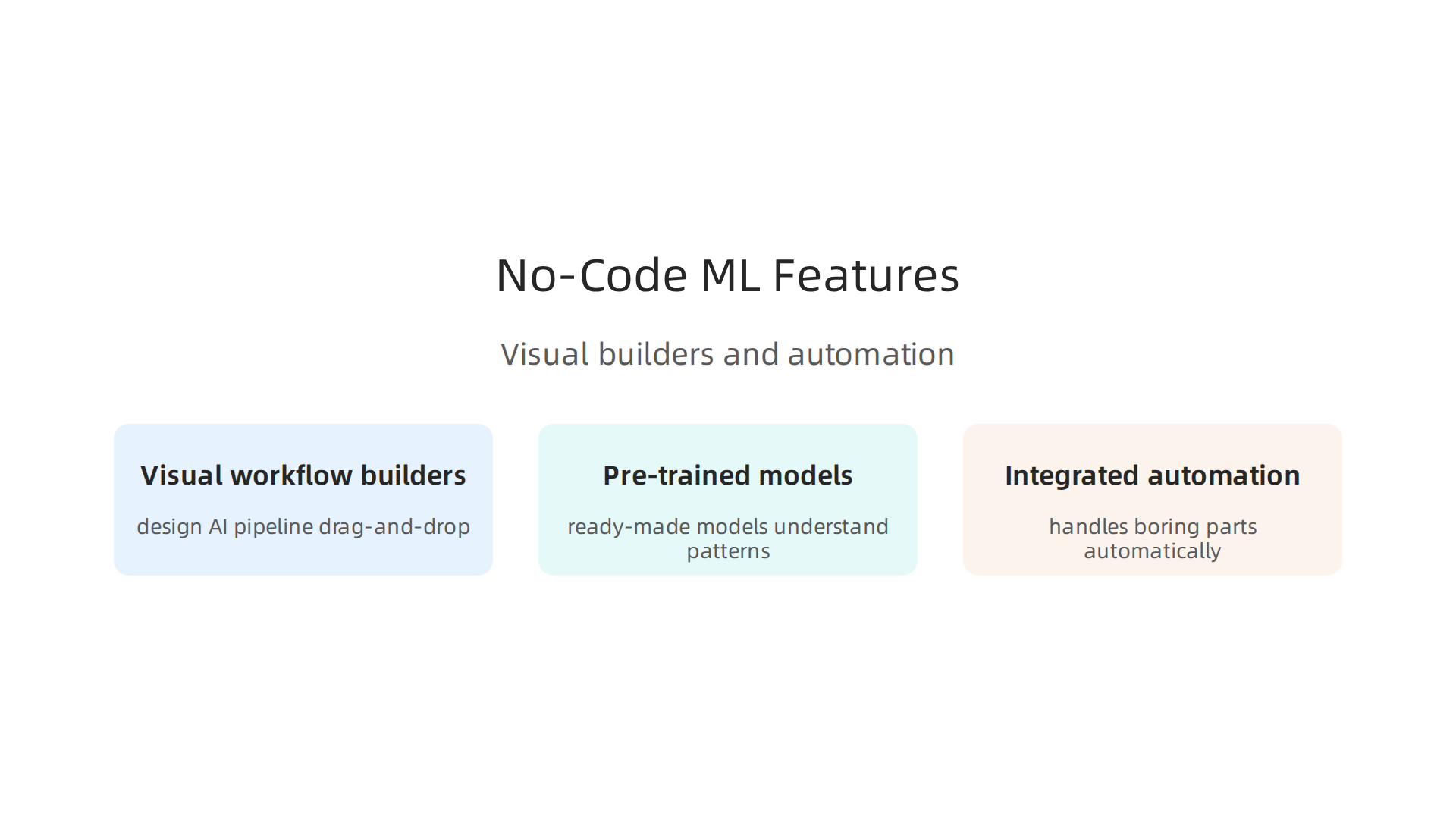
Visual workflow builders. These are the heart of no-code ML. They let you design your AI pipeline using a simple drag-and-drop interface. You connect blocks that handle data, training, and output. Everything is visual. You can see the whole process from start to finish.
Pre-trained models. You do not need to train a model from scratch. Most platforms offer ready-made models that already understand patterns. You just feed them your data and fine-tune a few settings. This saves weeks of work.
Integrated automation. The platform handles the boring parts automatically. Things like data cleaning, model tuning, and deployment happen in the background. You focus on the results.
The real magic is what this means for you. In 2026, the no-code ML market is already valued at nearly $2 billion and is growing fast. The no-code AI platforms market is expected to reach over $44 billion by 2033. And according to Gartner, the low-code development market will exceed $30 billion in 2026 alone.
These numbers tell a clear story. The barrier to entry for AI has dropped dramatically. You no longer need a computer science degree or years of coding experience. A marketer can build a customer prediction model. A teacher can create a grading assistant. A small business owner can automate inventory forecasting.
That said, you still need one critical skill. You need to know how to talk to these tools effectively. That is where prompt engineering comes in. If you want to go deeper on this skill, check out some online certifications for software engineering that cover modern AI workflows.
No-code ML is not about replacing developers. It is about giving everyone a seat at the AI table. And in 2026, that table is bigger than ever.
The Role of Prompt Engineering in No-Code AI
Now that you understand what no-code ML can do, you might wonder how to get the best results from these tools. The secret lies in prompt engineering. This is the skill of crafting questions or instructions that guide an AI model toward the output you want.
In 2026, prompt engineering has become the bridge between you and the machine. In no-code environments, prompts replace traditional parameter tuning and feature engineering. Instead of writing code to tweak a model, you write better instructions. The IBM guide to prompt engineering explains this as designing input queries that produce accurate, creative, and consistent results. A well-written prompt can make the difference between a model that guesses and one that delivers exactly what you need.
Why does this matter so much for no-code ML? Think about it this way. When you use a drag-and-drop AI tool, the model can process your data in many ways. Your prompt tells it which way to go. If you ask a vague question, you get a vague answer. But if you use techniques like chain-of-thought prompting, where you break a problem into steps, the model follows your reasoning. The advanced prompt engineering guide for 2026 shows how these methods boost accuracy without any coding.
This skill also helps you control the model’s style and tone. For example, you might want your AI output to sound natural, almost undetected as machine-generated. Good prompts make that possible. Or you might want to upscale the quality of generated images or text. Prompt engineering gives you that control.
Mastering prompt design is essential for anyone using no-code ML. It turns a general tool into a specialized assistant. If you want to build this skill, consider exploring Google prompt engineering courses that can help you get started. The better you get at prompts, the more your no-code ML tools will surprise you with what they can do.
Top No-Code ML Platforms in 2026
Now that you know how to craft effective prompts, you’re ready to explore the platforms that make no-code ML possible. The market in 2026 is full of options, and each tool brings something different to the table. The best no-code AI platforms for building apps range from all-in-one enterprise suites to specialized tools for specific tasks.
Let’s look at a few leading platforms you might encounter:
- Kissflow – A top choice for building business apps with AI features. It focuses on automation and workflow integration, making it ideal for teams that want to add ML without managing infrastructure.

- Dataiku – This platform is built for enterprise teams. It balances collaboration with governance. The enterprise machine learning platforms buyer’s guide explains how to evaluate scalability and architecture when choosing a tool like Dataiku.
- Vertex AI (Google) – A strong option if you already use Google Cloud. It offers pre-trained models and a simple interface for custom training. You can pair it with skills from Google prompt engineering courses to get even better results.
- Azure Machine Learning (Microsoft) – Designed for organizations in the Microsoft ecosystem. It provides drag-and-drop model building and connects easily with Azure services.
Features vary a lot between these platforms. Some support image generation and NLP, while others focus on tabular data or forecasting. Pricing also differs. You might pay per user, per compute hour, or per prediction. The complete low code no code platform comparison breaks down these differences and helps you match a tool to your budget.
Another thing to consider is integration. If your team already uses Slack, Salesforce, or AWS, look for a platform that connects to those tools. For example, if you rely on AWS, you might explore the AWS DevOps certification still matters guide to understand how ML fits into your existing pipeline.
Ultimately, the right no-code ML platform depends on your use case, team size, and technical comfort. Start with a free trial of one or two tools. Test them with a small project. Online certifications for software engineering can help your team build the skills needed to get the most out of these platforms. The goal is to find a platform that lets you focus on solving problems, not wrestling with code.
Advanced Prompt Engineering Techniques
Once you pick a platform from the list above, the next step is to get better at talking to the AI. Basic prompts work fine, but advanced techniques can take your results much further.
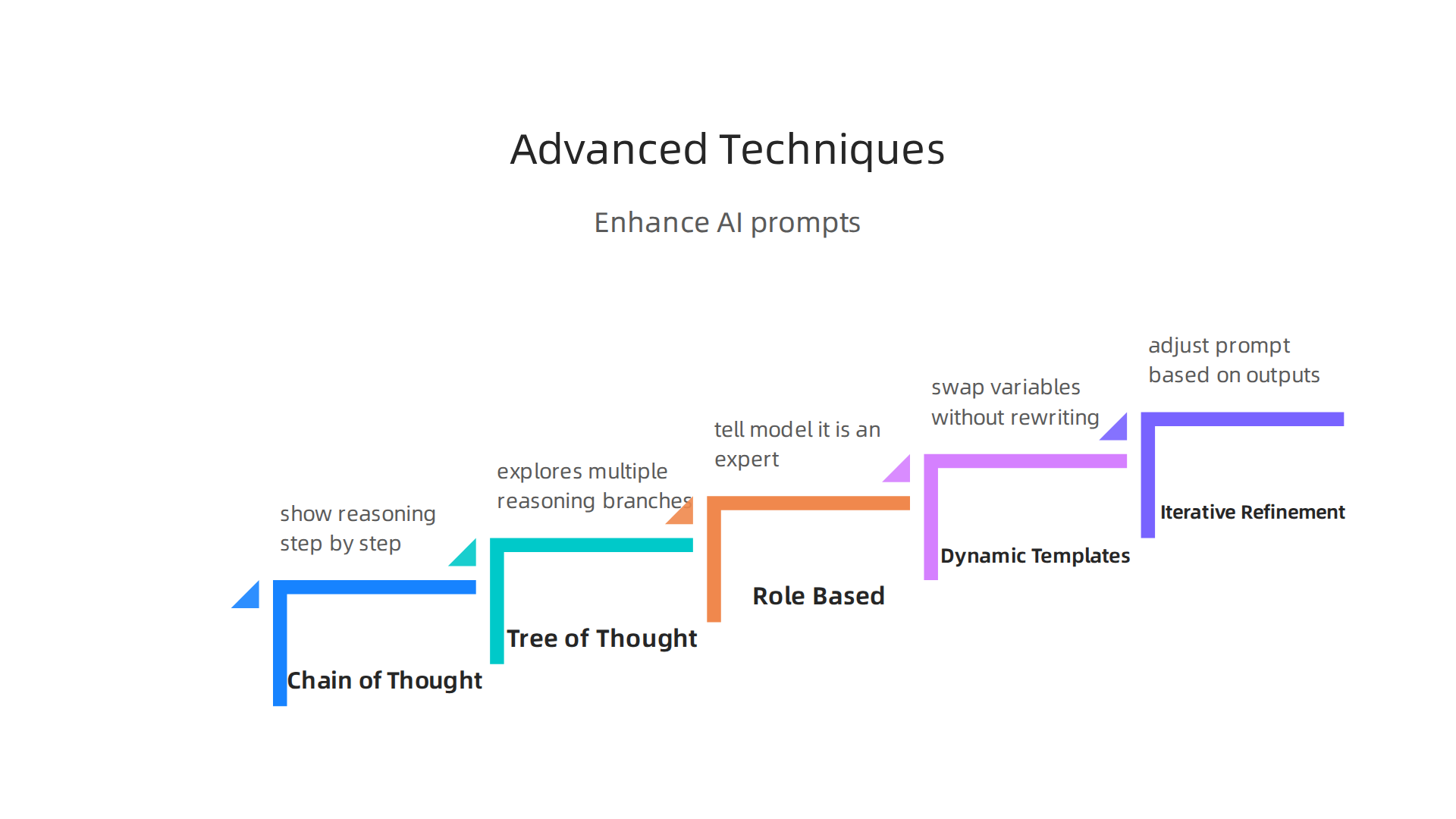
One powerful method is chain-of-thought prompting. You ask the model to show its reasoning step by step. This improves accuracy for math, logic, and complex decisions. For example, instead of asking "What is the total cost?" you prompt, "Let’s calculate step by step: first find the base price, then add tax, then apply the discount." This technique is widely used by pros in 2026 to get more reliable outputs. The complete guide to prompt engineering in 2026 explains how to apply chain-of-thought effectively.
Tree-of-thought prompting takes this further. The model explores multiple reasoning branches at once. It picks the best path and shares that answer. This works well for planning tasks and creative problem-solving. The advanced prompt engineering techniques guide covers how to set up tree-of-thought prompts.
Role-based prompting also helps a lot. You tell the model it is an expert data scientist, a sales analyst, or a customer support rep. This focuses the output on the right tone and detail level. According to IBM’s 2026 guide to prompt engineering, role-based prompts reduce guesswork for the model and yield more consistent results.
Next, consider dynamic prompt templates. These let you swap variables like product name, date, or region without rewriting the whole prompt. Iterative refinement means you adjust the prompt based on the outputs you see, slowly improving results. The advanced prompt engineering course teaches how to build templates that work across different tools.
Finally, each no-code ML platform has its own settings. In Vertex AI, you can adjust temperature and system messages. In Azure, you can control context length. These small tweaks matter a lot. For example, lowering temperature makes outputs more predictable. Raising it adds creativity.
All these techniques build on skills you can learn through Google prompt engineering courses. They help you generate undetected ai content that reads naturally and upscale ai outputs for better quality. The goal is to make your prompts work smarter, not harder, so you spend less time fixing and more time building.
Real-World Applications and Case Studies
All those prompt engineering techniques become powerful when you put them to work with no code ML platforms. Instead of writing code, you use drag and drop interfaces to build models that solve real business problems.

And in 2026, companies across many industries are already seeing big results.
Customer service is a top use case. Teams use no code ML to build chatbots that handle common questions automatically. These bots reduce wait times and free up human agents for harder issues. One retailer cut response time by 60 percent after launching a no code chatbot.
Healthcare is another area where no code ML shines. Hospitals use these tools for diagnostic support. For example, they train models to flag unusual patterns in medical images. No coding required. According to a 2026 guide on no code AI, healthcare providers are using these platforms to speed up analysis and reduce human error (Kanerika).
Marketing personalization also gets a boost. With no code ML, you can build models that predict what products a customer will like. Then you serve them personalized recommendations. This leads to higher sales and better customer satisfaction. The same guide notes that businesses see big improvements in conversion rates after deploying no code models.
Supply chain optimization is another win. Companies use no code ML to forecast demand, manage inventory, and plan shipping routes. A logistics firm reduced waste by 30 percent using a simple no code forecasting model.
The benefits go beyond just getting results. No code ML saves time and money. Instead of hiring a team of data scientists, you can train one person to use a no code platform. Development cycles drop from months to days. A 2026 report on no code transformations found that businesses are adopting these tools to stay competitive and cut costs (Integrate.io).
Industries like finance and retail report especially high ROI. Banks use no code ML to detect fraud faster. Retailers use it to optimize pricing. The combination of speed, low cost, and accuracy makes these tools a smart investment.
If you want to build these skills for yourself, you can start with the same advanced prompting techniques we covered above. Then explore a no code ML platform to apply them. For a deeper dive into the skills that power this work, check out Google prompt engineering courses that can help you level up. The future of AI is hands on, and with no code ML, anyone can join in.
Overcoming Common Challenges in No-Code ML
No code ML makes machine learning accessible, but it is not without hurdles. The same tools that let you drag and drop your way to a model also bring new problems you need to solve.
Knowing those challenges upfront saves you time and frustration.
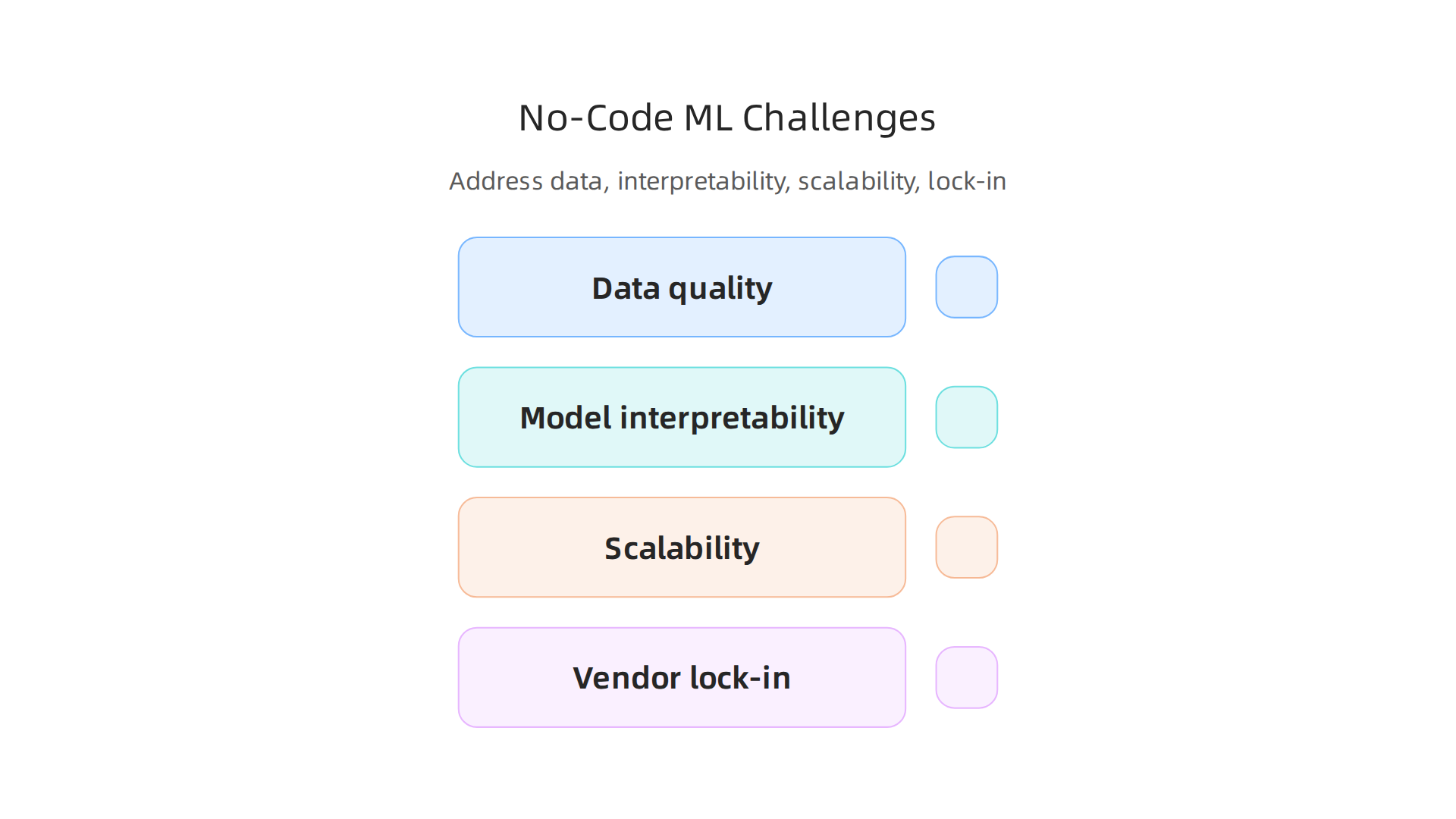
The biggest challenge is data quality. No code platforms are good at processing data, but they cannot fix bad data for you. If your dataset has missing values, duplicates, or wrong labels, your model will learn the wrong patterns. A 2026 report on no code transformations found that data quality issues remain the top reason models fail in production (Integrate.io). The fix is simple but critical: clean your data before you import it.
Model interpretability is another common pain point. When your model makes a decision, you want to know why. Some no code platforms show you feature importance charts, but others give you a black box. This becomes a big deal in regulated industries like finance and healthcare. You need to pick a platform that offers clear explanations for every prediction. The 2026 guide on no code AI emphasizes that interpretability tools are a must have for any serious project (Kanerika).
Scalability can trip you up too. A model that runs fine on a small dataset might slow down or crash when you feed it real world data. Your no code ML platform needs to handle growing data volumes without breaking. Look for platforms that offer cloud based scaling options. And always test your model with larger datasets before you launch.
Vendor lock in is a longer term risk. Once you build everything inside one no code platform, moving to another tool can be painful. Your workflows, configurations, and trained models may not transfer easily. A good strategy is to keep your data portable and use platforms that support standard export formats. The 2026 trends analysis on low code and no code highlights that interoperability is becoming a key evaluation criterion for businesses (CodeWave).
So how do you overcome these challenges? Start small. Pick one simple use case first. Spend the extra time on data preparation. Use a hybrid approach where you combine no code ML with traditional code when you need more control. And always include human in the loop validation. Have a person review model outputs before you trust them fully.
Expert advice recommends robust testing at every stage. Do not launch a model and walk away. Test it, retest it, and monitor its performance over time. This is where having strong foundational skills helps. If you want to build a deeper understanding of how models work under the hood, check out Google prompt engineering courses that teach you the thinking behind effective AI workflows. The better you understand the core concepts, the easier it is to troubleshoot no code ML problems.
No-Code ML in Enterprise Environments
Big companies are jumping into no-code ML to speed up innovation without sacrificing control. In 2026, enterprise teams are using these tools to build models faster while keeping risk and compliance in check. But doing it right requires more than just picking a platform.
The first big consideration is data governance. Enterprise data is sensitive, and your no-code ML platform needs to handle it securely. You need role based access, encryption, and audit trails. The enterprise machine learning platform guide for 2026 emphasizes that governance should be a core feature, not an afterthought (Dataiku).
Security is another must. When you give business teams direct access to ML tools, you open up new risks. Your platform should enforce data privacy policies and protect customer information. The best no-code AI platforms for 2026 include enterprise grade security as a baseline (Kissflow).
Integration with existing IT infrastructure is the third piece. Your no-code ML models need to connect with data warehouses, CRMs, and APIs. A platform that fits your current stack saves major headaches. The low code no code platform comparison for 2026 ranks integration ability as a top buying factor (DesignRevision).
So what makes enterprise adoption successful? Two things matter most: a center of excellence and cross functional teams. A center of excellence sets standards, reviews models, and trains employees. Cross functional teams bring together data engineers, business analysts, and compliance officers. This mixture ensures models are both useful and safe.

If you want to lead a no-code ML initiative, build your foundational skills. Start by learning how AI models work under the hood. Google prompt engineering courses teach you to craft better prompts that improve model outputs. This skill transfers directly into no-code ML workflows. Also explore how complementary technologies like undetected ai detection and upscale ai upscaling tools integrate with your ML pipelines. Knowing the full ecosystem helps you choose the right platform.
For engineers looking to go deeper, explore online certifications for software engineering. These credentials build your understanding of system architecture and make you a smarter platform evaluator.
Remember, enterprise no-code ML is a team sport. Get leadership buy in, set clear governance, and start with a small use case that delivers visible business value. Expand from there.
Future Trends and Opportunities for Developers
The line between traditional coding and no-code ML is fading fast. By 2026, Gartner predicts that 70% of new enterprise applications will use low-code or no-code technologies (Integrate.io). That shift creates huge opportunities for developers. You don’t have to choose between being a coder and a no-code builder. You get to do both.
Here is what the trend means for you.
No-Code Meets Traditional Code
No-code ML platforms are not replacements for software engineering. They are extensions. You will increasingly wire together no-code models with traditional backend services, APIs, and frontend apps. The no-code interface handles the model building. You write the glue code. This hybrid approach speeds up delivery without losing control. The best low-code and no-code platforms in 2026 are designed to slot right into existing development pipelines (Codewave).
Skills That Will Set You Apart
Two skills will matter most in this new landscape: prompt engineering and AI orchestration.
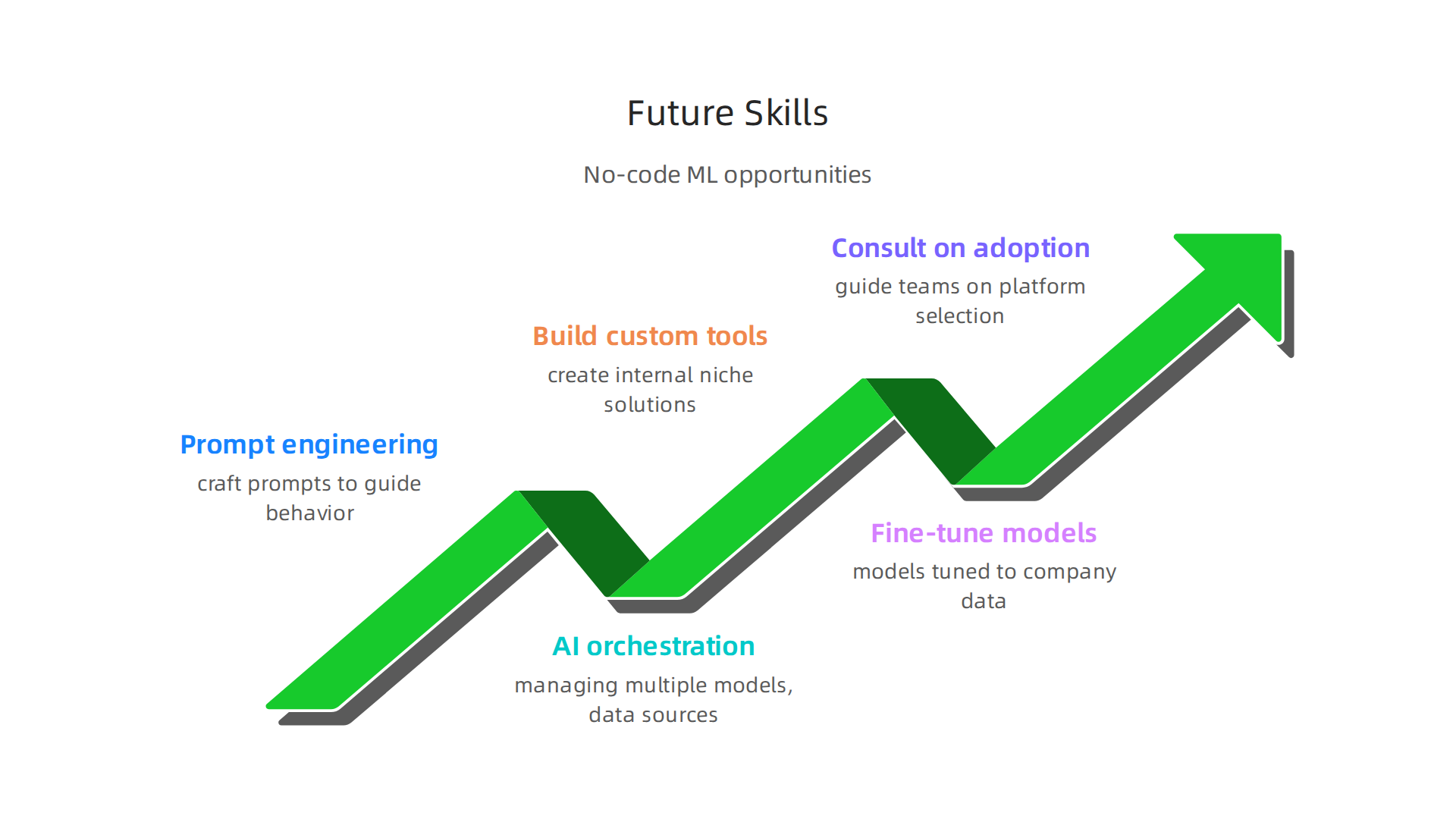
Prompt engineering is not just for ChatGPT users. In no-code ML, you craft prompts to guide model behavior, tune outputs, and control data transformations. Taking Google prompt engineering courses builds this skill fast. It directly improves your ability to get great results from no-code tools.
AI orchestration means managing multiple models, data sources, and automation steps in one workflow. As machine learning trends for 2026 point to Agentic AI and MLOps, knowing how to orchestrate becomes a superpower (SoftTeco). You will coordinate models that handle detection, upscaling, and prediction.
Where You Can Build Your Career
The opportunities fall into three buckets.
1. Build custom no-code tools. Businesses need niche solutions that commercial platforms do not offer. You can create internal tools for undetected ai detection workflows or custom upscale ai upscaling pipelines. Wrap them in simple no-code interfaces.
2. Fine-tune models for specific use cases. Pre-built models are generic. Companies want models tuned to their data. Your ability to fine-tune using no-code platforms will be highly valued.
3. Consult on adoption. Enterprises need experts who understand both the business side and the technical side. You can guide teams on platform selection, governance, and integration.
To stay ahead, invest in your learning today. Online certifications for software engineering build the foundation you need to thrive in this hybrid world.

The future belongs to developers who can bridge code and no-code. Be one of them.
Summary
This article explains how no-code machine learning democratizes AI by letting non-engineers build, train, and deploy models using visual tools and pre-trained components. It covers the core features of no-code ML platforms, why prompt engineering is the essential skill for getting reliable results, and practical advanced techniques like chain-of-thought, tree-of-thought, and role-based prompting. The guide compares leading platforms and shows how to pick one based on use case, integration, and budget, while highlighting real-world applications in customer service, healthcare, marketing, and supply chain. It also outlines common challenges—data quality, interpretability, scalability, and vendor lock-in—and gives enterprise best practices around governance and security. Finally, the article maps future trends and career opportunities for developers who bridge traditional coding with no-code ML workflows.