

Introduction: Why Comprehensive IT Services Matter More Than Ever
Picture this: you are an engineering leader juggling hybrid cloud infrastructure, AI integration, and growing security threats all at once.

Your team is already stretched thin. Every new tool adds another layer of complexity. This is the reality for most organizations in 2026. The modern IT environment has become a tangled web of platforms, vendors, and shifting priorities.
That is where comprehensive IT services come into play. A well-rounded IT services strategy brings everything together under one roof. Instead of managing separate teams for cloud, security, and application development, you get a unified approach that breaks down silos. The result? Faster digital transformation and fewer headaches.
The numbers back this up. The global IT services market was valued at $1.61 trillion in 2025 and is expected to reach $3.17 trillion by 2035, according to the latest IT Services Market Size to Attain USD 3.17 Trillion by 2035 report. That growth shows how critical these services have become for companies of all sizes.
Engineering leaders face constant pressure to deliver innovation while keeping costs under control. A smart IT services strategy addresses both. It helps you focus on what matters most: building great products and supporting your users. Whether you need custom software development services or expert guidance on cloud operations, the right partner can make all the difference.
If you want to stay ahead of these trends, there is one resource worth your time. The The AI Newsletter Worth Reading delivers clear daily updates on AI and technology shifts that impact your work. It is a simple way to cut through the noise and focus on insights that matter.
And when you are ready to explore a new IT services partner, check out our guide on how to pick the right software development company for your unique needs.
What Are Comprehensive IT Services? Beyond the Buzzwords
When you hear "IT services," it is easy to think of a help desk or a cloud hosting plan. But that picture is way too small. In 2026, comprehensive IT services cover a much wider scope. They bundle together managed infrastructure, cloud platforms, cybersecurity, AI and machine learning tools, and strategic consulting into a single integrated package.
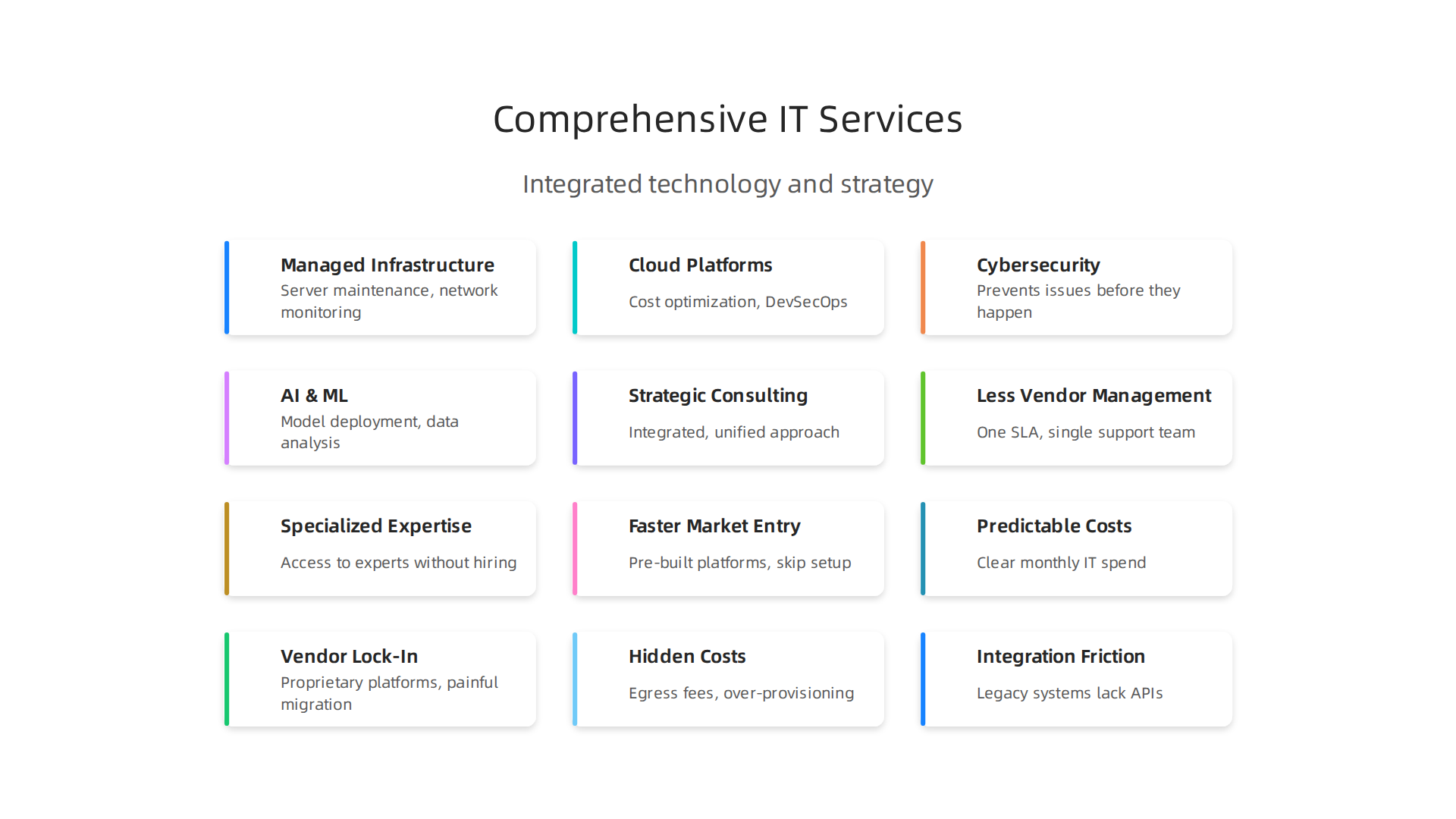
Instead of stitching together a dozen vendors, you get one partner that understands your full stack from on-premises data centers to edge devices.
What does this look like in practice? It means your IT provider handles everything from server maintenance and network monitoring to cloud cost optimization, DevSecOps pipelines, and AI model deployment. They do not just fix problems after they happen. They build systems that prevent issues in the first place. That is the difference between point solutions and a true comprehensive approach. Point solutions solve one problem at a time. Comprehensive IT services ensure everything works together.
According to a detailed IT services market report, the industry is broken into categories like design and implementation, operations and maintenance, and technologies such as AI and machine learning, big data analytics, and threat intelligence. This breakdown shows just how broad the field has become. And the numbers back it up: the global IT services market is projected to grow past $3 trillion by the mid-2030s.
The line between traditional IT services and SaaS is also blurring fast. Modern offerings now include built-in platform engineering and DevSecOps capabilities. That means your vendor does not just give you servers to rent. They give you a complete environment where your teams can build, deploy, and secure applications without switching between disconnected tools. This shift is especially important if you need custom software development services or operate in regulated industries like healthcare, where custom medical software development services demand strict security and compliance from day one.
Even software testing is getting baked into the service layer. A good software testing services company no longer works in a silo. Instead, testing becomes a continuous part of the delivery pipeline, automated and integrated with the rest of your stack. The result is faster releases and fewer production bugs.
To stay on top of how platform engineering and AI are reshaping development, check out our guide on engineering technology trends in 2026. It covers exactly how these capabilities are becoming standard in modern IT services.
Core Components of a Comprehensive IT Service Portfolio
So what actually goes into a modern IT service portfolio? If you strip away the buzzwords, three pillars hold everything up. Cloud infrastructure makes the foundation. AI powered operations and integrated cybersecurity keep it safe and smart. And managed DevOps with platform engineering lets your teams move fast without breaking things.
Let us break down each one so you know exactly what to look for when evaluating a provider.
Cloud Infrastructure: More Than Just Rentable Servers
Cloud infrastructure used to mean a few virtual machines and a storage bucket. That is not enough anymore. In 2026, a strong IT service portfolio covers infrastructure as a service (IaaS) and platform as a service (PaaS) as the starting point. But it also includes serverless computing, edge computing nodes, and multi cloud orchestration as standard features.
Why does this matter? Because your applications do not live in one place anymore. You might have a core database on AWS, a serverless function on Azure for bursty workloads, and edge devices running code near your users through Cloudflare or similar providers.
A good IT services partner manages all of those environments from a single dashboard. They handle cost optimization, scaling policies, and failover without you touching anything.
Modern tech stacks also demand containerization and orchestration. Docker and Kubernetes are no longer optional for most teams. A comprehensive provider should offer managed Kubernetes clusters, automated scaling, and integrated monitoring. According to the guide on top software development tech stacks for 2026, cloud platforms like AWS, Azure, and Google Cloud are central, but so are tools like Terraform for infrastructure automation and CI/CD pipelines for deployment. A provider that bundles these together saves your team weeks of setup time.
If you are curious about the latest announcements in cloud computing, check out our summary of key trends from AWS re:Invent 2026 for cloud engineers. It covers exactly how these cloud capabilities are evolving.
AI Powered Operations (AIOps) and Integrated Cybersecurity
The second pillar is where intelligence meets protection. Traditional IT services react to problems. Modern services predict and prevent them. AIOps uses machine learning to analyze logs, metrics, and events across your entire stack. It spots anomalies before they become outages and automates common fixes like restarting a service or scaling a database.
Cybersecurity is no longer a separate add on. It is baked into every layer. Zero trust architecture means no user or device is trusted by default, even inside your network. Secure Access Service Edge (SASE) combines network security with wide area networking, giving remote workers secure access without routing everything through a central data center. A comprehensive IT services provider should offer both as part of the package, not as pricey extras.
The business case for these security models is strong. Research on the business case for SASE measuring its true ROI shows that enhanced productivity and secure access for remote workforces are top benefits. In a world where hybrid work is the norm, you cannot afford gaps in your security posture.
Managed DevOps and Platform Engineering
The third pillar is about speed. Your internal developers should spend their time building features, not fixing broken pipelines or configuring servers. Managed DevOps services take care of the toolchain so your team can focus on product velocity.
What does this look like in practice? The provider handles CI/CD pipeline setup and maintenance, infrastructure as code templates, secrets management, and deployment automation. They also bring platform engineering capabilities, meaning they build an internal developer platform that your teams consume like a product. This platform includes self service access to environments, monitoring dashboards, and standardized deployment workflows.
For teams building custom software, this integration is huge. Imagine your software testing services company partner automatically runs tests in a staging environment every time a developer pushes code. No human handoffs. No delays. That is what managed DevOps delivers.
To see how these concepts fit into broader engineering strategies, read our context engineering guide for agile and DevOps teams. It explains how to align platform engineering with your team’s workflows.
How These Three Pillars Work Together
A single provider that delivers cloud infrastructure, AIOps with zero trust security, and managed DevOps gives you a single point of accountability.

You do not have to blame three vendors when something breaks. You get one SLA, one billing relationship, and one team that understands your full stack.
That is the real value of comprehensive IT services. It is not just about checking boxes. It is about creating a system where every component supports the others. Cloud resources auto scale based on AI predictions. Security policies automatically update when new threats emerge. Developers deploy code through a platform that enforces best practices without slowing them down.
When you evaluate providers in 2026, look for these three pillars. If any one is missing or weak, your portfolio has a hole. And in today’s fast moving tech environment, holes become expensive problems fast.
Key Benefits for Engineering Teams and Enterprise Organisations
If you have ever tried juggling three different vendors for cloud, security, and DevOps, you know the pain. Each one has its own dashboard, its own support team, and its own SLA. When something breaks, you spend hours just figuring out who to call. A comprehensive IT services portfolio fixes that.
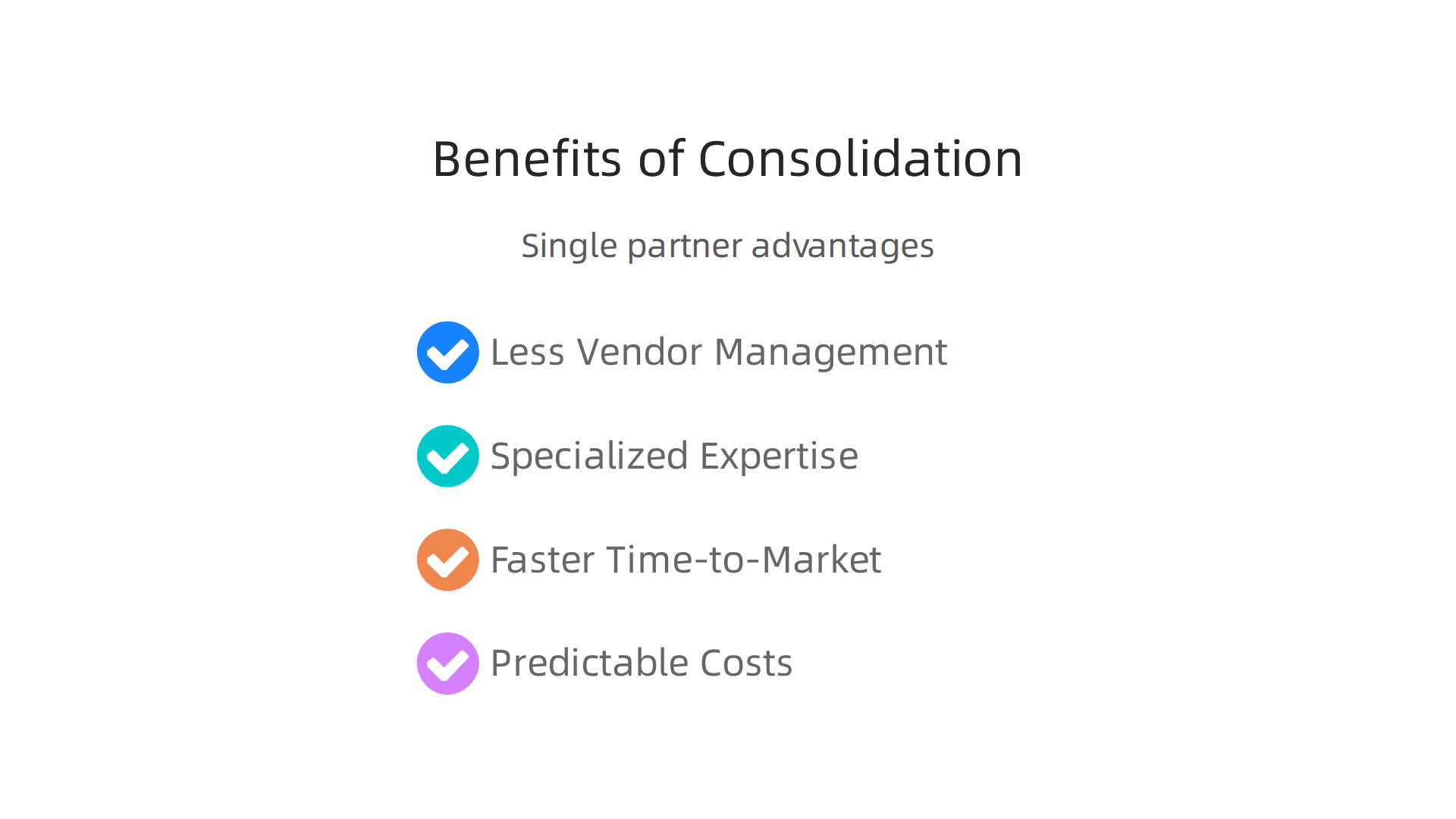
Here are the biggest benefits your team gets when you consolidate under one partner.
Less Vendor Management, Faster Incident Response
The first and most obvious win is simplicity. One provider means one SLA, one billing relationship, and one support team that knows your entire stack. When an incident happens, you make one call. The provider already understands how your cloud infrastructure, security policies, and deployment pipelines interact. That cuts mean time to resolution dramatically.
But the savings go beyond just response time. Research on calculating the ROI of managed services shows that 46% of organizations that use managed services cut their annual IT budgets by 25% or more. Fewer vendor relationships mean less overhead in procurement, contract management, and onboarding.
Access to Specialized Expertise Without Hiring
Hiring in-house experts in AI, DevOps, zero trust security, or cloud architecture is expensive and slow. A good IT services provider already has a bench of specialists. You get access to that expertise as part of your monthly fee.
This is especially valuable for teams working on custom software development services. If you need to build a healthcare platform, for example, you might need custom medical software development services that meet strict compliance rules. A provider with deep experience in that area can guide you through regulations like HIPAA without you hiring a compliance expert full time. You can learn more about evaluating partners like this in our guide on how to pick the right software development company in 2026.
Faster Time-to-Market Through Pre-Built Platforms
When your provider already has managed Kubernetes clusters, CI/CD pipelines, and monitoring dashboards ready to go, your team does not start from zero. You skip weeks of setup and configuration.
The managed services market report 2026-2031 shows that companies using managed services see significant acceleration in software release cycles. Instead of building tooling, your engineers build features. That is the difference between launching in six months versus three.
For engineering teams that need to move fast, this is a game changer. Your software testing services company partner, for instance, can plug directly into your provider’s deployment pipeline and run automated tests on every commit. No extra tooling required.
Predictable Costs and Better Budgeting
With a single provider, you know exactly what your IT spend will be each month. No surprise bills for emergency support or unplanned hardware upgrades. That predictability makes it easier to plan larger investments, like adopting a new AI platform or expanding into a new market.
If your team is exploring new technologies, staying informed is critical. You can get clear daily AI updates from The AI Newsletter Worth Reading to keep your knowledge current without spending hours researching.
When you choose a comprehensive IT services partner, you are not just buying components. You are buying speed, expertise, and peace of mind.

The benefits show up in your bottom line and in your team’s ability to focus on what really matters: building great software.
How to Evaluate and Select the Right IT Service Provider
Knowing the benefits is one thing. Finding the right partner is another. Here is how to evaluate IT service providers so you make a choice that lasts.
Look at Their Roadmap for AI, Security, and Modular Design
A great provider does not just fix today’s problems. They plan for tomorrow. Ask for their product roadmap. Does it show clear plans for AI integration? Can they explain how they will help your team use AI tools in your workflows? Do they have a plan to keep your security posture strong?
Security certifications like SOC 2 and ISO 27001 are table stakes. But deeper than that, you want a provider who treats security as an ongoing practice, not a checkbox. The 2026 guide on evaluating managed security providers explains that real-world response performance matters more than just having the right tools.
Also look for modular service architecture. You do not want to buy a huge package when you only need cloud support and security monitoring. A modular provider lets you start small and add services as you grow.
Check Cultural Fit: Does the Provider Get How You Work?
Your engineering team probably uses Agile, Scrum, or platform engineering practices. If your provider does not understand those, you will fight friction every day.
During conversations, ask how they handle sprint planning. Ask if they have experience with platform engineering teams. The best providers adapt to your methodology instead of forcing you into theirs. You can read more about how modern engineering workflows are evolving in this guide on engineering technology trends in 2026.
If you need custom software development services, confirm the provider has engineers who have worked in your specific domain. For example, a software testing services company that integrates into your CI/CD pipeline will save you time. Make sure they speak your language, both technically and culturally.
Use a Weighted Scorecard to Compare Options
Do not pick a provider based on a single sales call. Create a weighted scorecard that covers four areas: technical capabilities, SLAs, pricing transparency, and reference checks.

Give each area a weight based on what matters most to your team. For example, if uptime is critical, give SLA performance a higher weight. If you are on a tight budget, weight pricing transparency more heavily.
The 2026 IT vendor management best practices guide recommends using a structured scorecard to compare vendors without bias. Include questions like:
- What is your average response time for urgent issues?
- Can you share a sample SLA with defined uptime, resolution times, and penalties?
- Do you offer transparent tiered pricing or flat monthly fees?
- Can I speak to two or three current clients with similar project needs?
Run away from providers who refuse to put SLAs in writing or cannot give local references. A good partner will welcome your questions.
When you evaluate with a clear scorecard, you remove guesswork. You end up with a partner who fits your needs today and can grow with you tomorrow.
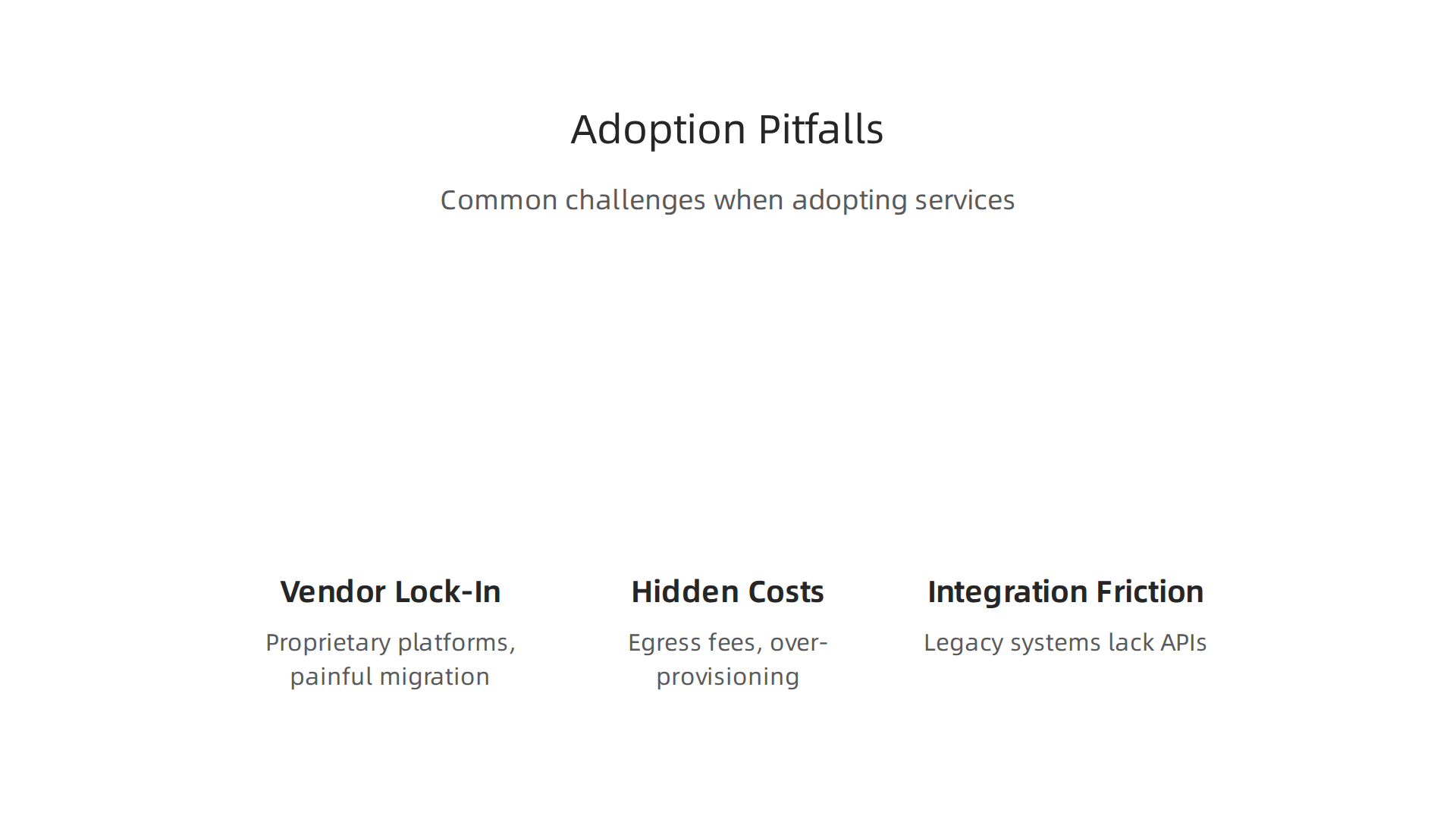
Common Challenges and Pitfalls When Adopting Comprehensive IT Services
Bringing on a full suite of IT services can transform your business. But the road is not always smooth. Many teams run into serious problems after signing the contract. Knowing what can go wrong helps you avoid it.
Vendor Lock-In and Migration Complexity
One of the biggest risks is vendor lock-in. Some providers build their services on proprietary platforms. That might mean a custom PaaS or a managed AI tool that only works inside their ecosystem. Once your data and workflows are tied to their platform, leaving becomes painful and expensive.
Migration out of these systems can take months. You may face data export fees, compatibility issues, and downtime during the switch. The 2026 guide to managed service provider challenges in 2026 points out that fear of vendor lock-in makes many companies hesitate to commit to a single provider. Always check if the provider uses open standards and lets you take your data with you.
Hidden Costs That Surprise You
The sticker price is never the whole story. Three common hidden costs catch teams off guard.
First, data egress fees. Cloud providers often charge you to move data out of their systems. If your IT services include heavy data processing, these fees add up fast.
Second, over-provisioning. You might buy a large service package when you only need a few features. Modular pricing helps, but some providers bundle services you do not use.
Third, change management expenses. Training your team, updating internal processes, and dealing with temporary productivity drops all cost money and time. A good provider will be transparent about these. The complete guide to managed IT services in 2026 recommends asking for detailed pricing before signing anything. Do not settle for vague estimates.
Integration Friction with Legacy Systems
Your existing on-premises systems were not built to talk to modern managed services. That causes friction. Legacy databases, custom software, and older hardware often need custom connectors or middleware to work with new cloud tools.
This is especially true if you rely on custom software development services. Those internal apps may lack APIs or use outdated protocols. A software testing services company might also struggle to integrate automated tests into a provider’s pipeline if the two systems do not align. Even custom medical software development services, which must meet strict compliance rules, can create headaches when moving to a managed platform.
The fix is to ask potential providers how they handle legacy integrations during the vetting process. Some offer migration assistance or hybrid setups that keep old systems running while new ones come online. Reading up on picking the right software development company can also help you understand what to look for in a partner that supports smooth transitions.
Being aware of these challenges upfront saves you from nasty surprises. Ask the hard questions before you sign. Your future self will thank you.
Future Trends: AI, Automation, and the Next Wave of IT Services
Despite the challenges we just covered, the IT services landscape in 2026 is evolving fast. The numbers back this up. The global market is projected to grow from $1.65 trillion in 2025 to $3.29 trillion by 2033, according to the latest IT services market forecast to 2033. Three major trends are driving this growth: AI-native services, autonomous operations, and sustainability offerings.
AI-Native IT Services Become Standard
In 2026, AI is no longer an add-on. It is a core part of the service package. Leading providers now offer ModelOps, data pipeline management, and LLM hosting as first-class services. Instead of just managing servers and networks, your IT provider helps you train, deploy, and monitor machine learning models. This shift changes how custom software development services work too. Developers now build AI features directly into applications, and the IT provider handles the infrastructure underneath. If your team is exploring these changes, take a look at the latest engineering technology trends in 2026 to see how platform engineering and AI are reshaping development.
Autonomous IT Operations (AIOps) Move from Reactive to Predictive
Remember the days of waiting for a server to crash before fixing it? Those days are ending. AIOps tools now predict problems before they happen. They analyze millions of data points in real time, detect anomalies, and even resolve issues automatically. Some providers report cutting ticket volumes by 30 to 60 percent. That means fewer late-night calls for your team and more uptime for your business. The shift to predictive operations is one of the biggest changes in managed IT services this year. As the Future of Automation: Trends 2026 report explains, more organizations are using agentic AI to handle complex decisions without human input.
Sustainability as a Service Gains Traction
Green IT is becoming a real offering, not just a buzzword. In 2026, you can choose a provider that schedules your cloud workloads during times when renewable energy is abundant. They call this carbon-aware computing. Some providers also offer carbon tracking dashboards and help you meet ESG goals without lifting a finger. If your company has sustainability targets, this is a trend worth exploring. The same cloud infrastructure that powers your AI can now run greener.
These trends are not science fiction. They are happening right now. The key is to pick a provider that is already investing in them. Want to keep up with daily AI and tech developments that affect your IT decisions? Get clear daily AI updates from The Deep View Newsletter. It helps you separate signal from noise so you can plan your next move with confidence.
Summary
This article explains what modern comprehensive IT services are, why they matter, and how engineering leaders should evaluate them in 2026. It breaks the market into three practical pillars—cloud infrastructure, AI-powered operations with integrated security, and managed DevOps/platform engineering—and shows how a single provider can reduce friction across those areas. You’ll learn the concrete benefits of consolidation (faster incident response, access to specialist skills, predictable costs, and quicker time‑to‑market) and the common pitfalls to watch for, such as vendor lock‑in, hidden fees, and legacy integration issues. The piece gives actionable guidance for selecting a partner—ask for roadmaps, verify cultural fit, and use a weighted scorecard—and explains what to expect as AI, autonomous operations, and sustainability features become standard offerings. After reading, you’ll be able to assess providers against a clear checklist and make choices that keep your team focused on shipping product rather than managing toolchains.