
Introduction: Navigating the Complex Software Development Company Landscape
Finding the right software development company in 2026 is harder than it sounds.

Hundreds of firms now offer specialized services across AI, cloud computing, and embedded systems. Engineering leaders and CTOs face a tough choice: build everything in-house, outsource to a partner, or work with a niche agency.
The global software market keeps growing fast. According to the latest software development services market size and trends report, the industry was valued at over $450 billion in 2024 and is expected to nearly double by 2033. That growth brings more options but also more noise.
How do you separate a great software development company from one that just talks a good game? You need a clear way to evaluate technical skills, industry experience, and cultural fit. This guide gives you a simple framework to understand, evaluate, and select the right partner for your next project.
If you want to stay ahead of the curve on AI trends that shape modern software teams, subscribe to The AI Newsletter Worth Reading for daily updates.
We will also look at how top engineering teams build better workflows. For a deeper dive, check out our practical roadmap for engineering teams to improve your team’s productivity.
The software development landscape is complex, but you do not have to navigate it alone. Let us break it down step by step.
What Defines a Software Development Company in 2026?
Not all software companies are the same. In 2026, the term "software development company" covers a wide spectrum. You have tiny boutique shops with five engineers who specialize in one thing. You also have massive global firms with thousands of employees handling everything from strategy to deployment.
Understanding these categories helps you pick the right partner. Let us look at the main types.
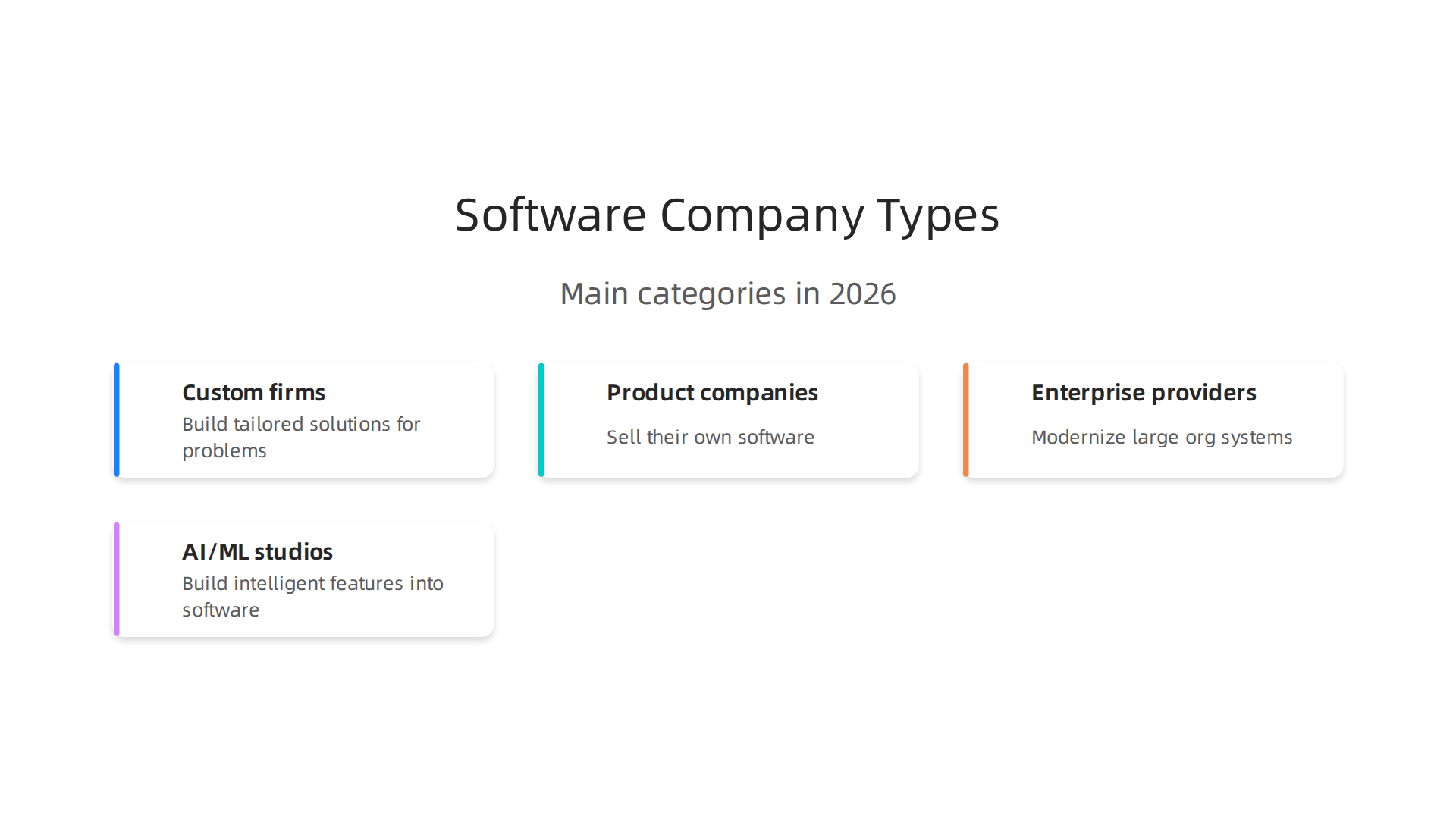
Custom software development firms focus on building tailored solutions for specific business problems. They do not sell a product. They build your idea from scratch. This segment is growing fast. The custom software development market size was valued at over $50 billion in 2026 and is expected to reach $213 billion by 2035.
Product companies have their own software they sell to customers. Think of platforms like Salesforce or Shopify. These companies usually focus on one core product and improve it over time.
Enterprise solution providers help large organizations modernize their systems. They deal with complex integrations, legacy migrations, and compliance requirements. These firms often combine development with consulting services.
AI and ML-focused studios are the new players making a big splash. They specialize in building intelligent features into software. The 2026 global software industry outlook from Deloitte notes that agentic AI adoption is reshaping how companies operate and compete.
Here is the thing: the lines between these categories are blurring. A custom development firm now offers advisory services. A product company starts building custom solutions for clients. An enterprise provider adds AI capabilities. In 2026, you need to look beyond labels and evaluate what a company can actually deliver.
Understanding these categories is just the start. To get the full picture, read our guide on engineering technology trends in 2026 and how they reshape development teams.
When you start searching for a software development company in the USA, keep these categories in mind. The right fit depends on your project size, technical complexity, and long-term goals.
The Core Pillars of a Successful Software Development Company
What separates a great software company from an average one in 2026? It comes down to three core pillars: the technology stack they use, the way they build software, and the people they hire.
Let us look at each one.
Technology stack: what tools power the work
Top companies today build with composable architectures and cloud-native microservices. Instead of one giant application, they break things into small, independent services that can scale on their own. They also use AI-augmented development pipelines to speed up coding, testing, and deployment. The languages driving this change include Python for AI, TypeScript for modern apps, and Go for cloud infrastructure. According to the list of most in-demand programming languages for 2026, TypeScript became the most used language on GitHub, while Python powers nearly half of all AI projects. A software development company in the USA that wants to stay competitive must invest in these tools.
Methodology: how teams deliver software
Agile and DevOps are still the foundation, but now teams add continuous discovery and AI-driven testing. They do not just plan sprints and release code. They constantly talk to users, run experiments, and use AI to catch bugs early. A solid DevOps workflow includes automated CI/CD pipelines, feature flags, and real-time monitoring. The DevOps best practices for agile teams guide shows a step-by-step sprint workflow that helps teams ship faster with fewer failures. In 2026, the best software companies treat methodology as a living system, not a fixed playbook.
Talent and culture: the human side of success
Technology and process mean nothing without the right people. Successful companies recruit for AI fluency, meaning developers who understand how to work with large language models and intelligent agents. They also build cross-functional teams where engineers, designers, and product managers collaborate closely. And remote-first operations are now a standard expectation, not a perk. To attract and keep top talent, firms need to offer real growth opportunities. Our guide on software developer skills for 2026 breaks down the exact capabilities candidates need to stand out.
These three pillars stack together. A strong tech stack enables fast methodology. A smart methodology supports developer culture. Great culture attracts the talent that pushes the stack forward. When all three work well together, you get a software development company that delivers reliably, innovates constantly, and earns long-term trust.
If you want to stay current on the technology trends that shape these pillars, consider The AI Newsletter Worth Reading. It delivers clear daily AI updates straight to your inbox.
Key Trends Shaping the Software Development Company Ecosystem
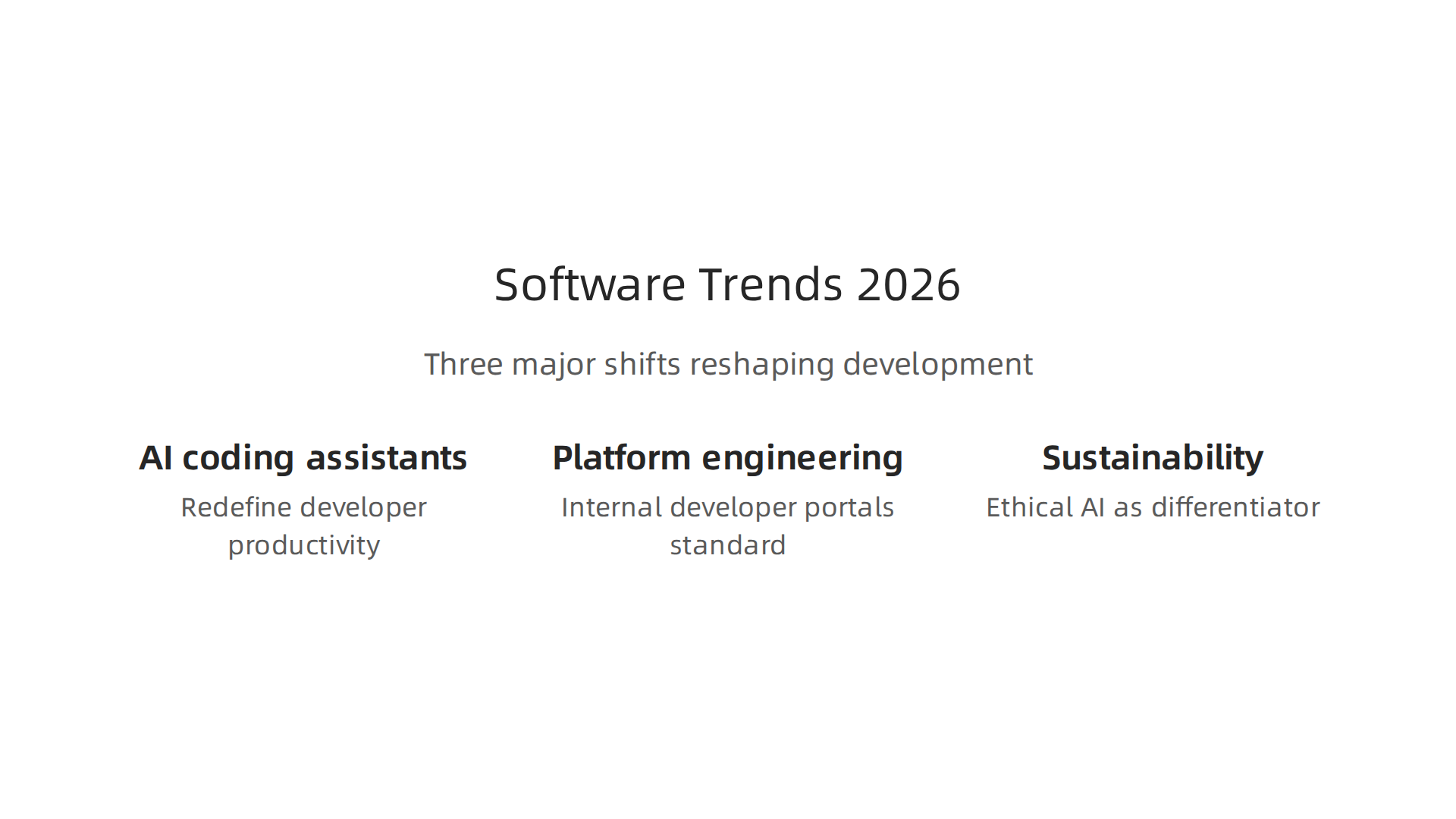
The software development industry is moving fast in 2026. Three major shifts are changing how any software development company operates, hires, and delivers value.
Understanding these trends helps you choose the right partner or build a stronger internal team.
AI coding assistants and generative AI redefine developer productivity
AI is no longer just an experiment on the side. It is now a central part of how code gets written. In 2025, roughly 41% of all new code was AI-generated. A recent analysis of the Software Development Trends 2026 guide reports that 90% of organizations now use AI in their development workflows and over 80% see measurable productivity gains. That is a huge shift. A software development company that ignores AI tools will struggle to keep pace. Developers today need to know how to work alongside AI agents just as much as they need to know a programming language. We rounded up the best options in our breakdown of AI tools for developers in 2026 to help you get started.
Platform engineering and internal developer portals become standard
Here is a problem many growing teams face. Developers waste hours each week setting up environments, managing permissions, and navigating messy toolchains. That cognitive load slows everyone down. Platform engineering fixes this by creating a single internal developer portal that handles the heavy lifting. Teams get self-service access to infrastructure, deployment pipelines, and monitoring tools without needing to wait on operations. The Top 5 Software Development Trends in 2026 list names platform engineering as one of the key shifts reshaping how it companies ship software. It reduces friction and lets engineers focus on building, not configuring.
Sustainability and ethical AI emerge as real differentiators
This is a trend that does not always get attention but matters more every year. Green software practices are gaining real traction. Companies that optimize their code for energy efficiency cut costs and lower their carbon footprint at the same time. Ethical AI is also becoming a brand advantage for any forward-looking software company in USA markets and beyond. Clients increasingly want to work with a software development company that builds responsible systems, not just fast ones. As one industry report notes, Development Trends 2026: What’s Actually Changing and Why It Matters points out that inefficient systems waste money and carbon together. Sustainable practices reduce both.
For a deeper look at how AI and platform engineering are reshaping the industry together, check out our complete guide on AI and platform engineering trends.
How to Evaluate and Choose a Software Development Partner
Choosing the right partner for your next project can feel overwhelming.

You want someone who delivers quality work, communicates clearly, and stays on budget. But how do you separate a great software development company from one that just looks good on paper?
Start with a clear set of criteria. Look at technical expertise first. Does the team have deep experience with the specific technologies you need? Then check domain experience. Have they built similar products for your industry before? Cultural fit also matters a lot. You want a partner whose work style and communication habits match yours. And pricing transparency is a must. Vague estimates and hidden fees are big red flags.
Case studies are helpful, but they only tell one side of the story. Go deeper. Ask for recent work samples that match your project complexity. Request direct client references and call them. Ask about team stability. A high turnover rate can derail your project. A solid guide on choosing a software development partner in 2026 suggests checking things like GitHub contributions and open-source participation to see real technical depth.
To make sure you pick the right fit, use a multi-phase vetting process.
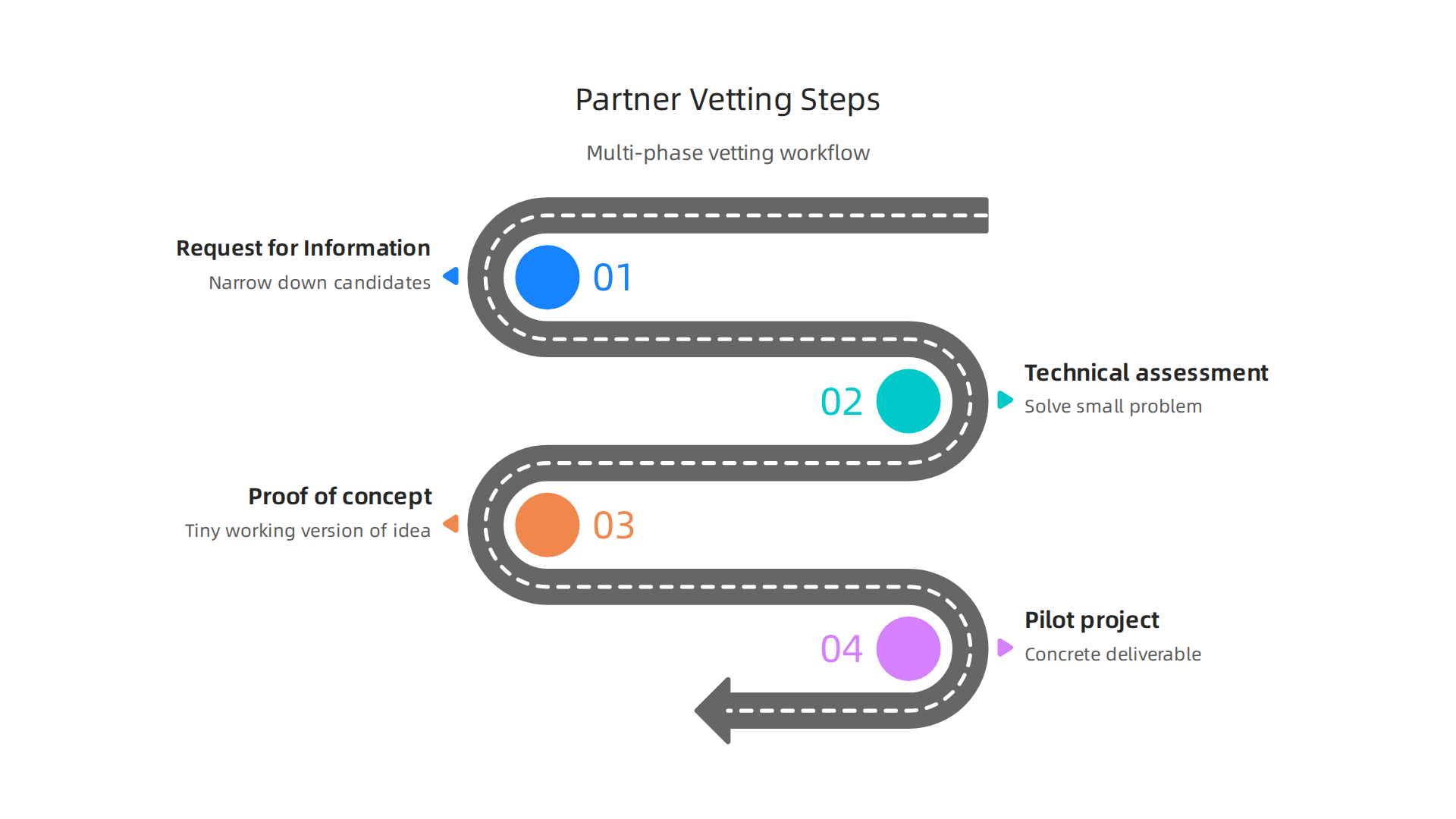
It protects both sides and builds trust before big commitments. Start with a simple request for information (RFI). That helps you narrow down candidates. Then move to a technical assessment where the partner solves a small problem related to your project. After that, ask for a proof of concept (a tiny working version of your idea). Finally, run a short pilot project with a concrete deliverable. This phased approach shows you how the team actually works under real pressure.
When you are evaluating the partner’s technical team, it also helps to know what skills modern developers need. Check out our roundup of software developer skills in 2026 to see what strong engineers should bring to the table.
Staying current is part of the evaluation too. The best partners adopt new tools and practices early. To keep yourself informed about AI trends that affect development, consider subscribing to The AI Newsletter Worth Reading for daily, clear updates that help you ask smarter questions during the vetting process.
Building In-House vs. Outsourcing: Strategic Considerations for 2026
One of the biggest decisions you will face is whether to build your own internal team or work with an external software development company.

Both paths have real trade-offs, and the right answer depends on your goals, timeline, and resources.
An in-house team gives you full control. You own the intellectual property completely. Your engineers live and breathe your product every day. Communication is fast because everyone sits in the same meetings or Slack channels. There is no vendor contract to manage and no handoff delays slowing you down. But building a team from scratch takes serious time and money. You have to hire, train, and build a strong engineering culture. That is not something you can rush. You also need to keep those engineers busy even when project demands slow down. That overhead adds up fast and can drain your budget during quiet periods. For many companies, the investment in full-time hires only makes sense when they have a steady, long-term pipeline of work.
Outsourcing flips those trade-offs. An external partner can scale up quickly and bring niche skills that are hard to find locally. Many software companies in the USA work with offshore teams to reduce costs while accessing top global talent across different time zones. The catch is coordination. Language barriers and cultural differences can slow things down if not managed well. You also need strong contracts and clear requirements to protect your intellectual property. Trust and transparency become critical from day one. Research on choosing a software development partner shows that around 20% of outsourcing partnerships fail within two years, often because of poor communication and misaligned expectations. The key is to vet partners carefully and invest in the relationship early.
Here is what smart teams are doing in 2026. They are adopting a hybrid model. Keep a small, strong core in-house team that owns the product vision and architecture. Then bring in external partners for specific needs like scaling up quickly, launching a new feature, or accessing rare technical skills. Many IT companies now offer flexible engagement models that make this easier than ever. This approach gives you the best of both worlds. You maintain strategic control while staying flexible on costs and capacity. It also reduces risk because you are not fully dependent on one model.
To make this work, you need to know what skills your core team should have. Understanding the most important software developer skills in 2026 helps you decide which roles to fill internally and which to outsource.
The hybrid model also means you need to stay informed about new tools and AI trends that affect how teams collaborate. If you want to keep up with these changes without the noise, The AI Newsletter Worth Reading delivers clear daily updates that help you make smarter partnership decisions.
Future-Proofing Your Software Development Strategy
Building a strong hybrid team is a smart start. But in 2026, that alone is not enough. The software market is growing fast. The global software development market is estimated at $578 billion in 2026 and is expected to nearly double by 2033. To stay ahead, you need a strategy that can handle constant change.

Here are three areas to focus on.
Invest in Continuous Learning
Technology moves faster every year. What worked in 2024 might be outdated by 2027. Your team needs to keep learning. AI fluency is now a must. A 2026 survey found that 67% of organizations have already adopted AI and machine learning in their development workflows. Low-code and no-code platforms are also taking off. Gartner predicted that 70-75% of new enterprise applications would be created using these tools by 2026. Your developers do not need to become experts in every tool, but they should understand how to use AI copilots, spot good low-code options, and handle basic cybersecurity risks. The security trend is growing fast too. Zero-trust security adoption jumped to 51% in 2026. Make learning part of your weekly rhythm, not a once-a-year training event.
If you want to know which skills matter most right now, check out this guide on the most important software developer skills in 2026. It breaks down what your team should focus on this year.
Adopt Flexible Architectures
Rigid systems break under pressure. In 2026, smart teams build with flexibility in mind. That means using composable and headless architectures. Instead of one giant application, you break things into smaller, independent pieces that can be swapped out or updated without touching everything else. Cloud-native development has become the default. Gartner predicted that 95% of new digital workloads would run on cloud-native platforms by 2026. Microservices, serverless functions, and API-first design let you adapt quickly when the market shifts. If a new AI tool appears, you can plug it in without rewriting your whole stack. If a customer needs a new feature, you can launch it fast. Flexible architectures also make it easier to work with external partners because each piece is independent.
Build a Culture of Experimentation
Finally, stop guessing and start measuring. The best software companies in 2026 treat innovation like a science. They run small experiments, test ideas with real users, and use data to decide what to keep. This means adopting frameworks like DORA metrics. Track deployment frequency, lead time, change failure rate, and recovery time. These numbers tell you if your team is getting faster without breaking things. Also, measure developer experience. If your engineers are burned out or stuck in meetings, innovation slows down. Create space for experiments. Give teams time to try new tools or approaches without fear of failure. When something works, scale it. When it fails, learn fast and move on.
By focusing on learning, flexible architecture, and a culture of experimentation, your software development strategy will not just survive 2026. It will thrive.
Summary
This guide explains how to find and evaluate a software development company in 2026, when choices range from boutique custom shops to global enterprise providers and AI-focused studios. It covers the core pillars that distinguish top firms—technology stack, delivery methodology, and talent/culture—then reviews three major trends (AI-augmented coding, platform engineering, and sustainability) that change how teams work. You’ll get a practical vetting process (RFI, technical assessment, POC, pilot), criteria for judging technical depth and domain fit, and a clear discussion of build vs. buy trade-offs, including the hybrid model many teams now prefer. Finally, the guide shows how to future-proof your strategy with continuous learning, flexible architectures, and a culture of experimentation so you can select partners who deliver reliably and scale with your business.