
Introduction: The Developer Experience Revolution
Have you ever watched a strong engineering team struggle to ship simple features? The code is fine. The people are smart. Yet something feels slow and frustrating. That friction is a developer experience problem, and in 2026 it has become one of the most important competitive advantages a company can build.
Developer experience (DX) is the set of conditions that shape how engineers work every day. It includes how fast code moves through review, how much mental effort a task requires, and how easily a developer can focus without interruptions. These aren’t soft metrics. They predict whether your team will burn out, churn out, or ship at full speed.
The numbers are clear. According to the latest research on developer experience metrics, organizations that invest in DX see better productivity and lower turnover. On the flip side, poor DX leads to wasted time, frustrated engineers, and teams that fall apart. The cost of ignoring it is huge.
This guide gives you a practical, evidence-based roadmap to improve DX in 2026. We’ll walk through the root causes of bad developer experience, the tools and practices that fix it, and how to measure what actually matters. Whether you’re an engineering manager, a CTO, or a senior developer, you’ll find actionable steps you can take starting today.
If you want to stay ahead of the curve, subscribe to The AI Newsletter Worth Reading for daily updates that help you make smarter decisions about technology and your career.

And if you’re wondering what skills your team needs to thrive in this new landscape, check out our guide on software developer skills for 2026 to see where the industry is heading.
What Is DX Engineering? Defining the Discipline
So what does it actually mean to practice DX engineering? It’s not about free snacks or trendy IDE themes. It’s a real engineering discipline. DX engineering is the systematic practice of designing, measuring, and improving the developer experience across the entire software delivery lifecycle. Think of it as applying the same rigor you’d use for performance optimization or security to the way your developers work.
A clear definition helps everyone align. When you call it a discipline, you signal that it deserves real investment, not just a side project. According to the Developer Experience (DevEx) in 2026 guide on DEV Community, DevEx in 2026 includes AI integration workflows, diff based development, cognitive load management, and self service platforms.
It’s the sum of your tooling, CI/CD pipelines, local dev setup, documentation quality, code review culture, security boundaries, and feedback loops. All of that together shapes how fast and happily your team ships.
DX engineering is different from user experience (UX) and traditional DevOps. UX focuses on the end user of your product. DevOps focuses on the handoff between development and operations. DX engineering looks at the developer as the user of internal systems. You treat your internal developer platform like a product. You measure what makes developers slow down, frustrated, or blocked.
A practical way to think about it: DX engineering borrows ideas from design patterns in software engineering and from MVC architecture. Just as you would structure an app into separate concerns, you structure your development environment to reduce friction. You separate local setup from deployment. You create clear boundaries so that one change doesn’t break everything. You make the system predictable and easy to reason about.
When teams define DX engineering clearly, they can advocate for what they need. They stop chasing random tooling upgrades and start fixing the real bottlenecks. They build a culture where agile software development actually works because the environment supports fast iteration, not because they just adopt the name.
For a deeper look at how to apply these ideas to your workflow, check out this context engineering guide for agile and devops teams. It covers how to design your development environment so that teams can move faster without sacrificing quality.
Defining DX engineering gives you a shared language. It turns a vague feeling of slowness into something you can measure, discuss, and fix.
But does measuring and fixing DX actually move the needle for your business? The short answer is yes, and the numbers back it up. In 2026, the quality of your developer experience directly determines how fast your team ships code, how few bugs they introduce, and how long they stay at your company.
When developers have clear workflows, fast feedback loops, and reliable tooling, they deliver features faster. Every minute your team spends wrestling with a broken build or waiting for a slow CI pipeline is a minute they are not building value. Companies with strong DX consistently report shorter cycle times and higher deployment frequency.

This is not just a nice to have. It is a competitive edge that separates high-performing teams from everyone else.
At the same time, code quality improves. Developers who understand the boundaries and expectations inside your development environment make fewer mistakes. They write cleaner code because they are not distracted by confusion. Fewer production incidents and less rework means your engineering budget goes further.
Then there is the talent side. Developers leave jobs where they feel frustrated and blocked. In a tight labor market, losing a senior engineer costs months of recruitment and onboarding. A good DX signals to your team that you respect their time and craft. That alone reduces turnover and helps you retain the people who drive your roadmap.
Now add AI into the mix. In 2026, 84% of developers use or plan to use AI coding tools. But the 2026 State of Code Developer Survey report shows that many still spend extra time debugging AI-generated code. The teams that get the most out of AI are the ones with solid DX foundations. When your local environment, documentation, and deployment pipelines are clean, AI tools slot in naturally. When DX is messy, AI adds more noise than value.
The financial impact is real. According to the same survey, developers who work in well-optimized environments report an average productivity boost of 35%. That is not a small lift. For a ten-person engineering team, that effectively gives you the output of three extra developers without adding headcount.
To stay on top of these trends and make smarter DX investments, consider getting clear daily AI updates from The Deep View Newsletter. It will keep you informed about the tools and workflows that matter most for your engineering team.
Investing in DX in 2026 is not an expense. It is one of the highest-leverage moves you can make for your business agility and your developer job market in 2026.
Key Trends Shaping Developer Experience in 2026
DX is not a static concept. The tools and workflows that felt fast last year already feel slow in 2026. Three big trends are redefining what good dx engineering looks like today.
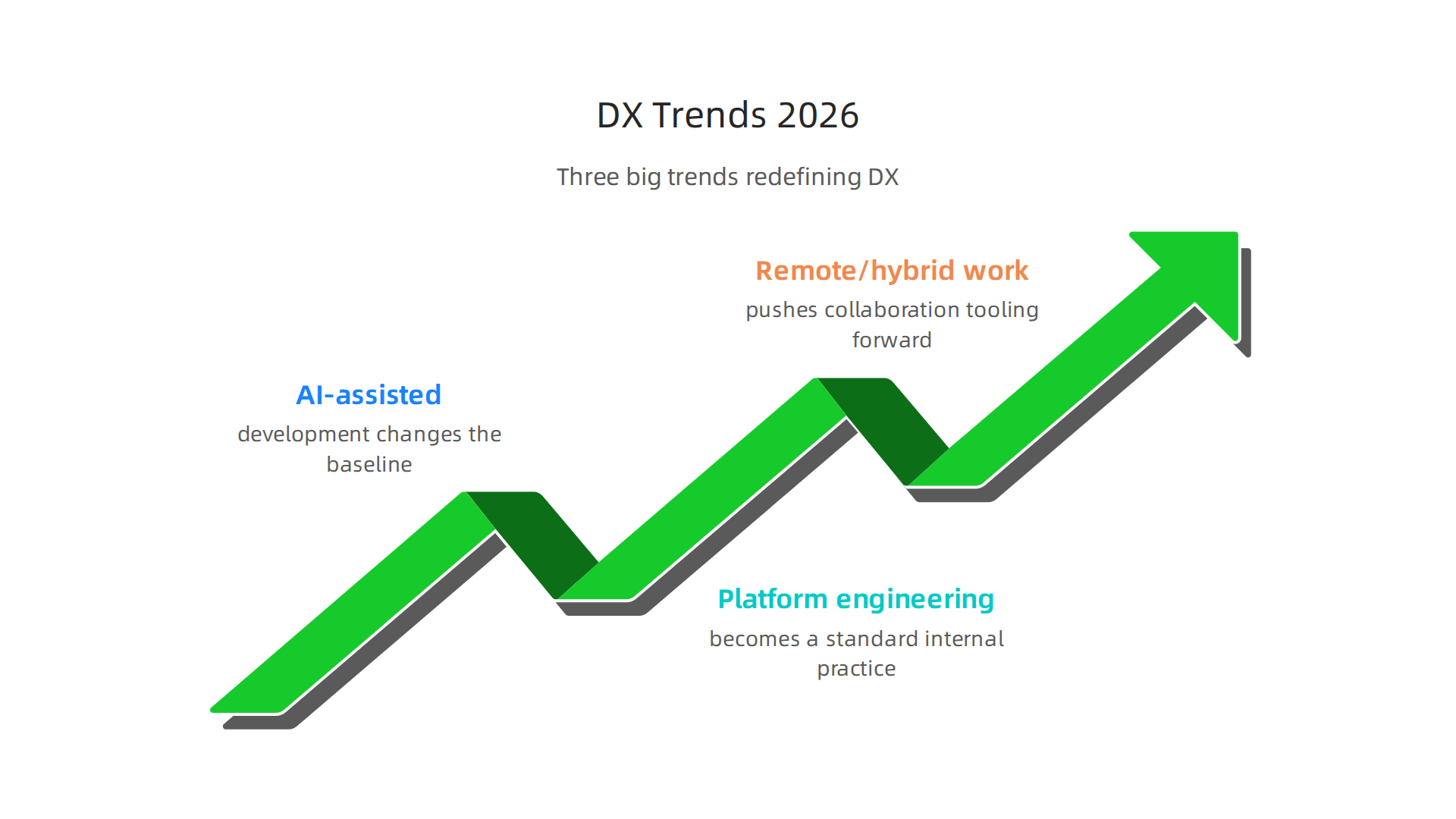
AI-assisted development changes the baseline. By 2026, using AI coding tools is no longer optional for high performance. The State of Code Developer Survey report found that 64% of developers now use AI agents on the job.

These agents write code, generate tests, and review pull requests. But here is the catch: teams that have clean DX see AI as a superpower. Teams with messy DX see AI as a source of extra debugging. Good dx engineering means your local environment, documentation, and pipelines are ready to accept AI output without friction.
Platform engineering becomes a standard internal practice. In 2026, many organizations build internal developer platforms (IDPs) to reduce the cognitive load on their teams. These platforms act as a single front door for infrastructure, deployments, and monitoring. They give developers self-service access without needing to understand every backend detail. This trend fits perfectly with context engineering for agile and devops teams, a concept that helps teams understand the boundaries and expectations of their development environment. When done right, platform engineering cuts wait times and lets developers focus on building features instead of fighting tooling.
Remote and hybrid work pushes collaboration tooling forward. The shift to distributed teams is not reversing. Developers in 2026 expect async-friendly tools that keep everyone on the same page regardless of time zone. This includes better PR review systems, shared documentation, and real-time pair programming environments. Teams that invest in solid async workflows report smoother handoffs and less context switching. The whole system depends on a strong DX foundation.
These trends are not separate. They overlap and reinforce each other. AI tools work best inside a well-structured platform. A good platform makes remote collaboration easier. And every improvement in DX feeds directly into faster delivery and happier engineers.
Core Pillars of a High-Performance DX Strategy
A strong dx engineering strategy does not happen by accident. It takes focused effort on four core pillars: tooling, culture, metrics, and continuous feedback.
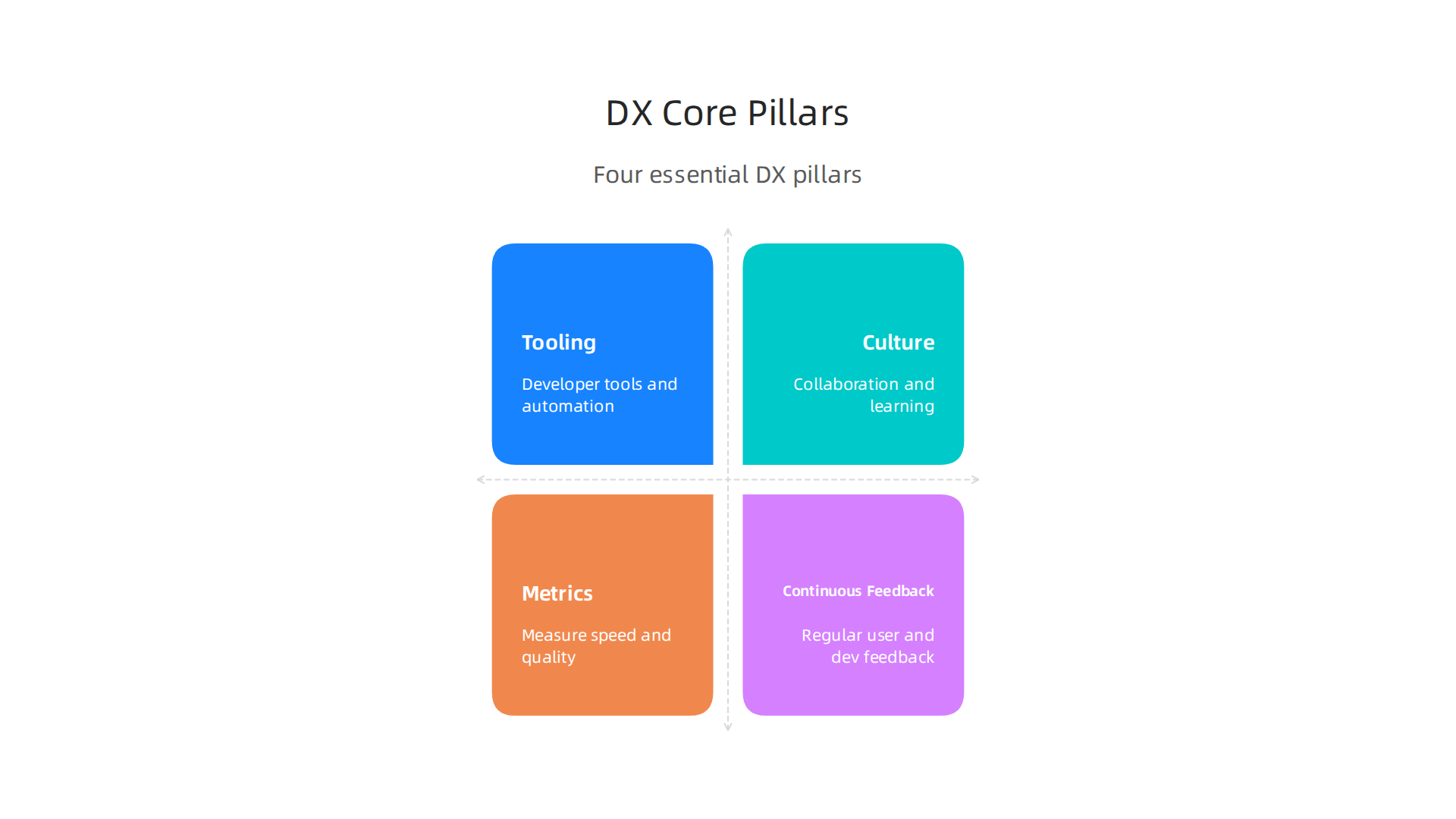
Each pillar supports the others. When all four work together, your team enters a virtuous cycle of improvement.
Pillar one: tooling. This is the most visible part of DX. It includes your local development environment, CI/CD pipelines, code review systems, and documentation. In 2026, tooling also covers how AI assistants integrate into your workflow. Good tooling is intuitive and standardized. Developers should be able to start contributing without fighting setup problems. According to the IBM overview of developer experience components, tooling must be usable, self-service, and backed by clear documentation. Every minute saved in setup time is a minute your team can spend on real features.
Pillar two: culture. Tooling alone is not enough. Your team must have a culture that encourages collaboration, learning, and experimentation.

Code reviews become learning opportunities instead of gatekeeping sessions. Teams that support each other and celebrate small wins see faster delivery and lower burnout. Culture also means giving developers the freedom to improve systems, not just push features. A healthy culture treats mistakes as data, not blame. This mindset feeds directly into how teams adopt new skills and tools. For more on building this culture, read about software developer skills for 2026.
Pillar three: metrics. You cannot improve what you do not measure. Great dx engineering teams track both hard numbers and soft signals. Cycle time, deploy frequency, and mean time to recovery tell you how fast your pipeline runs. Developer satisfaction surveys, Net Promoter Scores, and experience sampling reveal how your team feels about the process. The trick is to balance both. Speed without well-being leads to burnout. Happy teams without speed rarely ship.
Pillar four: continuous feedback. The final pillar closes the loop. Developers must have easy ways to give feedback about tooling, workflows, and blockers. That feedback must lead to action. When a developer says "this deployment step takes too long," the team should investigate and fix it. Regular retrospectives, anonymous surveys, and one-on-ones keep the feedback flowing. When feedback loops work, every cycle improves the next one.
These four pillars are not optional extras. They are the foundation of any high-performance dx engineering effort. Build them intentionally, and your team will move faster, feel better, and deliver more.
Implementing DX Frameworks in Your Organization
Knowing the four pillars is one thing. Putting them into practice is another. That is where proven dx engineering frameworks come in. Three of the most popular ones in 2026 are SPACE, DORA, and DevEx. Each gives you a clear way to measure and improve developer experience.
SPACE stands for Satisfaction, Performance, Activity, Communication, and Efficiency. It helps you look at both how developers feel and how fast they work. DORA focuses on four key metrics: deploy frequency, lead time for changes, mean time to recovery, and change failure rate. DevEx is a newer framework that looks at flow state, feedback loops, and cognitive load. All three work well together.
So how do you start using these frameworks? The key is to go step by step. Do not try to roll out all three at once. Pick one, measure your current baseline, then make small changes. For example, you could run a survey to capture developer satisfaction scores as part of the SPACE framework. Then start tracking deploy frequency with DORA. Over time, layer in DevEx principles like reducing context switching.
Implementation also needs teamwork. You cannot do it alone. Get buy-in from leadership early. Show them how better DX leads to faster shipping and lower turnover. Work with your DevOps and QA teams to set up the right tooling for collecting metrics. According to recent DevEx framework guidance, you should replace old KPIs like “lines of code” with the Core 4 metrics of Speed, Effectiveness, Quality, and Impact.
Common pitfalls to avoid. The biggest mistake is trying to change everything at once. That leads to team burnout and abandoned initiatives. Another trap is building the framework without asking developers what they actually need. If you ignore their input, you will solve the wrong problems. Also, do not forget about legacy systems. Older codebases may not support modern CI/CD pipelines right away. You need a realistic upgrade plan.
Start small. Pick one team, run a pilot with a single framework, and learn from it. Then expand slowly. For more on how agile and DevOps teams are adopting these methods, check out this context engineering guide for agile and devops teams.
When you implement frameworks the right way, your dx engineering efforts stop being theory and start delivering real results.
Overcoming Common DX Barriers: From Friction to Flow
Frameworks give you a starting point, but they do not clear every path. Even teams with strong SPACE or DORA practices still face real friction points in their dx engineering journey. The most common ones in 2026 include outdated CI/CD pipelines, poor documentation, constant context switching, and manual approval steps.
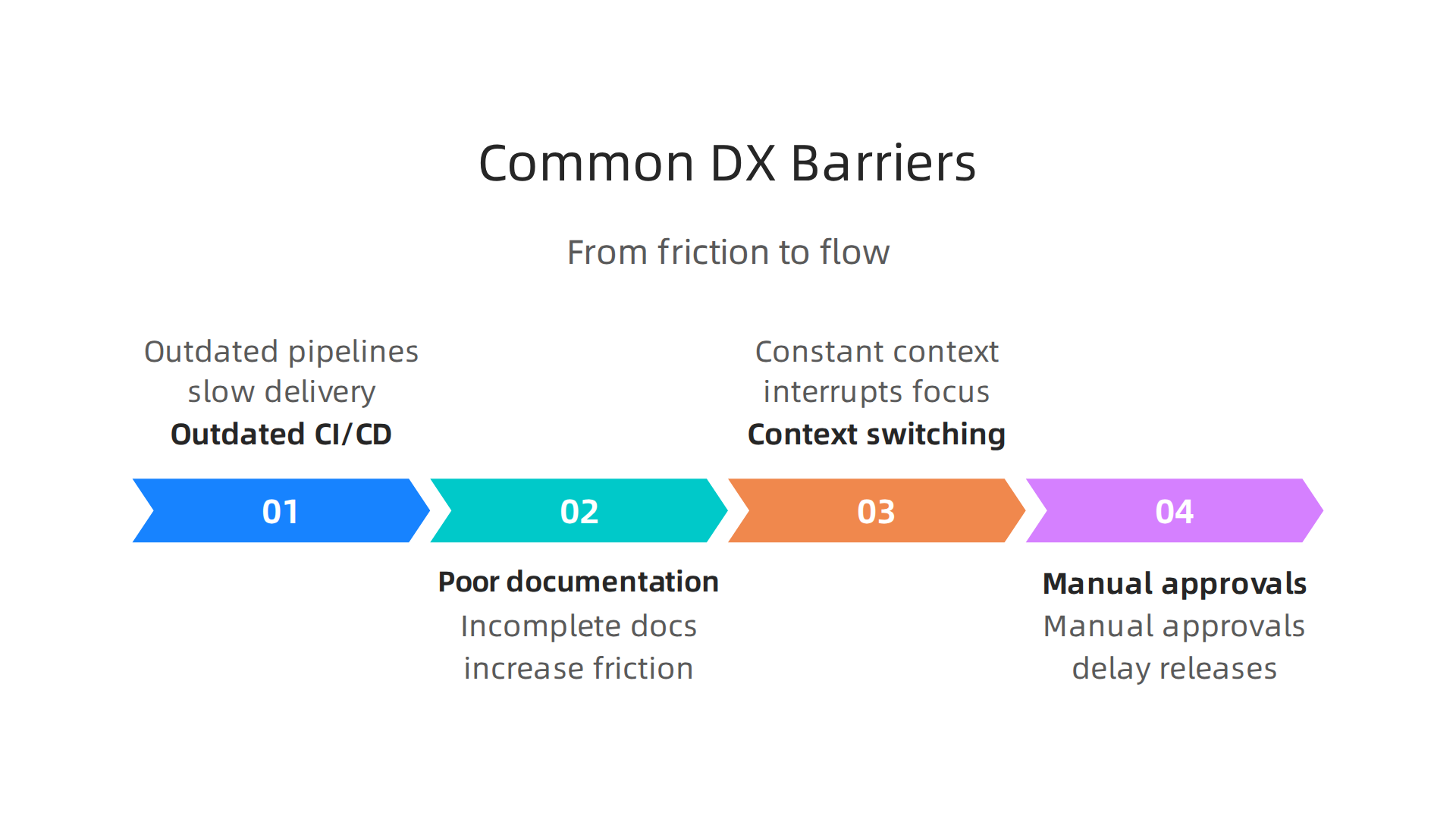
Each one interrupts flow and slows down delivery.

Outdated CI/CD pipelines. When builds take hours or deployments need manual clicks, developers lose momentum. The fix is full automation. Set up continuous integration that runs tests on every commit. Automate deployments so code moves from merge to production without human steps. According to Developer Experience Best Practices for Engineering Teams, automating build and deployment processes is one of the highest-impact changes you can make.
Poor documentation. Developers waste hours searching for answers in outdated wikis or scattered README files. The solution is living documentation that stays current. Write SDK docs with real code samples. Keep release notes and changelogs up to date. Include a troubleshooting section for common problems. Good documentation saves every person on the team time.
Context switching. When developers juggle meetings, tickets, and deep coding work, focus breaks. Batch meetings into set windows. Protect focus blocks on the calendar. Use clear ownership to reduce the need for constant check-ins. To build stronger habits around focus and productivity, learn which developer skills to master in 2026.
Manual approvals. Waiting for sign-offs on routine changes creates unnecessary delays. Replace manual gates with automated policy checks. Use progressive delivery for higher-risk changes, rolling them out to a small percentage of traffic first. Keep human review only for compliance-sensitive releases where judgment matters most.
The real-world payoff. Teams that remove even one friction point see measurable gains in shipping speed and developer satisfaction. The pattern is simple. Identify the biggest bottleneck. Apply the right mix of tooling and process change. Measure the result. Then tackle the next barrier. Each fix compounds over time. Start with one change and watch your team move from constant friction into steady flow.
Measuring DX: KPIs, Metrics, and ROI
Once you start clearing friction points, the next step is measuring what changed. But how do you actually track whether your dx engineering improvements are working? Counting lines of code or hours worked misses the bigger picture. Real progress shows up in satisfaction, flow, and reduced waste.
The SPACE framework gives you a balanced way to measure these things. It looks at five dimensions: Satisfaction and well-being, Performance, Activity, Communication and collaboration, and Efficiency and flow.
Instead of picking just one number, you get a full picture of your team’s health. For a deeper walkthrough, check out what the SPACE framework is and when to use it.
DORA metrics are another strong tool. They track deployment frequency, lead time for changes, change failure rate, and mean time to recovery. Together with SPACE, they help you see both the human side and the delivery side of your engineering work.
Now, what about ROI? You can put real numbers on dx engineering gains. Start with time saved. If your team moves from a three-hour build to a ten-minute one, calculate the hours freed across all developers each week. Multiply by your average developer hourly rate, then by 52 weeks. That is a direct cost reduction.
Next, factor in retention. Unhappy developers leave. Replacing one senior engineer can cost 50 to 200 percent of their annual salary. Better development experience keeps people around longer, saving you that replacement cost.
Defect reduction also adds up. Fewer bugs in production means less time spent on hot fixes and fewer angry customers. Track your change failure rate before and after your improvements. A drop from 20 percent to 10 percent is a massive savings in incident response time.
To get the full picture, you need both hard numbers and developer sentiment. Tools like internal developer portals can pull data from your version control, CI/CD pipelines, and issue trackers into one place. They make it easier to spot trends without digging through spreadsheets.
If you want to go deeper on how to structure your team’s workflow for better measurement, read this context engineering guide for agile and devops teams. It explains how to design systems that naturally produce useful data.
Remember, the goal is not to track everything. Pick a few metrics that match your team’s biggest pain points. Measure them before and after your changes. Then watch the numbers move in the right direction. That is how you prove your dx engineering work is worth the investment.
The Future of DX: AI, Automation, and Beyond
We have covered how to measure DX and prove its value. But what comes next? The world of software engineering is changing fast. AI coding assistants, automation, and real-time data are reshaping how developers work. The future of dx engineering is about creating systems that learn and adapt.
AI coding assistants are already part of the daily toolchain for many teams.

Tools like GitHub Copilot and ChatGPT help write code faster. But here is the thing. They also introduce new UX challenges. Developers must review AI-generated code carefully, understand why it was suggested, and decide whether to trust it. This adds cognitive load. If the suggestions are wrong or hard to understand, frustration grows. As noted in the developer experience metrics guide for 2026, AI coding tools change how we think about DevEx because they affect both satisfaction and mental effort. Getting the balance right is a key part of dx engineering going forward.
Automation is another big piece of the puzzle. Teams are already automating testing, deployments, and infrastructure setup. This reduces toil and frees up time for more creative work. In the future, automation will get smarter. It will learn from past incidents and adjust pipelines on the fly. This ties directly into agile software development. When teams spend less time on repetitive tasks, they can focus on delivering value faster.
Long term, DX may evolve into a continuous feedback loop driven by machine learning and real-time analytics. Imagine tools that spot friction as it happens. They detect when a developer is stuck, when a build fails for no good reason, or when code review is taking too long. Then they suggest fixes automatically. This kind of system would make dx engineering more proactive than reactive.
AI also affects how we think about design patterns in software engineering. Many AI models generate code that follows common patterns like mvc architecture. This could reinforce best practices or lock teams into outdated approaches. The key is to stay critical and adapt what works for your context.
If you want to learn more about working effectively with AI-generated code, check out this guide on how to bridge the AI to human gap in your code.
The future of dx engineering is bright. Teams that embrace AI wisely, automate the boring stuff, and build feedback loops will stay ahead. To keep up with how AI and tech are reshaping the industry, get daily insights delivered to your inbox. Try The AI Newsletter Worth Reading for clear updates that help you make better decisions.
Summary
This article explains why developer experience (DX) is now a strategic advantage and gives a practical roadmap for improving how engineering teams work in 2026. It defines DX engineering as a discipline—covering tooling, CI/CD, documentation, culture, and feedback loops—and explains how those elements combine to speed delivery, reduce bugs, and lower turnover. The guide highlights three major trends (AI-assisted development, platform engineering, and remote collaboration), lays out four core pillars to focus on (tooling, culture, metrics, continuous feedback), and describes proven frameworks like SPACE and DORA. You’ll learn which common friction points to attack first (slow builds, bad docs, context switching), how to measure impact with actionable KPIs, and how to pilot changes without overwhelming teams. The article also looks ahead to AI and automation, showing how clean DX makes AI tools a net win rather than added noise. After reading, you’ll have concrete steps to start a pilot, measure progress, and show ROI to leadership.