
Introduction
Landing a notion software engineer intern role in 2026 is one of the most exciting opportunities you can chase as a student developer.

Notion builds tools millions of people use every day, and their intern program puts you right in the middle of real product work. You ship code that matters to real users.
But here’s the thing. Getting in is not easy. The program is highly competitive, and thousands of talented students apply every cycle. According to Notion’s Fall 2026 SWE Intern job posting, the company looks for candidates with previous internship experience, strong problem-solving abilities, and a collaborative mindset. They want people who think carefully, communicate clearly, and put users first.
As the tech job market shifts in 2026, standing out means having a solid foundation. Whether you come from a vt software engineering program or have built a wix website portfolio to showcase your projects, the key is showing real impact in everything you do.
This guide walks you through every step of the process. You will learn what Notion expects from applicants, how to craft a strong application, and how to navigate the interview pipeline from start to finish. Whether you are still building your skills or getting ready to hit submit, this roadmap gives you a clear path forward. For more context on where the industry is headed, check out our tech jobs 2026 blueprint for salary and growth insights.
And if you want to stay ahead of fast-moving trends in AI and software development, The AI Newsletter Worth Reading delivers daily updates straight to your inbox.
Let’s get started.
Why Notion’s SWE Internship Stands Out in 2026
Not every internship gives you real ownership. But that is exactly what makes the notion software engineer intern program different. From day one, you work on features that ship to millions of users. You are not just fetching coffee or fixing small bugs. You design, build, and debug real parts of the product. The company trusts you with serious work because they know interns can bring fresh ideas.
Another big reason this internship stands out is the mentorship. According to the Software Engineer Intern (Fall 2026) posting, every intern is paired with a senior engineer who guides them through the whole 12-week program. That means you get one-on-one help learning the codebase, planning your projects, and growing your skills. You also work on AI native projects, which is a huge advantage as artificial intelligence becomes more central to software. If you want to understand where this tech is headed, reading about engineering technology trends in 2026 can give you helpful context.
The company is also growing fast, so you get exposure to cutting-edge infrastructure challenges. You work across web services, databases, and applications while using modern tools like TypeScript, React, and Python. This is not a slow-moving environment. You learn how to scale systems and solve tough problems alongside top engineers. And with hourly pay between $57 and $61 plus equity, the internship shows how much Notion values its interns. For any student developer, this combination of real ownership, strong mentorship, and fast-paced growth is hard to beat.
Application Timeline and Requirements
So you want to be a notion software engineer intern? Great. But timing matters a lot. Applications for summer 2026 open in early fall 2025 and close by December. That means you need to start preparing months ahead. If you wait until spring, you will likely miss the window. You can check the Software Engineer Intern (Fall 2026) requirements to get a clear picture of what you need.
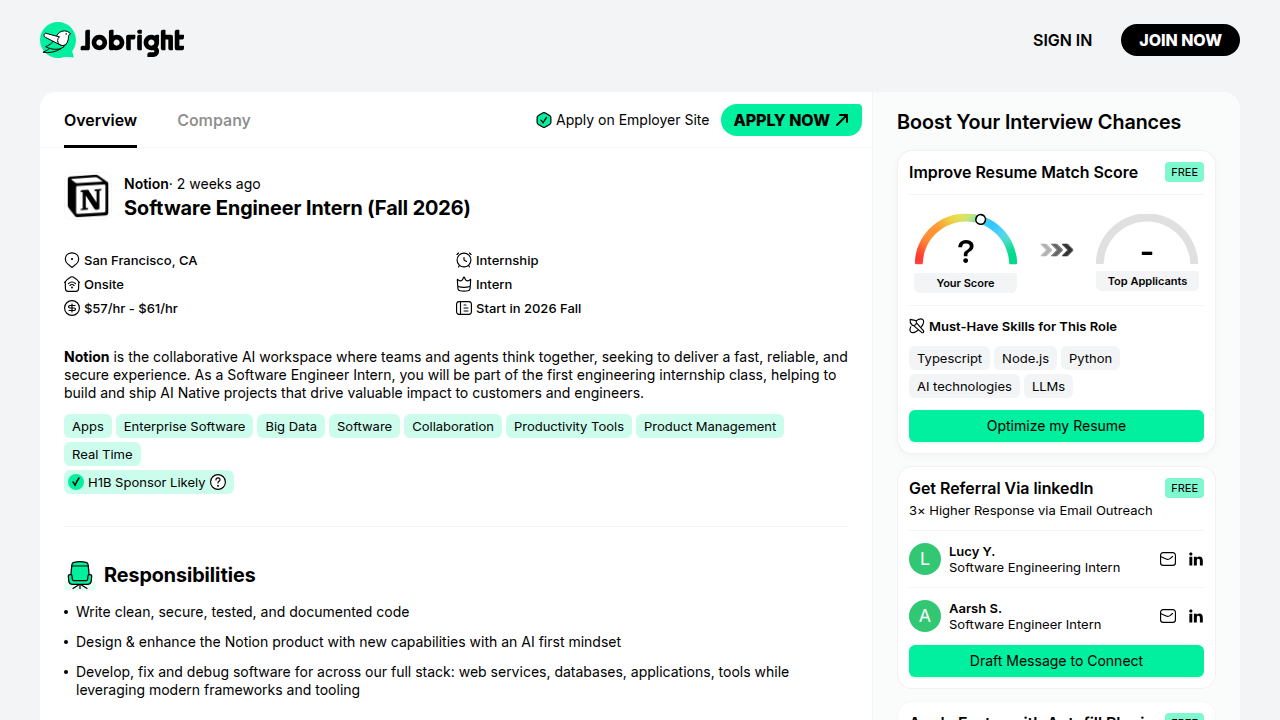
What does Notion look for in applicants? First, strong computer science fundamentals. You should be comfortable with data structures, algorithms, and system design. Second, they require previous internship experience. That is a big one. Third, they want a product mindset. You need to care about users and think about how your code affects real people. You also need to be proficient in languages like TypeScript, Node.js, or Python. If you are still building your skills, reading about software developer skills to master can help you fill gaps.
For the application itself, you usually submit a resume and a cover letter. Sometimes they ask for a portfolio. If you have side projects or a personal website, include a link. The application also includes questions about why you want to join Notion and your career goals. They want thoughtful answers, not generic copy-paste. So take time to write genuine responses.
As you prepare, staying on top of tech trends can give you an edge. Notion loves interns who are curious about AI and new technologies. That is why getting clear daily updates from a trusted source matters. Check out The AI Newsletter Worth Reading to keep your finger on the pulse.
Cracking the Notion Intern Interview Process
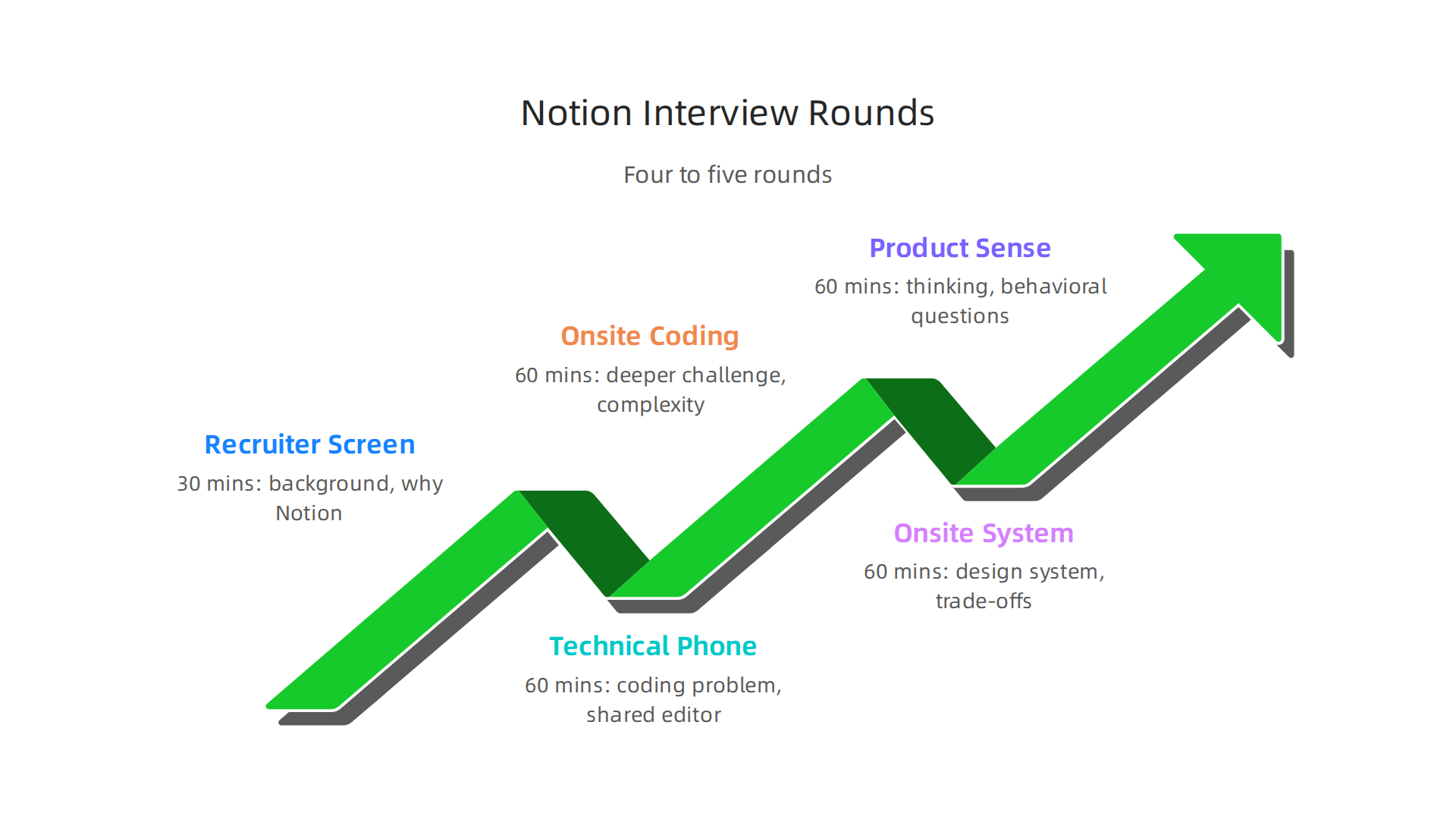
After you submit your application, the interview process is the next big step. The process for a notion software engineer intern is different from other big tech companies. It focuses on practical skills and product thinking. Most candidates go through four to five rounds over two to five weeks.
If you prepare the right way, you can feel confident walking into each one.
What the Rounds Look Like
Recruiter Screen (30 minutes): This is a short chat about your background and why you want to work at Notion. Be ready with specific reasons. Do not just say you like the product. Pick one feature or problem they solve that excites you. Have two or three stories ready about your past projects and what you learned. A detailed Notion interview guide says you need a clear story about your career goals and what draws you to collaboration tools. Speak clearly and stay organized.
Technical Phone Screen (60 minutes): Expect a coding problem in a shared editor. Notion does not use tricky LeetCode puzzles. They give you a problem that feels like real work. Maybe build a small feature or fix a bug. Write clean code and talk through your thought process. They care more about working solutions than fast answers. Practice with a friend or record yourself to check how clearly you explain your code.
Onsite Coding Round (60 minutes): This is a deeper coding challenge. You might build a simplified version of Notion blocks or handle nested content. They add new requirements to see how you handle complexity. Focus on code quality and strong data structures. Pay attention to edge cases. If you are a student in a program like VT software engineering, your coursework on data structures will help you here. Also, reading a developer experience roadmap can teach you how to write maintainable code that interviewers love.
Onsite System Design (60 minutes): You design a system related to Notion’s product. Examples include collaborative editing or a permissions model. Walk through your decisions step by step. Talk about trade-offs and scalability. Study common patterns like caching, database sharding, and real-time sync before your interview. Show you can think about the big picture, not just the code.
Onsite Product Sense + Culture (60 minutes): This round mixes product thinking with behavioral questions. Have two or three stories ready that show teamwork, ownership, and user focus. Be real. Notion wants interns who care about building something useful, not just solving coding problems. Think about how your past work helped real users or solved a meaningful problem.
How to Prepare Smart
Do not spend all your time on algorithm puzzles. Notion rewards practical skills. Build projects in TypeScript or Python. Create a portfolio of your work on a platform like Wix to show what you can do. Some candidates use protech services to practice coding with real-time feedback. The key is to practice real problems, not memorize answers.
Get familiar with the rounds early. Practice explaining your technical decisions out loud.

And stay curious about what Notion builds. The more you understand their product, the better you will perform. Land that role as a notion software engineer intern and you will spend the summer shipping features that millions of people use every day.
Compensation, Perks, and Relocation for Notion Interns
Now let’s talk about what you actually get paid. Notion pays its interns well. According to the Notion Software Engineer Intern job posting, the hourly rate is $57 per hour for Bachelor’s students and $61 per hour for Master’s students.
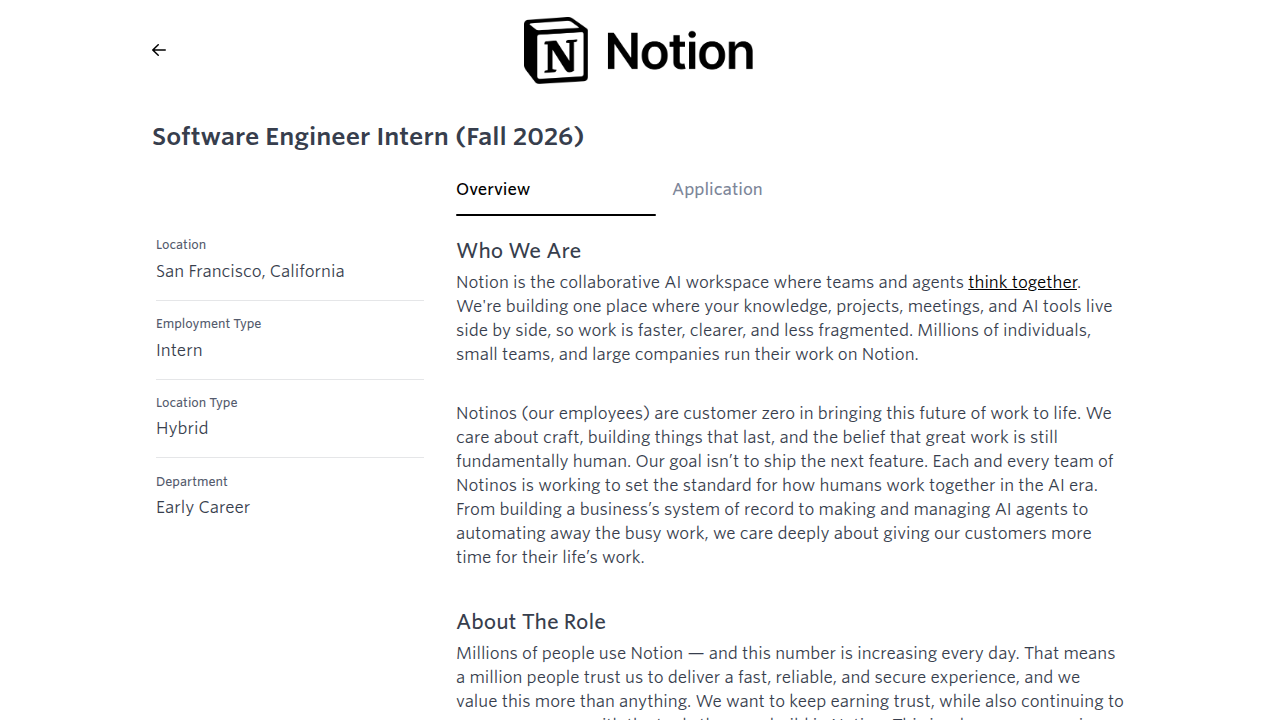
That comes out to roughly $9,000 to $10,000 per month before taxes. Over a 12-week summer internship, you are looking at around $27,000 to $30,000 just in base pay.
These rates put Notion above many other mid-size tech companies. Most competitors hover around $45 to $55 per hour for similar roles. Notion clearly values its interns and wants to attract top talent.
Perks Beyond the Paycheck
The money is just the start. Notion provides a long list of benefits that make the internship even more valuable. Notion’s careers page lists perks like medical, dental, and vision insurance with premiums mostly covered, a monthly lifestyle stipend for dining and hobbies, commuter funds, free lunch and snacks, a phone stipend, paid parental leave, mental health support, and funds for learning and development. You also get flexible paid vacation and a company-wide closure at the end of the year. These benefits show that Notion cares about your whole life, not just your work hours.
Relocation and Housing Help
Since the internship takes place in San Francisco or New York City, Notion helps with the move. They offer relocation assistance and housing stipends to make the transition easier. Living in a new city for a summer can be expensive, and this support takes some of that weight off your shoulders.
The Big Picture: Return Offers
Here is the most valuable part. Return offer rates at Notion are very high. Landing the notion software engineer intern role can open the door to a full-time position with a starting total compensation well above $200,000 when you include equity and bonuses. The internship is a strong stepping stone into a long-term career.
If you want to understand where the tech job market is heading, check out this tech jobs 2026 guide for a broader look at salaries and growth trends.
And if you want to stay sharp on AI developments that could help you during your internship, The AI Newsletter Worth Reading delivers clear daily updates on what matters in artificial intelligence.
Life as a Notion Intern: Culture, Mentorship, and Projects
So you landed the role. What does it actually feel like to work there? Notion doesn’t treat interns like coffee runners. You join a real cross-functional team from day one. That means you work alongside engineers, designers, and product managers who are building features millions of people use. You are not watching from the sidelines. You own a meaningful project that the team expects to ship live by the end of your 12 weeks.
Mentorship That Actually Helps
Every intern gets a dedicated mentor and a manager. According to Notion’s own blog post about their winter interns, you can expect daily check-ins with your mentor, weekly one-on-ones, plus mid-point and final performance reviews with your manager.

Senior engineers walk you through code reviews and help you break down tough problems. You never feel stuck alone.
The team values what they call "be kind and direct." That means honest feedback delivered respectfully. You will hear what you are doing well and where you can grow. That kind of clarity helps you improve fast.
Culture Built on Trust and Transparency
Notion’s culture stands out. The Notion Glassdoor rating sits at 4.4 out of 5 stars, with 89% of employees recommending the company. People describe the culture as product-obsessed and transparent. Leadership shares company goals openly, and founders like Ivan Zhao stay accessible. Interns feel that trust too. You get autonomy to figure out solutions your own way. There is no micromanagement.
That said, the pace moves fast. Notion is not a place to coast. But the company backs that pace with real support for work-life balance and strong benefits.
What You Build Matters
In your final week, you stand up at a company-wide meeting and demo what you built. That is a big moment. You show your work, share what you learned, and get honest reactions from the whole team. That experience alone gives you confidence and a real project to talk about in future interviews.
If you want to understand how engineering teams build great cultures, this developer experience 2026 guide explains what makes teams thrive.
The not so secret truth about the notional software engineer intern experience is that it sets you up with skills, connections, and a resume that opens doors anywhere.
Common Mistakes to Avoid During the Notion Intern Application and Interview
Applying for a notion software engineer intern role? It is an exciting goal. But a lot of strong candidates slip up on a few key things. Avoid these three common mistakes to give yourself a real shot.
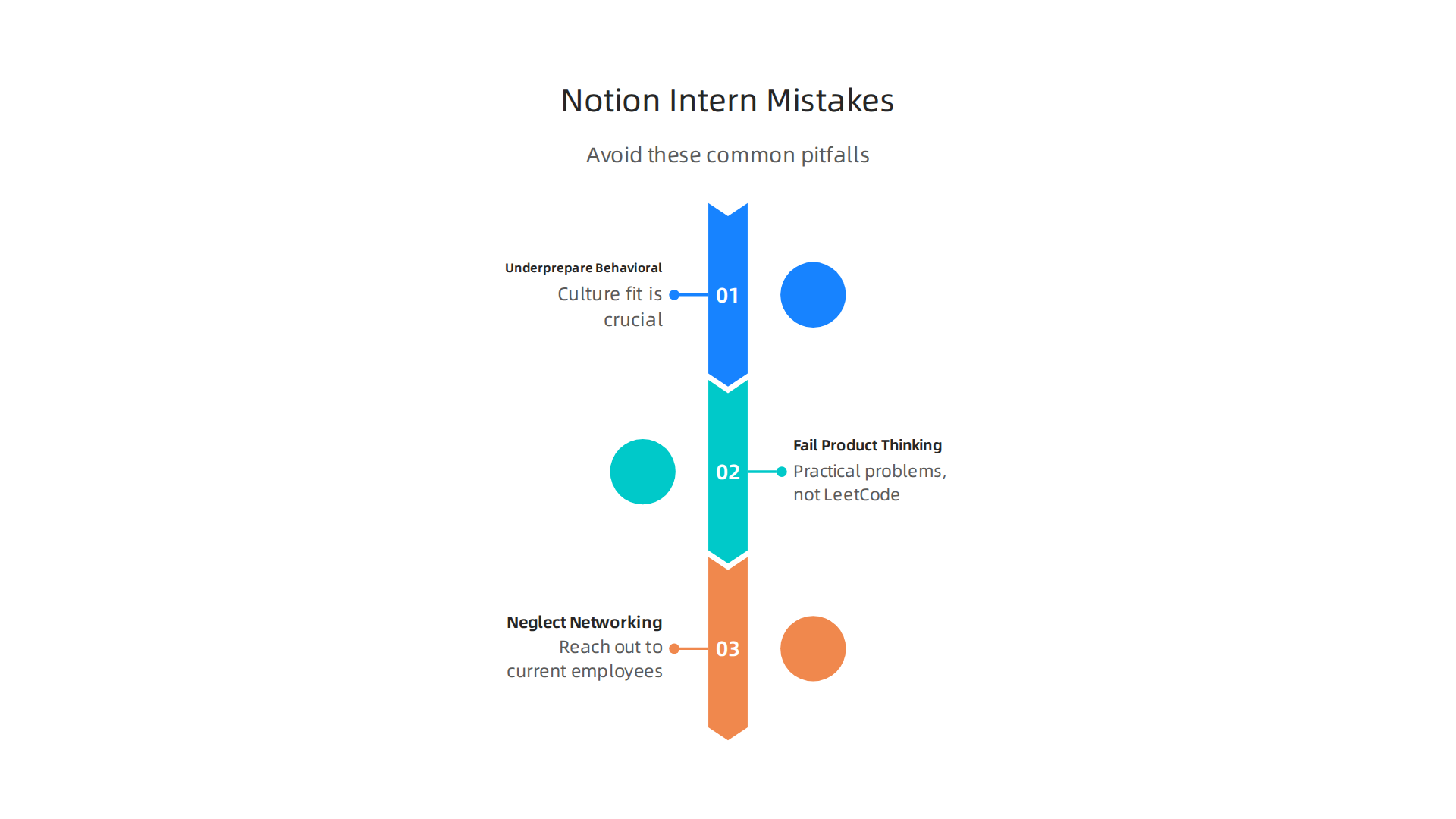
Mistake 1: Underpreparing for the Behavioral Round
Notion cares deeply about culture fit. The interview includes a product sense and culture round that is unlike most big tech companies. If you only grind coding problems and ignore this part, you will struggle. You need to know why Notion specifically. Read their mission and understand how they build products. A Notion interview prep guide explains that the behavioral round rewards candidates who have a clear narrative about why they want to work at Notion.
Mistake 2: Failing to Showcase Product Thinking
Notion’s coding rounds are not typical LeetCode grinds. They ask practical problems that feel like real features you would build at the company. You need to show clean code, clear communication, and good design choices. The Notion Labs software engineer interview guide highlights that practical engineering decisions matter more than algorithmic tricks. So practice building small features instead of just memorizing algorithms.
Mistake 3: Neglecting to Network with Current Employees
Getting an inside perspective helps a lot. Reach out to current or former Notion engineers. Ask about their experiences and what the team values. This can also lead to a referral, which improves your chances of getting an interview. A LinkedIn post from a successful Notion candidate shares how connecting with people inside the company made a big difference.
How to Prepare Smarter
Focus on the things that actually matter at Notion: culture fit, product thinking, and real-world coding. Build a portfolio of projects that show your engineering skills. Even a simple wix website portfolio can help you stand out if it highlights thoughtful problem-solving. And remember to keep learning about the latest tools and trends in software engineering. Understanding key software developer skills for 2026 will set a strong foundation for your interview prep.
Staying informed about the tech world is also part of being a great candidate. If you want a quick daily dose of important AI and tech news, check out The AI Newsletter Worth Reading. It helps you keep your knowledge fresh without spending hours scrolling.
How to Prepare Your Application Materials for Notion
Your application materials are your first handshake with Notion’s hiring team. They need to show you understand what makes Notion different from other tech companies.

Here is how to make your resume, cover letter, and portfolio stand out.
Tailor Your Resume to Show Product Impact
Notion does not just want to see a list of technologies you know. They want to see how you used those skills to build something real. Instead of saying "built a REST API with Node.js," say "designed and shipped a new feature that reduced load time by 25% for 10,000 users." That shows product sense. The Software Engineer Intern (Fall 2026) job posting at Notion highlights that they value "thoughtful problem-solving" and putting users first. So frame every bullet point around the problem you solved and the impact it had, not just the technical stack.
Write a Cover Letter That Shows Passion for Notion
Notion’s application often asks short answer questions instead of a traditional cover letter. For example, the Notion Partners 2026 internship asks, "Why are you interested in an internship at Notion?" and "What are your career goals?" Take these seriously. Be specific about what you love about Notion’s product, like how it helps teams stay organized or how its flexible blocks empower creators. Mention a feature you admire or a way you have used Notion yourself. This shows you are not just applying everywhere.
Link to Personal Projects and Open Source Contributions
Notion values initiative. Include a link to a personal project, even a simple one, that shows you can design and build something from scratch. A wix website portfolio or a small app hosted on GitHub is better than nothing. Open source contributions also help because they show collaboration and real-world coding habits. The idea is to prove you can go beyond course assignments.
If you want to explore more about what skills employers are looking for in 2026, check out this analysis of the developer job market 2026. It will help you understand what to emphasize in your materials.
How Notion’s Internship Compares to Other Top Tech Programs
Once your materials are ready, you will probably start comparing offers. How does a notion software engineer intern position stack up against programs at Google, Meta, or smaller startups? Let’s break down the differences so you can make the best choice for your career.
Pay: Solid but Not the Highest
Notion pays its interns well. For roles based in San Francisco, the hourly rate is $57 for bachelor’s students and $61 for master’s students, as listed on the Software Engineer, AI Intern (Summer 2026) posting. That is higher than what many mid-size companies offer. However, total compensation at FAANG companies often ends up higher because of large stock grants and bonuses. For full-time roles, Notion’s median software engineer salary is around $380,000 according to Notion software engineer compensation data, but FAANG can reach higher at senior levels. So if pure money is your main goal, a FAANG offer might win. But Notion’s pay is still very competitive.
Culture and Ownership: You Build Real Things
Here is where Notion really shines. Interns at Notion get to work on features that ship to real users. You are not just fixing bugs or writing tests. You own a project from start to finish. That kind of responsibility teaches you how to think like a product engineer. Many interns say they learn more in 12 weeks at Notion than in a full semester. If you want to understand what great teams look like, reading about developer experience in 2026 can help you spot the best places to grow.
Return Offers: High Conversion Rates
Notion has a strong track record of turning interns into full-time employees. Conversion rates are often higher than those at Google or Microsoft. That means if you do well, you have a great chance of landing a full-time role. A Reddit discussion on intern offer comparisons shows that many candidates choose Notion specifically because of the return offer potential and the meaningful work. Plus, Notion offers excellent benefits like a monthly lifestyle stipend, health insurance, and learning funds, as shown on their careers page.
The Bottom Line
Notion’s internship might not pay the highest total comp in absolute dollars, but the growth, ownership, and return offer rate make it a top choice. If you want to build real products and learn fast, it is hard to beat.
And if you want to stay ahead in the fast-moving tech world, consider subscribing to a daily newsletter that breaks down AI and software trends. You can get started with The AI Newsletter Worth Reading for clear, daily updates.
Summary
This guide explains how to land a Notion software engineer intern role in 2026, walking you through what the company expects, when to apply, and how the interview pipeline works. It describes the application timeline, the resume and portfolio elements that show product impact, and the practical interview rounds—recruiter screen, technical phone screen, onsite coding, system design, and product/culture conversations. The article also covers compensation, perks, relocation support, and why the internship offers real ownership and strong mentorship. You’ll learn common application mistakes to avoid, how to prepare smarter (focusing on practical projects over pure algorithm drills), and what life on a Notion team looks like. After reading, you’ll have a clear prep plan, concrete changes to your application materials, and realistic expectations about pay, culture, and return-offer potential.