
Is a ‘Personal AI’ the Next Productivity Revolution for Software Teams?
Imagine an assistant that knows your codebase inside out. It understands your team’s coding style. It remembers the bug you fixed last week and the pull request you reviewed this morning. It even anticipates what you need next.
That is the promise of a personal AI — a context‑aware assistant that lives inside your development workflow. Unlike a generic chatbot, this tool learns your habits, your project history, and your team’s patterns. It does not just answer questions. It helps you write better code, automate repetitive tasks, and make smarter decisions faster.
Here is the thing: software teams in 2026 are drowning in information overload. The 2026 global software industry outlook from Deloitte shows that development teams are being remade around AI.

Gartner predicts that 80% of organizations will evolve large software engineering teams into smaller, AI‑augmented teams by 2030. That is a huge shift.
The core problem is clear. Developers spend too much time on busywork — searching for answers, updating docs, fixing small bugs. A truly personal AI could cut that time dramatically. It could give you back hours each week for the work that actually matters.
This article looks at how personal AI assistants are reshaping the way software teams build and ship products. We will explore research‑backed ways these tools boost productivity and even simplify tasks like website building. Whether you are a solo developer or an engineering leader, understanding this trend will help you stay ahead.
Want to keep up with the fast‑moving world of AI in software development? The AI Newsletter Worth Reading delivers clear, daily updates on the latest tools and trends.
Let us start by looking at what makes a personal AI different from everything that came before.
Defining ‘Personal AI’: Beyond Generic Assistants
So what exactly sets a personal AI apart from the generic assistants you have used before?
Think of the difference this way. A general AI chatbot is like a helpful librarian. It knows a little about everything. It can answer broad questions and point you in the right direction. But it does not know you.
A personal AI, on the other hand, is more like a dedicated partner who has sat next to you for months. It has read every line of code in your repository. It knows your team’s naming conventions.
It remembers that time you spent three hours debugging a threading issue last Tuesday. It learns your preferences, your workflow, and even the way you like to structure your commits.
This distinction matters because generic tools cannot truly understand the unique context of your project. A personal AI can offer context‑aware code completion that suggests the next function based on the exact pattern you have been using. It can perform automated refactoring that respects your existing architecture instead of rewriting everything in a different style. It can generate intelligent documentation that pulls directly from your codebase’s comments and history, not from some boilerplate template.
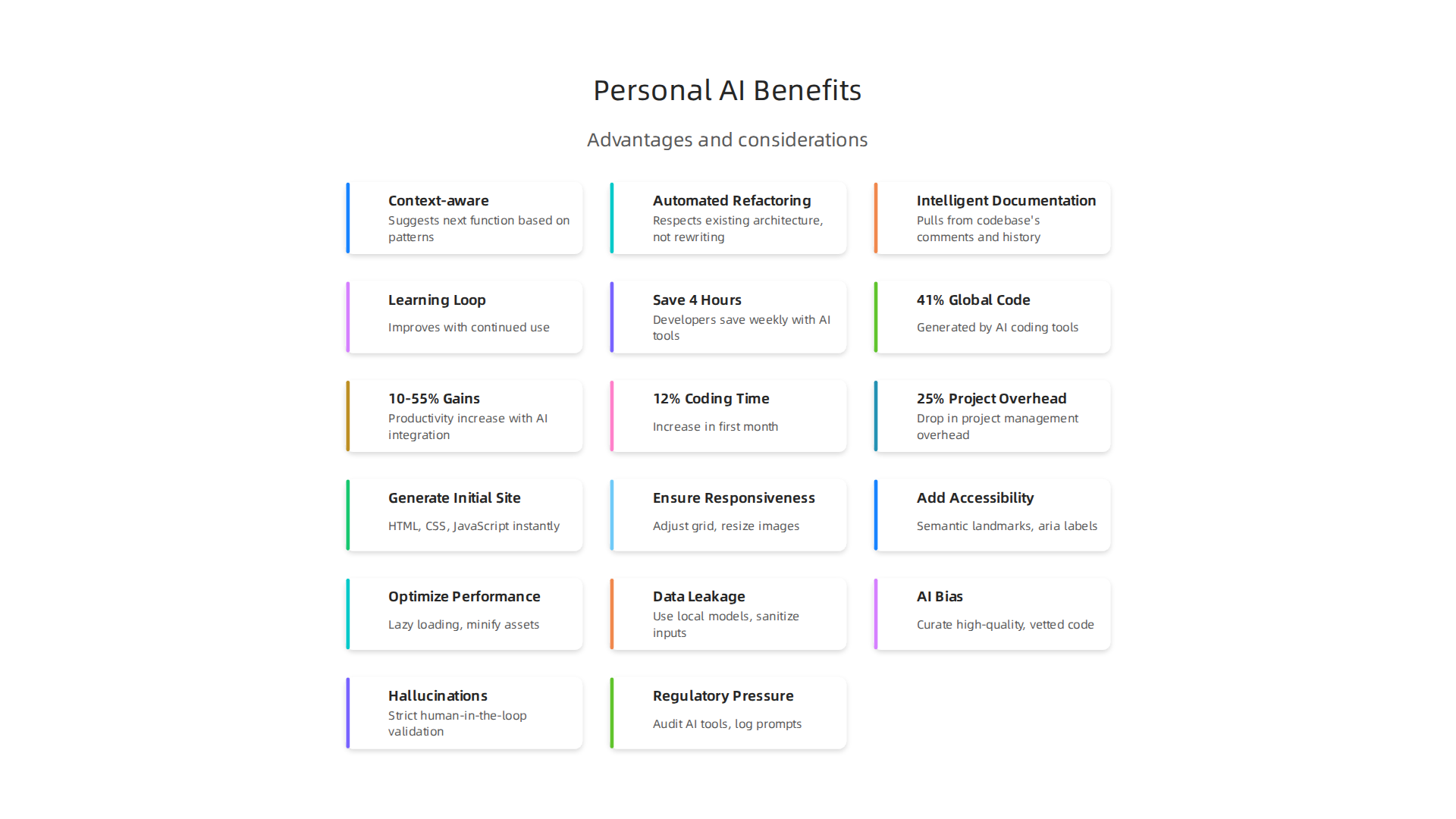
The real magic is in the learning loop. The more you use a personal AI, the better it gets. It notices when you override its suggestions. It picks up on your preferred libraries. Over time, it becomes finely tuned to your team’s specific needs. This is very different from a one‑size‑fits‑all assistant that treats every project the same.
Research from MIT Sloan shows that developers with AI tools actually changed how they spent their time. They did more core coding and less project management. A personal AI pushes this further by understanding your project’s priorities, helping you focus on the work that matters most to your team.
Want to see how these assistants are already changing the way teams build software? Check out this guide on personal AI assistants reshaping developer workflows in 2026.
Measurable Productivity Gains from Personal AI
So what does all that mean for your bottom line? Let’s look at the numbers. In 2026, the evidence is clear: engineering teams that adopt a personal AI see real, measurable gains. They code faster, fix fewer bugs, and waste less time bouncing between tasks.
A major study found that developers using AI tools save about four hours every week. That is according to the ShiftMag analysis of 4.2 million developers.
But here is the key difference: a personal AI multiplies those savings. Because it knows your codebase, it suggests exactly what you need next. You do not have to stop and describe your project every time.
Before personal AI, a typical day looked like this: Spend 30 minutes context switching, 20 minutes searching for the right function, and another 15 minutes reading old pull requests to understand why something was done a certain way. After adopting a personal AI, that overhead nearly disappears. The assistant remembers your decisions. It already knows your team’s naming conventions and preferred libraries.
That is a huge drop in cognitive load. Your brain no longer has to hold a dozen open tabs worth of project context. The personal AI handles those repetitive decisions for you. You can focus on the hard problems.
The numbers back this up. The Stanford HAI 2026 AI Index Report shows that AI coding tools now generate 41% of global code, and teams that integrate these tools well see productivity gains of 10 to 55 percent. Teams using a personal AI that learns their specific codebase tend to land on the higher end of that range.
Before and after scenarios tell the story. Take a mid size engineering team that started using a personal AI assistant. In the first month, they saw a 12% increase in coding time and a 25% drop in project management overhead. Bug rates actually went down because the AI caught inconsistencies early. Developers reported feeling less tired at the end of the day. They had more energy for creative problem solving.
Tools like Spark AI and Lightchain AI are examples of how numerous AI assistants now offer deep integration with existing codebases.
They are not just autocomplete. They become a part of your workflow.
The bottom line is simple. Personal AI does not just help you write code faster. It helps you think straighter. It cuts out the noise and lets you do the work that matters.
Want to stay on top of these fast moving tools and trends? Get clear daily AI updates delivered to your inbox with The AI Newsletter Worth Reading. It will help you and your team make smarter decisions about which personal AI fits your stack.
Building Websites Faster: AI-Assisted Design and Coding
Now let’s look at another area where personal AI is changing the game: building websites. Whether you need a landing page for a side project, a portfolio site, or a full product page, personal AI can take you from idea to published site in a fraction of the time it used to take.
In 2026, numerous AI website builders can generate complete, responsive, and SEO-friendly pages from a single prompt. According to a detailed 2026 comparison of the best AI website builders, tools like Playcode, Hostinger, and Wix ADI can create a full site in under a minute. But here’s where personal AI goes further. A personal AI that knows your brand colors, preferred CSS framework, and typical page structure can tailor the output exactly to your style. You do not have to start from scratch every time.
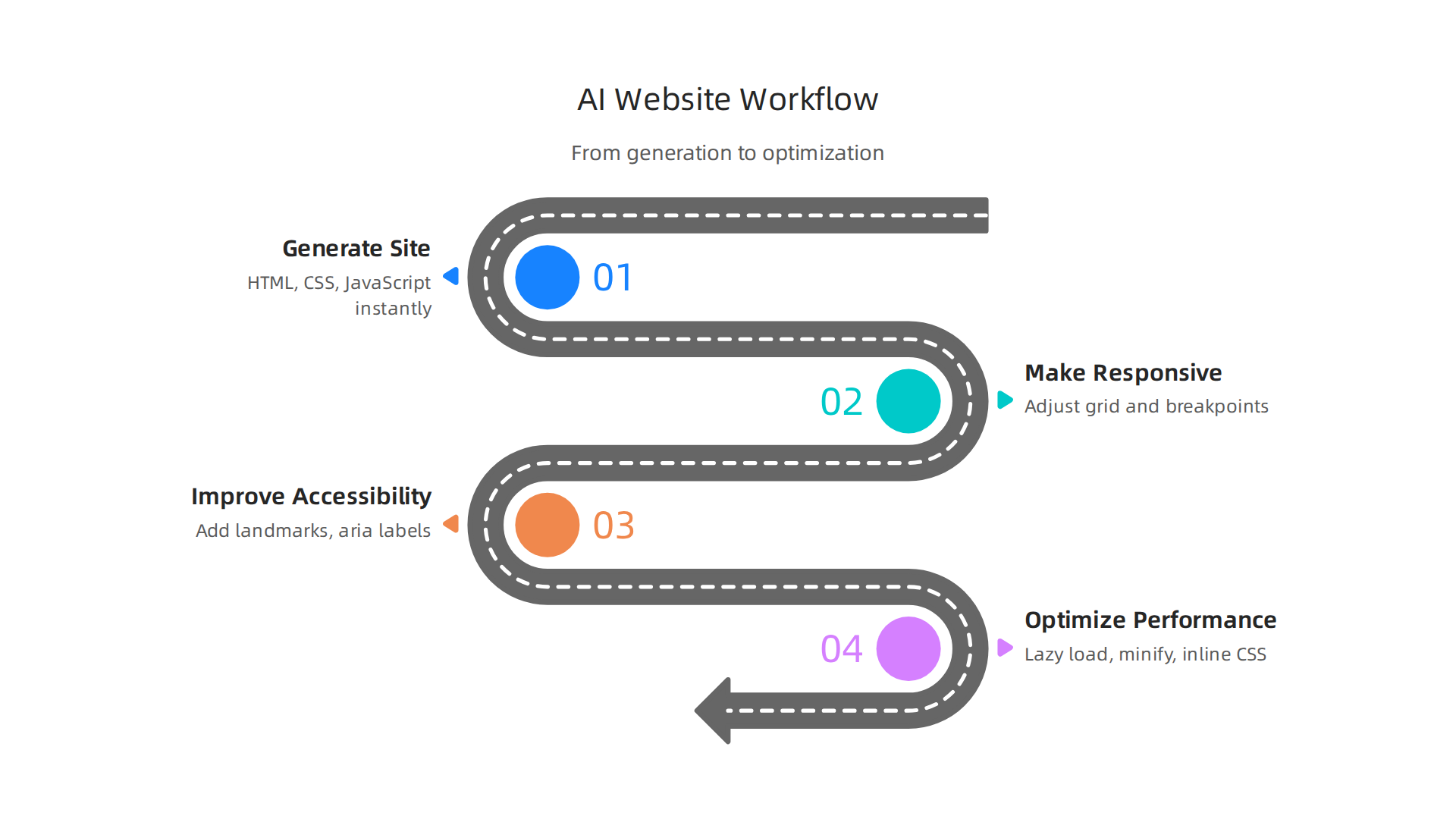
Imagine this workflow. You type "Build a landing page for my analytics tool with a hero section, three feature cards, a testimonial carousel, and a contact form." Your personal AI generates the HTML, CSS, and JavaScript instantly. Then you ask it to make the page responsive on mobile. It adjusts the grid, resizes images, and adds breakpoints. Next, you ask for accessibility improvements. It adds semantic landmarks, aria labels, and checks color contrast. Finally, you ask for performance optimization: lazy loading images, minifying assets, and inlining critical CSS.
All of that in a few minutes.
This is not just about speed. It’s about quality. The AI helps you hit responsive design, accessibility compliance, and performance best practices without digging through documentation. The same MIT Sloan research we mentioned earlier shows that developers using AI coding tools shift more time to core coding work. In this context, the core work is the unique logic and copywriting — not wrestling with CSS grid or writing cookie-cutter HTML.
If you want to learn more about how no-code and low-code AI tools are reshaping the entire development process, check out this guide on how building without code is transforming software development in 2026.
After your AI generates and refines the code, you can deploy using a platform like Hostinger AI website builder. It integrates directly with many AI outputs, letting you publish with a click.

The result is a production-ready site with proper SEO, analytics, and a custom domain — all built with your personal AI as your design assistant.
The takeaway is simple. Personal AI does not just accelerate backend coding. It turns website creation into a conversational, iterative process. You describe what you want, the AI builds it, and you polish together. That is the new normal in 2026.
Integrating Personal AI into Your Development Workflow
You have seen how personal AI can generate code and build entire websites. But the real magic happens when you weave that AI into your everyday development workflow. In 2026, the teams that get the most value from AI are not the ones with the most powerful tools. They are the ones that integrate personal AI directly into their IDEs, CI/CD pipelines, and project management systems.
Start with your code editor. Most modern IDEs now support AI plugins that learn from your project. You can train your personal AI on your team’s coding conventions, naming rules, and architectural patterns. For example, you can feed it your last 50 pull requests and ask it to match your style. Over time, it stops suggesting generic code and starts writing code that looks like it came from your team. The same approach works for frameworks. If your team uses React with a specific folder structure, your AI can remember that and generate new components the right way every time.
Next, connect your AI to your CI/CD pipeline. Imagine every pull request automatically gets a review from your personal AI. It checks for style violations, missing tests, and security issues. It can even suggest fixes. This is not about replacing human review. It is about catching the small stuff so your team can focus on logic and architecture. The ShiftMag analysis of AI productivity in 2026 found that teams winning with AI set clear goals and measure results. When you integrate AI into your CI/CD, you get measurable improvements in pull request cycle time and code quality.
Project management is another area where personal AI shines. You can have your AI summarize daily standup notes, estimate the effort for new tickets, and even suggest task assignments based on each developer’s strengths. This turns your AI into a team assistant that helps everyone stay aligned.
A key best practice is to feed your AI your team’s project history. The more context you give it, the better its output. Many personal AI tools now offer persistent memory or custom knowledge bases. Upload your architecture docs, style guides, and past sprint retrospectives. Your AI will then answer questions with the same context your team has.
The learning curve is real. Some developers resist using AI because they worry it will make bad suggestions or slow them down. The fix is simple. Start with one small workflow, like AI-assisted code review on a single repository. Measure the time saved and the error rate. Share those numbers with the team. Once people see real gains, buy-in comes naturally. According to 2026 developer productivity benchmarks, teams that combine AI adoption with structured measurement see 2.5 to 3.5 times return on investment.
If you want to stay ahead of how AI is reshaping the entire engineering workflow, consider subscribing to a newsletter that delivers clear daily insights on these trends. Start with The Deep View Newsletter for concise updates you can actually use.
Overcoming Challenges: Privacy, Bias, and Reliability
After connecting your personal AI into your development workflow, the next step is understanding the risks. In 2026, independent research testing over 100 large language models found that 45% of AI-generated code contains security flaws. That is a number that should grab your attention. The good news is that you can manage these risks with the right strategies.
The biggest concern for most teams is data leakage. When you paste proprietary source code into a third-party AI tool, that data leaves your control. It travels to external servers where it could be stored, learned from, or exposed. Many developers do not realize they are sharing API keys, database schemas, and internal architecture details. A deep investigation into the security risks of AI coding assistants reveals that most prompts to these tools transmit proprietary context without any filtering. The fix is to use local models that run entirely on your own hardware. Tools like Spark AI and Lightchain AI offer on-premise options that keep your code where it belongs. Sanitize your inputs too. Never paste credentials or internal secrets into a chat window.
Bias in AI suggestions is another real problem. A personal AI trained on public code repositories learns from millions of projects. Some of those patterns are outdated or insecure. The AI does not understand security. It predicts what code is statistically likely to appear next. That is why insecure coding patterns show up so often in its output. The solution is a curation layer. Feed your AI only high-quality, vetted code from your own team. Create a custom knowledge base with your style guides, approved libraries, and past code reviews. This trains your personal AI to match your standards instead of the average quality on the internet.
Reliability might be the hardest risk to manage. AI models hallucinate. They invent function names that do not exist, import libraries that are not real, and suggest APIs that return different data than promised. A major analysis of the hidden risks of LLMs in 2026 found that 55.8% of AI-generated code contains at least one critical vulnerability. That means the code is broken by default. Your best defense is a strict human-in-the-loop validation process. Every line of AI-generated code needs the same review you would give a junior developer. Treat the output as a first draft, not a final answer.
Regulatory pressures add another layer. If you work under GDPR or SOC2, you cannot send customer data through an unverified AI pipeline. You need to audit your AI tools, log all prompts, and document how your team uses these systems. Numerous AI platforms now offer compliance reporting built in. But the responsibility still sits with your engineering team.
The bottom line is simple. Your personal AI is a powerful assistant, but it makes mistakes. Some of those mistakes can cost you time, money, and customer trust. The teams that succeed are the ones that pair AI speed with human judgment. If you want to explore more ways to keep your code safe while using AI, check out our practical guide on how to bridge the AI to human gap in your code.
The Future of Personal AI in Software Engineering
The risks are real, but the direction is clear. Your personal AI is about to become much more than a code completion tool. In 2026, we are moving from AI copilots that suggest the next line to AI agents that handle entire tasks on their own. According to a detailed analysis of how AI is reshaping software development in 2026, this year marks the shift from reactive assistants to autonomous operators.
Personal AI Gets Autonomous
Think about what your personal AI could do if it did not need your hand on the wheel. It would read your project requirements, plan the architecture, write the unit tests, run them, fix failures, and open a pull request. All without you typing a single line. That is the direction we are heading. Tools like Spark AI and Lightchain AI already run locally and keep your data safe. Soon they will also manage project context, track dependencies, and even decide which tasks to prioritize.
This autonomy saves you time on boring work. Instead of writing boilerplate tests, you tell your AI to do it. Instead of digging through error logs, your AI finds the root cause and suggests a fix. The human judgment you bring is still critical, but the execution becomes faster.
AI Agents Talking to Each Other
Here is where things get really interesting. In the near future, your personal AI will not work alone. It will coordinate with other personal AIs from your team or even from outside your organization. Imagine one AI agent generates the backend code, another writes the frontend components, a third runs regression tests, and a fourth monitors the deployment pipeline. They share context, flag conflicts, and escalate issues to you when needed.
This kind of multi-agent collaboration is already appearing in production systems. Numerous AI platforms now offer dashboards that let you manage multiple agents at once. Your role shifts from writing every line to orchestrating this digital team.
The New Role of the Engineer
All of this points to one big change. The job of a software engineer in 2026 is less about typing code and more about making smart decisions. You design the system. You choose which AI agents to trust.

You validate their output. You handle the edge cases that agents miss.
Gartner predicts that by 2030, 80% of large teams will shrink into smaller AI-augmented groups. That means senior engineers who can architect systems and guide agents will be in high demand. The routine coding tasks disappear. The strategic thinking stays.
To keep up with these changes, you need reliable, daily intelligence on what works and what is hype. That is exactly why we recommend The AI Newsletter Worth Reading. It delivers clear updates on AI tools, trends, and best practices straight to your inbox every day.
For a closer look at how personal AI is already changing daily workflows, check out our full guide on personal AI assistants reshaping developer workflows. The future is coming fast. The teams that prepare now will lead the way.
Summary
This article explains how ‘personal AI’—a context‑aware assistant trained on your codebase and team history—can transform software teams by reducing busywork, improving code quality, and accelerating site and product delivery. It covers what makes personal AI different from generic chatbots, summarizes research and industry metrics showing time savings and productivity gains, and gives concrete examples of using AI for website building and CI/CD integration. The piece also covers practical adoption steps: integrating AI into editors and pipelines, running small pilots, and measuring results to build team buy‑in. It warns about real risks—data leakage, biased or insecure suggestions, and hallucinations—and recommends defenses like local models, curated knowledge bases, and human‑in‑the‑loop review. Finally, it looks ahead to autonomous AI agents and multi‑agent collaboration that will shift engineers toward orchestration and system design. After reading, you’ll know the benefits, where to start, how to mitigate risks, and what skills and tools to prioritize for AI‑augmented development.