

Introduction: Why precision matters when people say “AI”
In 2026, it feels like everyone is talking about "AI." This buzz is exciting, but it also causes a lot of confusion. When people use "AI" as a catch-all word, it makes things tricky for engineers and business leaders alike.

Think about it: if you’re trying to pick the right tools or build new systems, not knowing exactly what kind of AI you’re talking about can lead to big problems. This lack of clear language can make choosing the right architecture, buying new software, or even setting up rules for how AI is used much harder.
Actually, there are many different types and categories within the vast world of artificial intelligence. Experts use terms like "AI taxonomy" to organize these different areas and help everyone speak the same language. For example, some AI systems are designed to make predictions, while others are built to create new things, like text or images. Understanding these distinctions is key.
This guide is here to help you sort through the noise. We will focus on the important difference between general AI ideas and what we call generative AI. Generative AI models are special because they can create completely new content, which is a big part of the current AI revolution. By clearly telling the difference between general AI and generative AI, engineering teams can make much better choices. This is crucial when you are trying to pick the most popular AI tools or figure out the best AI prompts for your projects.
Throughout this guide, we will define these terms simply, compare their technical features, and give you real-world tips for how to evaluate different AI systems. This will help your team avoid common pitfalls and succeed, especially when you need to evaluate and integrate generative AI platforms for developer teams. Understanding these different AI types based on what they do can also show you how to get the best return on your investments. Our goal is to give you the clear understanding you need to navigate the rapidly changing AI landscape.
Want to stay informed about the latest AI breakthroughs without all the extra noise?
The AI Newsletter Worth Reading delivers clear, daily updates right to your inbox.
To get that clear understanding, we need to first look at how experts classify AI systems. This way of organizing AI is called an AI taxonomy. Think of it like a map for all the different kinds of AI out there. It helps engineers and business leaders speak the same language and make smart choices, especially when trying to use the most popular AI tools or create the best AI prompts for their projects.
A good AI taxonomy helps us sort things into useful groups. It separates:
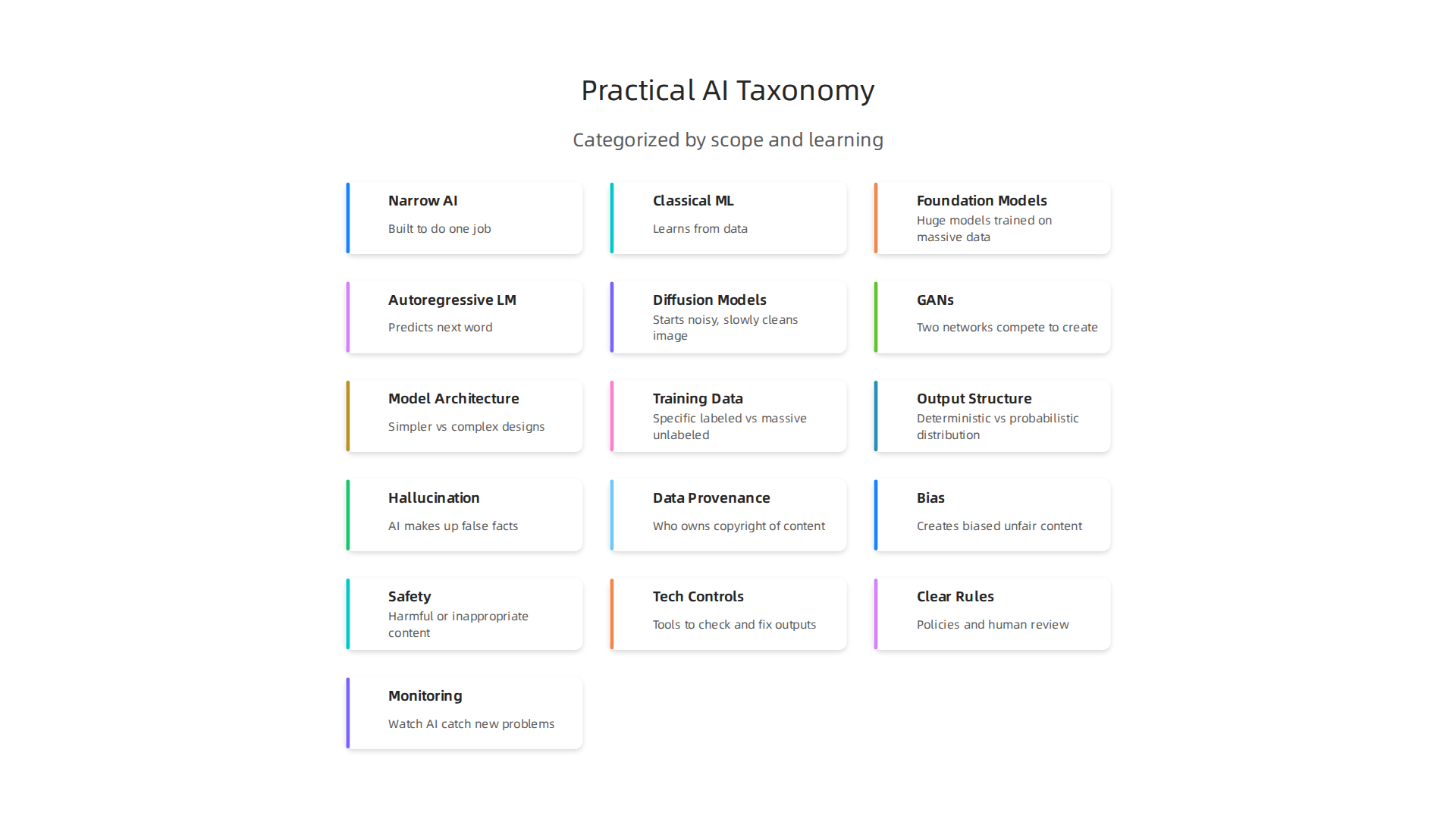
- Narrow or Task-Specific AI: These systems are built to do just one job very well. For example, an AI that only recognizes faces in photos, or one that recommends a movie you might like. It’s like a calculator that only does math; it doesn’t try to write a poem. This kind of AI is sometimes called "weak AI" because it doesn’t think generally, but it’s very powerful for its specific task The Hackett Group® Glossary Definition of AI Taxonomy.
- Classical Machine Learning (ML) Pipelines: These are older, but still very important, ways of using AI. They involve systems that learn from lots of existing data to find patterns and make predictions. Imagine a system that learns to spot spam emails by looking at thousands of old spam and non-spam messages. These systems follow a clear set of steps, or a "pipeline," to get their work done.
- Large-Scale Foundation Models: This is where the modern AI revolution gets really exciting. These are huge AI models trained on massive amounts of data. They can do many different things, like understanding language, creating images, or writing code. Many of these are at the heart of what we call generative AI. They form a "foundation" because many other AI applications can be built on top of them.
Understanding where an AI system fits in this practical taxonomy helps you know what it can actually do. It clarifies what the system is good at and where it might fail. For example, you wouldn’t expect a narrow AI for image recognition to write a story. This classification also tells you what kind of computer power and data it needs to run. Thinking about these different AI domains is crucial for planning.
When engineering teams look at AI, they also need to think about practical concerns. This includes how much data an AI model needs, how much computing power (compute) it uses, how fast it delivers results (latency), and how easy it is to watch and understand what it’s doing (observability). A shared AI taxonomy provides a common language for everyone involved to discuss these important technical details and avoid common pitfalls that can make AI projects fail.
Okay, we’ve talked about different kinds of AI like narrow AI and the older ways machines learn. But the big "AI revolution" everyone is talking about in 2026 really shines a light on something called generative AI. This kind of artificial intelligence is special because it doesn’t just understand or predict; it creates.
2) What is generative AI? Core mechanisms and model families
Generative AI refers to smart computer systems that can make brand-new content. Think of it this way: instead of just finding existing pictures, a generative AI can draw a picture that has never been seen before. It can also write text, make music, or even create computer code, all based on simple instructions or "prompts" you give it. This ability to generate new things is what makes it so powerful and different from traditional AI systems.
These creative AI systems work using different "model families," each with its own way of learning and creating. Some of the most popular ai tools in this area include:
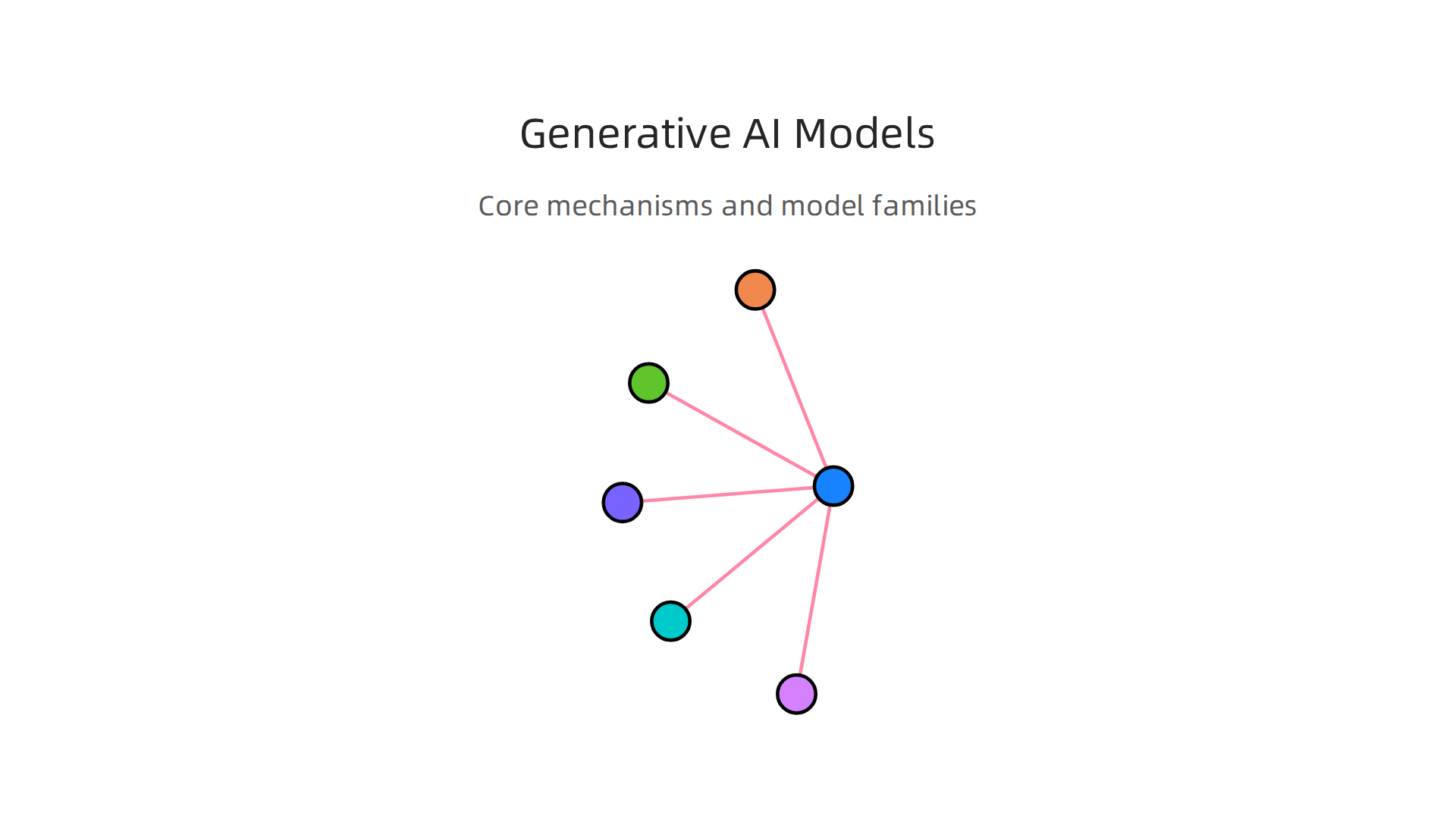
- Autoregressive Language Models: These are the brains behind many chatbots and text generators. They predict the next word in a sentence based on all the words that came before it. Imagine it writing a story, one word at a time, trying to make sure each new word makes sense with what’s already written. This is often how you get the best ai prompts to work when asking for creative writing.
- Diffusion Models: These models are great at making images and videos. They start with a fuzzy, noisy image and slowly clean it up, step by step, until it looks like a clear, new picture that matches your prompt. Many of the impressive AI-generated art you see today comes from these models A Survey on Generative Diffusion Models.
- Generative Adversarial Networks (GANs): GANs are a bit like two AIs playing a game. One AI, called the generator, tries to create new content (like fake photos). The other AI, called the discriminator, tries to tell if the content is real or fake. By constantly trying to fool the discriminator, the generator gets better and better at making very realistic new content Advancements in Generative AI: A Comprehensive Review of GANs, GPT, Autoencoders, Diffusion Model, and Transformers. These models have been reviewed for many uses, even helping with medical images A systematic review of generative AI approaches for medical image enhancement: Comparing GANs, transformers, and diffusion models.
Knowing how these models are trained and how they make their choices helps us understand why they act the way they do. Their "training objective" is their main goal during learning. This goal can explain why an AI might be super creative, sometimes repeat itself, or even "hallucinate" by making up facts that aren’t true. For engineering teams, understanding these deep details is key to knowing how to evaluate and integrate generative AI platforms for developer teams into their projects.
To stay on top of all the fast-changing news in AI, including the latest generative AI tools and best practices, many professionals turn to trusted resources.
Get clear daily AI updates from The AI Newsletter Worth Reading.
We just looked at the different kinds of generative AI models, like those that write words or make pictures. Now, let’s dive deeper into what makes generative AI truly different from older, more traditional AI. It’s not just about what they do, but how they are built, what they learn from, and how they show their answers. Understanding these key technical differences helps us see why the "AI revolution" of 2026 is so impactful.
3) Key technical differences: architecture, training data, and outputs
When we talk about "ai vs generative ai," we’re really looking at a few main things: their inner design, the information they learn from, and the way they give us results.
How They’re Built: Model Architectures
Think of an AI’s architecture as its brain structure. Traditional AI often uses simpler structures, sometimes like decision trees or rule-based systems, which are good for tasks like sorting emails or recommending products. They follow clear steps.
Generative AI, however, often uses more complex and flexible architectures, like the Transformer models you might find behind text generators, or Diffusion models for images. These systems are designed to find patterns in vast amounts of data and then use those patterns to create something new. For instance, Transformer models are super good at understanding language context, which is key for making sense of and generating text that sounds natural An Automated Survey of Generative Artificial Intelligence. Other models, like Diffusion Transformers, are making waves in creating stunning images, sometimes even outperforming older methods like GANs in certain tasks Diffusion Transformer vs GAN: Which Generates Better Images?. Because these advanced architectures are so complex, they need a lot more computer power and memory to run, which affects how engineering teams plan their projects.
What They Learn From: Training Data
Another big difference in "ai vs generative ai" is their training data. Older AI models usually learn from very specific, labeled data. For example, an AI that tells if a picture shows a cat or a dog would learn from thousands of pictures already marked as "cat" or "dog." This is like teaching a child one specific thing.
Generative AI models, especially what we call "foundation models," learn from a massive amount of varied and often unlabeled data from the internet. Imagine reading almost every book, article, and website ever made. This broad training allows them to understand many different topics and create diverse content across various "ai domains." However, processing such huge datasets can be very costly in terms of time and computing power, especially for models like autoregressive text-to-image systems Text-to-image Diffusion Models in Generative AI: A Survey. This wide learning also means they can respond to many different types of instructions, making the "best ai prompts" a skill in itself for users to master.
How They Give Answers: Output Structure
Finally, how these AIs give answers is very different. Traditional AI often gives a single, certain answer. If you ask it to tell you if a picture is a cat, it will say "yes" or "no." This is a predictable, "deterministic" output.
Generative AI, on the other hand, creates content that is more like a "probabilistic distribution." This means it generates content that could be one of many possible correct answers. When you ask it to write a story, there are countless ways that story could unfold, and the AI picks one based on its learned patterns. This creative freedom is amazing, but it also means checking their work is harder. It’s not always a simple right or wrong. Because of this, testing, watching for errors, and understanding when an AI might "make up" facts (called hallucinating) becomes very important. It’s why thinking about Context Engineering vs. Prompt Engineering: Architecting Robust AI Systems is so vital for getting reliable results. Ignoring these complexities can even lead to Why AI Projects Fail: How to Prevent Common Traps and Succeed.
Now that we’ve seen how generative AI is built and how it learns, let’s think about what this all means for the teams who build and manage these systems every day. The differences between traditional AI and generative AI lead to very different jobs for engineering teams, especially when it comes to setting things up, paying for them, and keeping them running smoothly.

4) Practical implications for engineering teams (architecture, cost, and maintenance)
The kind of AI you work with really changes how you do your job as an engineer. The "ai vs generative ai" talk quickly becomes a question of how to set up your technical systems, how much money you need, and what it takes to keep everything working.
Setting Up and Running AI Systems
Traditional AI often fits into existing computer systems more easily. These systems might need special software or a good amount of computing power, but they are often more predictable.
Generative AI, however, is a different story. Because these models are so big and do complex tasks, they need special computer systems to run well. This means teams must think about new ways to deploy their models, how to handle many users at once (scaling), and how to watch for problems. For instance, services like Amazon SageMaker AI now offer help to optimize generative AI deployment, looking at your model’s design to reach goals like lower cost or faster response times Amazon SageMaker AI launches optimized generative AI. Getting a quick response is super important; by 2026, people expect AI answers in less than one second AI Performance Optimization Guide 2026. This demand for speed makes planning complex. To learn more about setting up these advanced systems, you can explore resources on how to evaluate and integrate generative AI platforms for developer teams.
How Much They Cost
When we talk about "ai vs generative ai," the cost is a major difference. Traditional AI might need a good computer, but generative AI often needs much more powerful hardware, especially graphics processing units (GPUs). These big models use a lot of computing power every time they create something new. This means bigger electricity bills and more expensive computer parts.
In 2026, many companies are looking at how to cut these costs. For example, hosting generative AI models on your own computers, instead of using cloud services, can offer big savings. One report shows it can be up to 6 times cheaper per million "tokens" (small pieces of text) compared to cloud options On-Premise vs Cloud: Generative AI Total Cost of Ownership 2026 Edition. Finding ways to make these systems efficient is key, especially as more businesses join the "AI revolution."
Keeping Them Working (Maintenance)
Keeping any AI system healthy takes work, but generative AI brings its own challenges.
Traditional AI might need new training data every now and then, but changes are often slow. You watch for "data drift," where the new data doesn’t look like the old data the AI learned from.
For generative AI, maintenance is more hands-on. Because these models are so creative, they can sometimes make mistakes or even "hallucinate" (make up facts). So, teams need to constantly check the quality of their outputs. They also need to think about how often to retrain these models with new information and manage different versions of the models. Keeping track of how context is given to the AI, which is called context engineering, is also crucial for stable results. Understanding topics like Context Engineering: The 2026 Guide for Agile and DevOps Teams can help teams make sure their AI systems stay reliable.
The "AI revolution" means that engineering teams need to learn new skills and tools. It’s not just about building AI anymore, but about truly understanding the deep differences that impact their daily work and long-term planning.
Stay ahead of the curve and get clear daily AI updates to navigate the rapidly evolving tech industry.
The AI Newsletter Worth Reading
Understanding these core differences is just the first step. Next, teams need to know how to pick the right AI tool for the job. This is where evaluating generative AI tools against other AI platforms becomes super important. Knowing the difference between "ai vs generative ai" deeply affects how you make these choices.
5) How to evaluate generative AI tools versus broader AI platforms
When you want to use AI for your work, you have to choose carefully. It’s not enough to just know what AI can do; you also need to know how to tell if a tool is truly good for what you need. This is especially true for generative AI, which works differently from older, traditional AI systems.
What to Look For When You Evaluate AI
When you’re looking at AI solutions, especially generative AI, you need a clear way to measure how good they are. A good evaluation plan looks at several important things:
- Does it do the job? This means checking if the AI can actually complete the specific task you want, like writing a story or making a picture.
- Is it telling the truth? Generative AI can sometimes make up facts, which we call "hallucinations." You need to test how often this happens.
- How fast is it? This is called "latency." People expect quick answers from AI in 2026, so speed matters a lot.
- How much does it cost? Some AI tools are very expensive to run, especially generative ones.
- Is it safe to use? You need to make sure the AI won’t create harmful content or act in bad ways.
Looking at factors like how fast the AI responds (latency) and its cost is crucial. Services like AWS help teams build systems to automatically check these things Build an automated generative AI solution evaluation pipeline.
Different Ways to Measure Goodness
The way you measure how good an AI is changes a lot between traditional AI and generative AI.
For regular AI, you might just count how many times it gives a clear "yes" or "no" answer correctly. But for generative AI, you’re asking it to create something new. This means you need different ways to measure if it’s good. You have to think about how well it creates, how new its ideas are, and if it meets what users expect.
New benchmarks in 2026 are helping with this. Tools like ConsumerBench check how well generative AI works on everyday devices, looking at speed and how much computer power it uses ConsumerBench: Benchmarking GenAI on End-User Devices. Other tools, like GenAI-Perf, help measure how fast these large language models (LLMs) create content and how long it takes to get the first part of an answer Benchmarking LLM Applications Part 1 What is GenAI-Perf?. Learning about Dedicated AI Cluster Performance Benchmarks in Generative AI can show you what to look for.
Real-World Testing and Safety
To truly know if an AI tool is right, you need to test it thoroughly. This means you don’t just trust the AI; you test it in many ways. You might give it fake problems to solve (synthetic tests) and then let real people try it (real-world tests).
It’s also smart to try and "break" the AI by giving it tricky or bad requests. This is sometimes called "red-teaming" or finding the most accurate AI detector 2026 if you’re checking for AI-generated content. These tests help make sure the AI is safe for everyone who uses it. To make sure your AI projects don’t hit unexpected snags, it’s wise to understand Why AI projects fail and how to avoid common mistakes.
In the end, picking the right AI, especially with generative AI, needs careful thought. It’s not just about what it can do, but how well, how fast, how safe, and how much it costs to do it.
Even with careful checks, when we talk about AI, especially the difference between general AI and generative AI, some ideas can get mixed up.

It’s like thinking a smart calculator understands math in the same way a human does. That’s a common mistake.
What People Often Get Wrong About Generative AI
One big misunderstanding is believing that generative AI truly "understands" things like a person does. It doesn’t. While it can write amazing stories or make stunning images, it’s really good at finding patterns in huge amounts of data and then creating something new based on those patterns. It doesn’t have feelings or real thoughts.
Another big mistake is thinking generative AI will always tell you the truth. It’s actually quite prone to "hallucinations." This means the AI can make up facts or details that sound right but are completely false. This risk of hallucination is a serious concern, and managing it is very important for businesses using these tools Managing hallucination risk in LLM deployments at the EY …. It’s crucial for teams to use things like human review before letting AI-created content go out Generative AI Ethics: The 7 Biggest Risks Leaders Can’t ….
Big Worries: Ethics and Safety
When AI, especially generative AI, becomes more common in 2026, new worries come up. These are called ethical concerns and risks.
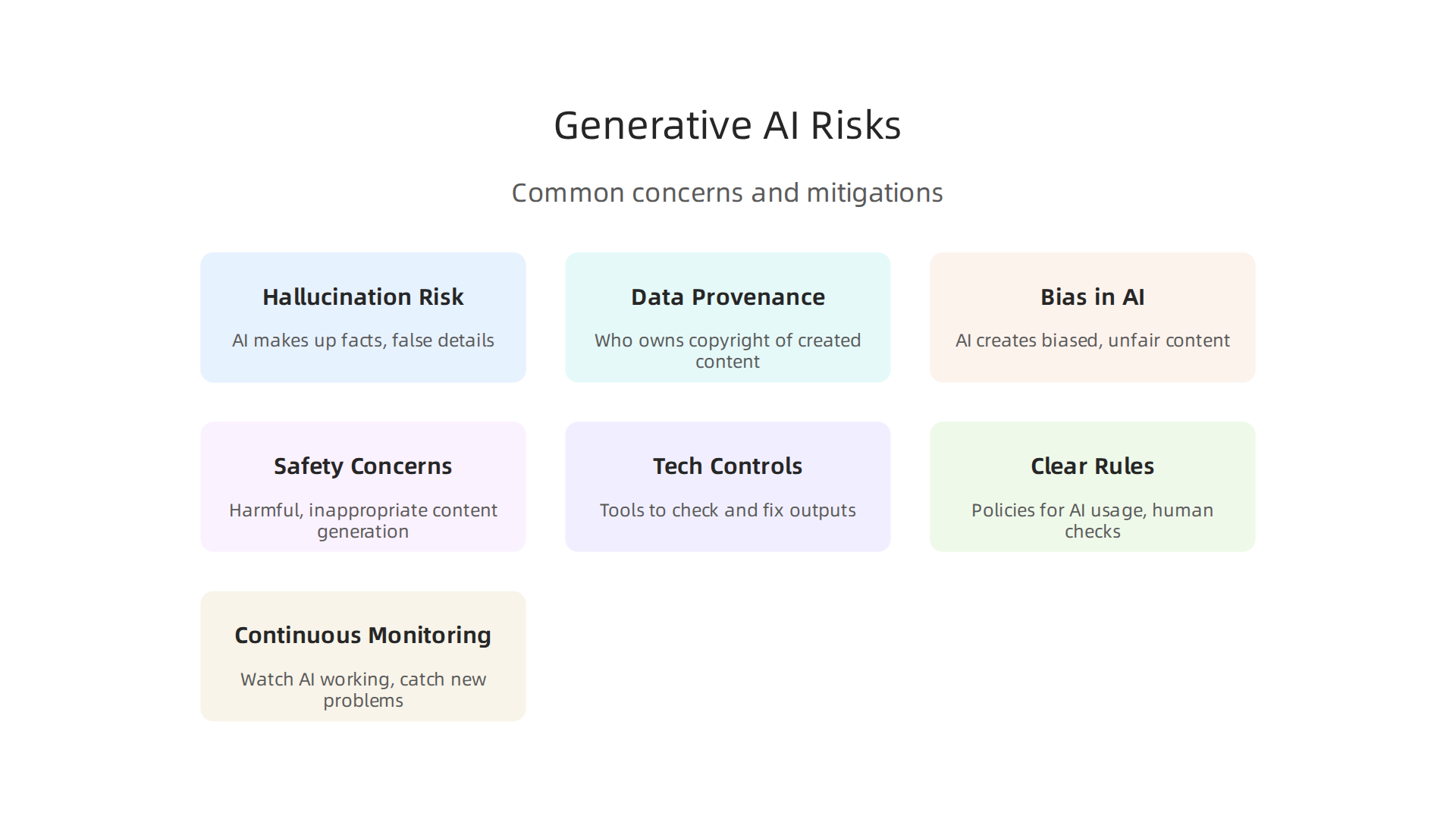
- Who owns what? If an AI creates something, who owns the copyright? What if the AI used copyrighted work to learn from? This is about "data provenance" which means knowing where the data came from NIST AI 600-1 Generative AI Profile – AI Governance Institute.
- Is it fair? AI learns from data given to it. If that data has biases (unfair ideas) in it, the AI might also create biased content. This can make existing problems worse.
- Is it safe? Sometimes, generative AI can create harmful, unfair, or inappropriate content. We need to make sure the AI is used safely and does not put users at risk Ethical Concerns of Generative AI and Mitigation Strategies. Companies also need to protect sensitive information they upload to AI tools, to avoid accidentally sharing private data Guidelines for the Ethical Use of Generative Artificial ….
How to Stay Safe: Lowering the Risks
To deal with these problems, we need good plans. This means a mix of:
- Tech controls: Using special tools to check what the AI creates and to fix bad outputs. This includes monitoring for issues like hallucination and bias Risk, Ethics and Trust in Enterprise Generative AI: A Practical Control Framework for CIOs & Boards.
- Clear rules: Having policies that explain how people should use AI and what is not allowed. This includes needing human checks for content that affects important decisions Hallucination, Bias, Model Drift & AI Risk.
- Always watching: Keeping an eye on how the AI is working over time to catch new problems. This means continuous monitoring and making sure all AI systems are accounted for, even "shadow AI" that might pop up in a company. The NIST AI 600-1: Generative AI Risk Profile (United States, 2026) offers a way to identify and fix these risks.
It’s about making sure that as the AI revolution moves forward, we are thoughtful about how we use these powerful tools. Learning to balance AI productivity with responsible AI practices for software teams is key.
Want to stay on top of the latest AI trends and how they impact software engineering? Get clear daily AI updates. The AI Newsletter Worth Reading delivers in-depth insights directly to your inbox.
Adoption Patterns and Integration Strategies for Engineering Teams
As the AI revolution moves forward, engineering teams need smart ways to bring generative AI into their daily work. This isn’t a one-size-fits-all process. How a team adopts these tools depends on what they need, how much control they want, and their budget.
Some teams choose an "API-first" approach. This means they use generative AI models that are hosted by other companies through a simple connection called an API. It’s like plugging into a service. This is often the quickest way to start using these powerful AI domains, requiring less setup from the team itself.
Other teams might want more control. They might take an existing AI model and "fine-tune" it with their own data. This makes the AI better at specific tasks for their company. For even more control and security, some bigger organizations might choose "on-prem serving." This means they run the generative AI models on their own computers and servers, keeping everything in-house. However, companies face many common challenges when adopting enterprise AI, and good planning is essential to avoid problems Enterprise AI Adoption Challenges: A 2026 Playbook.
Smart Ways to Bring AI into Your Work
To truly use generative AI well, engineering teams need clear plans. These plans should include:
- Clear Goals: Before starting, define what success looks like. How will you measure if the AI is actually helping?
- Small Tests (Pilot Scopes): Don’t try to change everything at once. Start with small projects to test the AI. This helps you learn and fix problems early.
- Teamwork and Rules: Different teams need to work together. This means having rules for how data is used and making sure everything is safe. If you’re wondering how to evaluate and integrate generative ai platforms for developer teams, these steps are crucial. It also helps to understand why ai projects fail how to prevent common traps and succeed before starting.
MLOps for Generative AI
When we talk about managing and updating AI models, especially in the context of "ai vs generative ai", we often use a term called MLOps. This stands for Machine Learning Operations. For generative models, MLOps needs special attention. It’s about making sure your AI tools keep working well over time.
This means building special pipelines for:
- Model Packaging: Getting your AI models ready to be used in real products.
- Evaluation: Checking regularly if the AI is still performing as expected.
- Prompt and Version Management: Keeping track of the "best ai prompts" that work well, and managing different versions of your AI models. Thinking about context engineering vs prompt engineering architecting robust ai systems is a big part of this.
These steps help move generative AI from a test project to a working part of a company. Many companies are already using smart MLOps practices to make their AI systems better in 2026 LLMOps in Production: 457 Case Studies of What Actually Works. It’s all about making sure that the new tools of the AI revolution are used effectively and safely. Getting generative AI into daily operations at scale requires a clear, phased strategy that builds on current skills instead of replacing them all at once Operationalizing Generative AI at Enterprise Scale.
Summary
This article clarifies the confusing shorthand