

Why Modern Engineering Teams Must Rethink AI Tooling and Ethics
It’s 2026, and the world of technology is moving faster than ever, especially with Artificial Intelligence (AI). Engineering teams today face new, big challenges. The tools we use to build AI are growing quickly, bringing both amazing chances and tricky problems.
Many new AI tools are helping software development engineers do their jobs better. Tools like Lightning AI, for example, are making it easier to create and use AI.
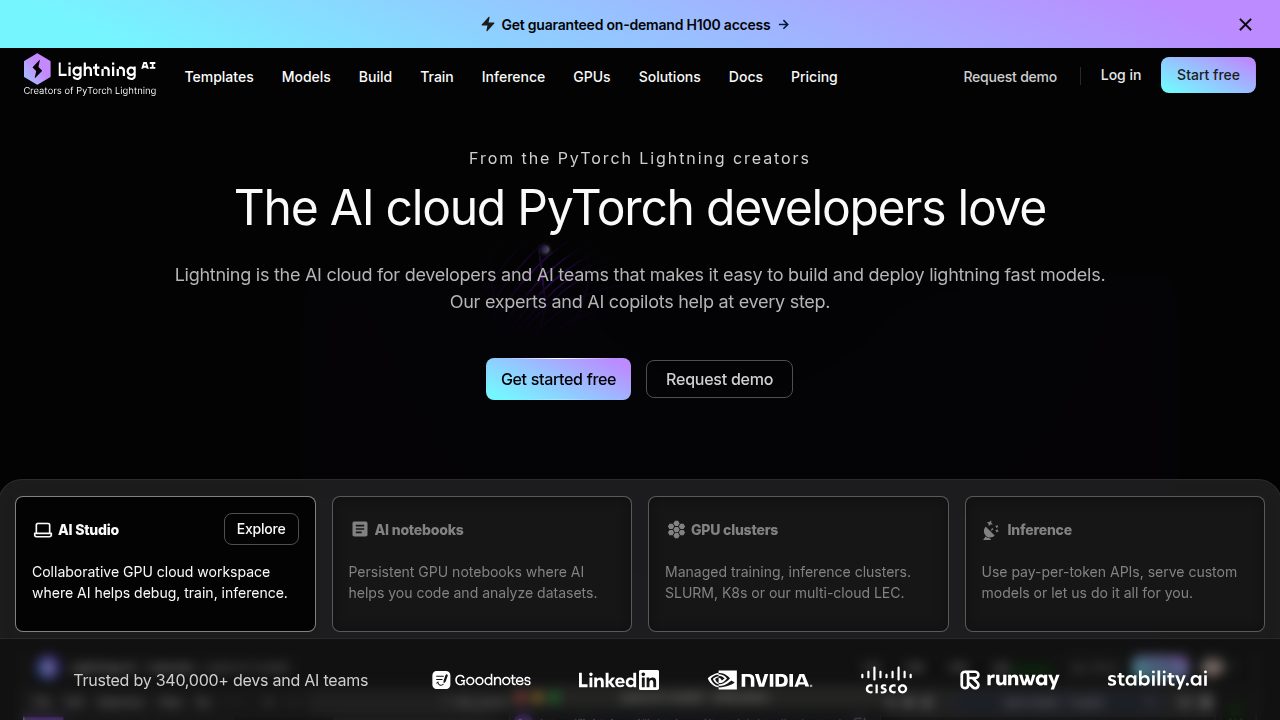
Lightning AI even offers ways to put AI models into action and connect with other programs smoothly, as seen in its review and integration options. Some tools allow AI agents to work directly with payment systems, showing how smart AI is becoming New Developer Tools Enable Lightning And AI Communities To …. The number of AI tools that can change how we work and build apps has really grown The Complete List of 11 AI Tools Transforming App ….
But with all these cool new tools, engineering teams have a double task. First, they need to pick the best tools that truly help them build things faster and better. This means choosing tools that fit well with how they already work, especially for tasks like data integration and preparing models. Second, and just as important, teams must make sure they use AI in a fair and right way. This is called embedding robust AI ethics. It means thinking about how AI choices affect people, from start to finish in every project.
It’s not enough just to make AI work. We must also make sure it works for good. This new focus on both smart tools and strong ethical rules is changing how engineering teams think about their work every day.

Understanding these shifts is key for any software development engineer looking to stay ahead. For more on how AI is changing our field, check out the latest Engineering Technology Trends 2026: How AI and Platform Engineering Are Reshaping Development.
To keep up with these fast changes in AI and technology, it helps to have reliable information.
Get clear daily AI updates from The AI Newsletter Worth Reading.
Understanding Lightning AI: Core Features, Architecture, and When to Adopt
After learning about the general need for smart AI tools and strong ethics, let’s look closer at one important tool: Lightning AI. This tool helps make working with AI models much simpler, especially for those using PyTorch. It does not replace PyTorch, but rather makes it much more powerful and easy to use Unleashing AI Velocity: A Deep Dive into Lightning AI and PyTorch ….
What Lightning AI Offers
Lightning AI stands out from other tools by making a software development engineer’s job much easier. Here are its main benefits:
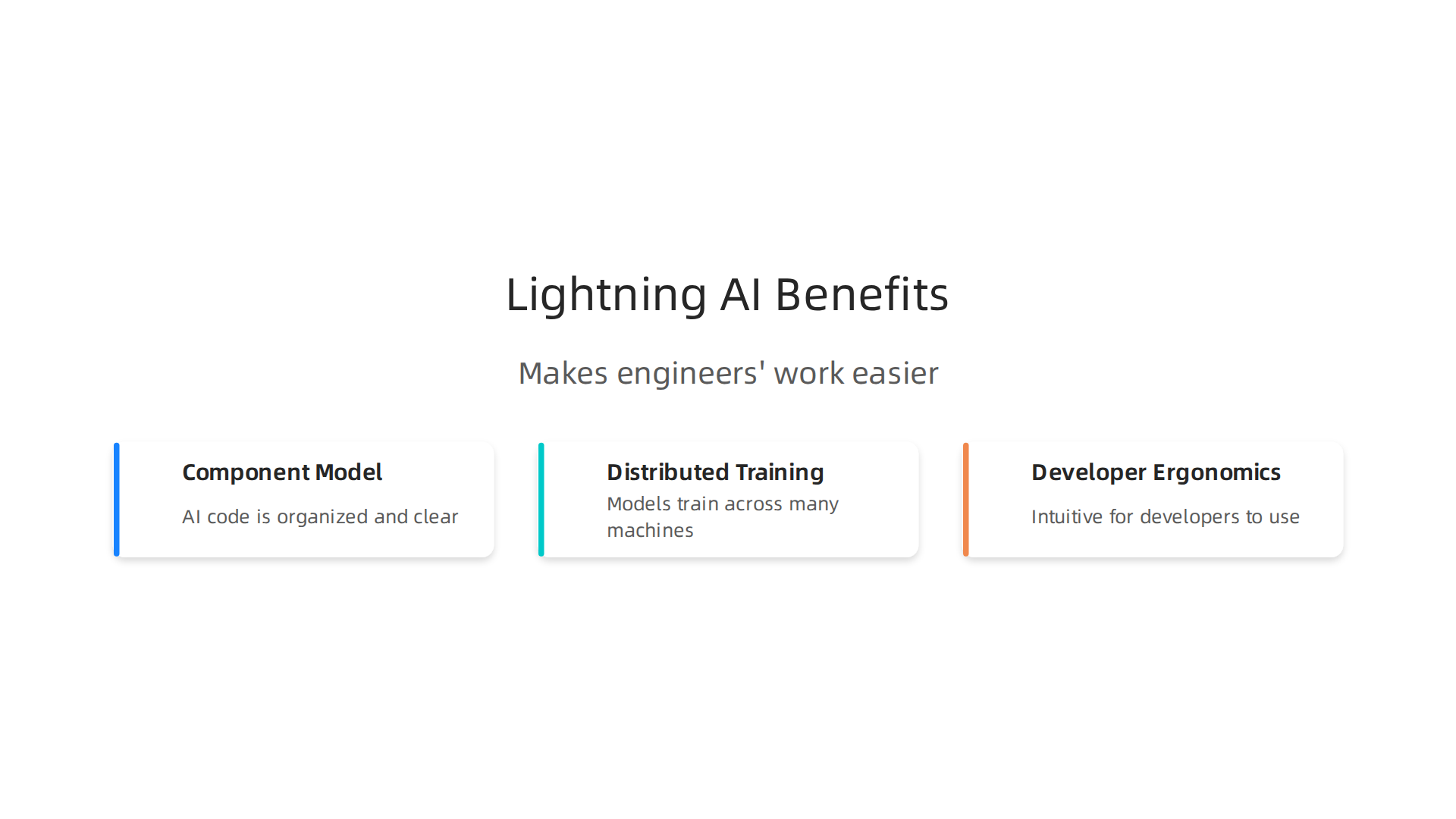
- Component Model: Imagine building a big toy car. Instead of having all the tiny pieces scattered, the component model helps you put them into neat, labeled boxes. This means your AI code is organized and clear. It takes away many common coding tasks that used to be done over and over, helping to augment AI development and make it more efficient.
- Distributed Training: Sometimes, AI models need a lot of computer power to learn. This might mean using many computers at once. Lightning AI helps your models train across many machines without you having to write complicated code for it. This makes scaling up your AI projects much easier, whether you are using one graphics processing unit (GPU) or many La Guía Definitiva para Acelerar el Desarrollo de IA en 2025.
- Developer Ergonomics: This fancy term just means it’s built to be very comfortable and intuitive for developers to use. Lightning AI handles a lot of the boring, repetitive parts of AI model training, so you can focus on the fun and important stuff: making your AI smarter.
While some might compare Lightning AI to older methods like plain PyTorch, for most production tasks in 2026, Lightning AI or similar tools are the preferred choice Lightning vs raw PyTorch for production AI in 2026 – CallSphere. Other tools that offer similar features include Modal and Replicate, providing good alternatives depending on a team’s needs Top 5 Lightning AI alternatives for ML teams in 2026 | Blog.
When Lightning AI Is a Good Fit
Choosing the right AI tool means thinking about how it fits with your team and your projects. Here’s when Lightning AI is a great match:
- For Production Work: If your team is building AI models that need to run in real applications, Lightning AI is strong. It helps with getting models ready for use and connecting them with other systems. It is known for its strengths in deployment and integration Lightning AI – Not a Fit When: Main Constraints (2026) – RFP.wiki.
- Growing Teams: If your team is getting bigger or you need to share AI projects easily, its clear structure helps everyone understand and work on the code together.
- Scaling AI Projects: When you need your AI models to handle more data or run faster by using more powerful computers, Lightning AI makes this scaling much less painful.
- Focusing on Model Logic: If your software development engineers want to spend more time inventing and less time on setup, Lightning AI helps by automating many tasks.
However, if a team is doing very new research or needs to build highly custom training loops that are outside the usual methods, using raw PyTorch might offer more freedom. Still, for most everyday AI work, Lightning AI helps improve developer experience by taking away much of the manual effort. If you are exploring various platforms, it is important to know how to evaluate and integrate generative AI platforms for developer teams.
When building AI models that need to work in the real world, just picking a good tool like Lightning AI is only the first step. To make sure these models run smoothly and reliably, especially for big companies, we need MLOps. MLOps is like the blueprint and rules for managing the entire life of an AI model, from when it’s just an idea to when it’s being used by millions of people. It helps software development engineers streamline their work, ensuring that AI projects run effectively.
What MLOps Means for Production AI
MLOps stands for Machine Learning Operations. It brings together the practices from software development (like DevOps) with machine learning to help teams build, test, and release AI models faster and with fewer mistakes. Think of it as a set of best practices to augment AI development and keep everything organized.
Here are the key parts of MLOps:
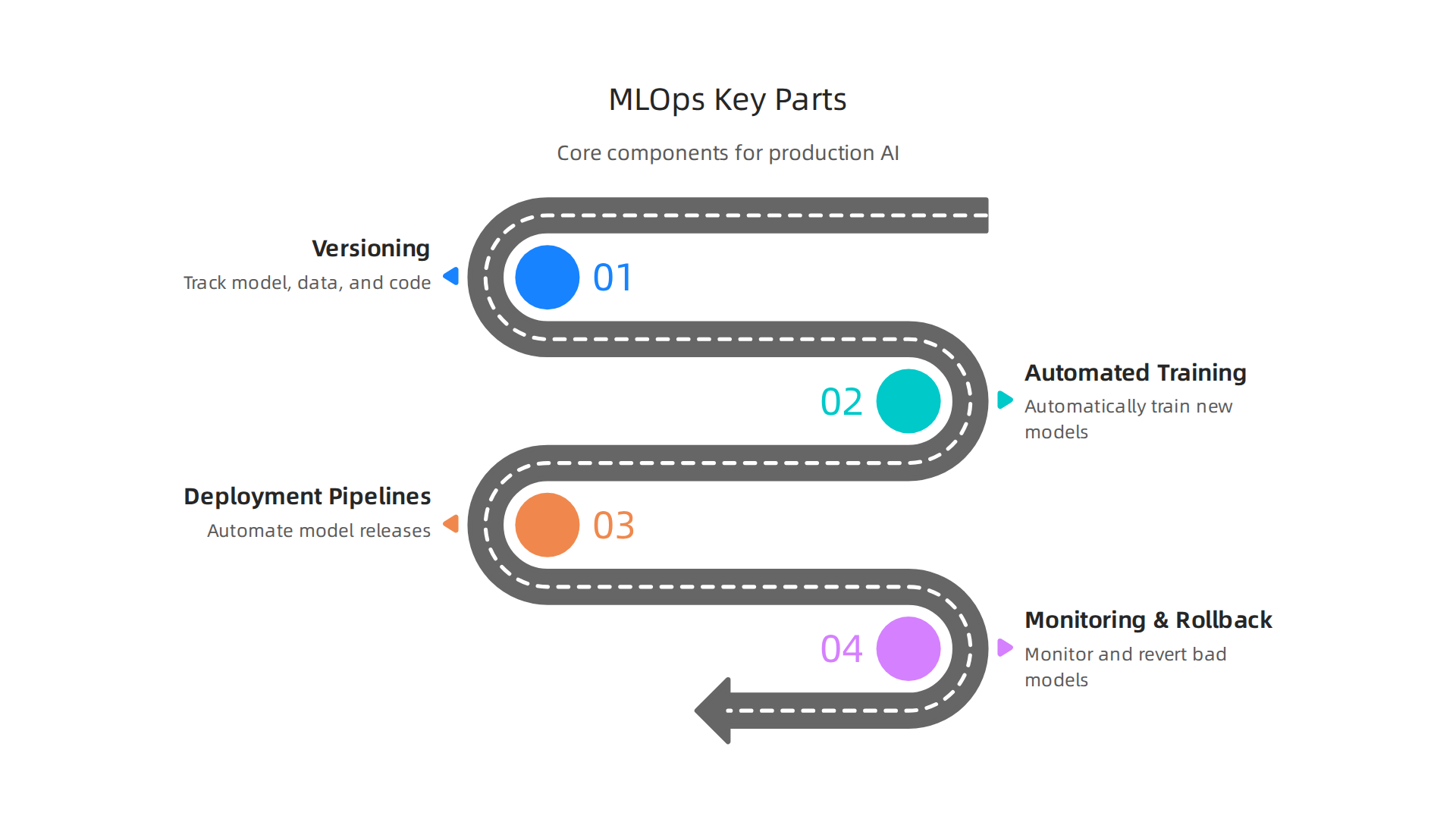
- Versioning Everything: Just like keeping track of changes in code, MLOps means you track every version of your model, the data it was trained on, and the code used to train it. This is super important for being able to go back and check why something worked (or didn’t). Tools like Git help with code, while other tools help manage data versions
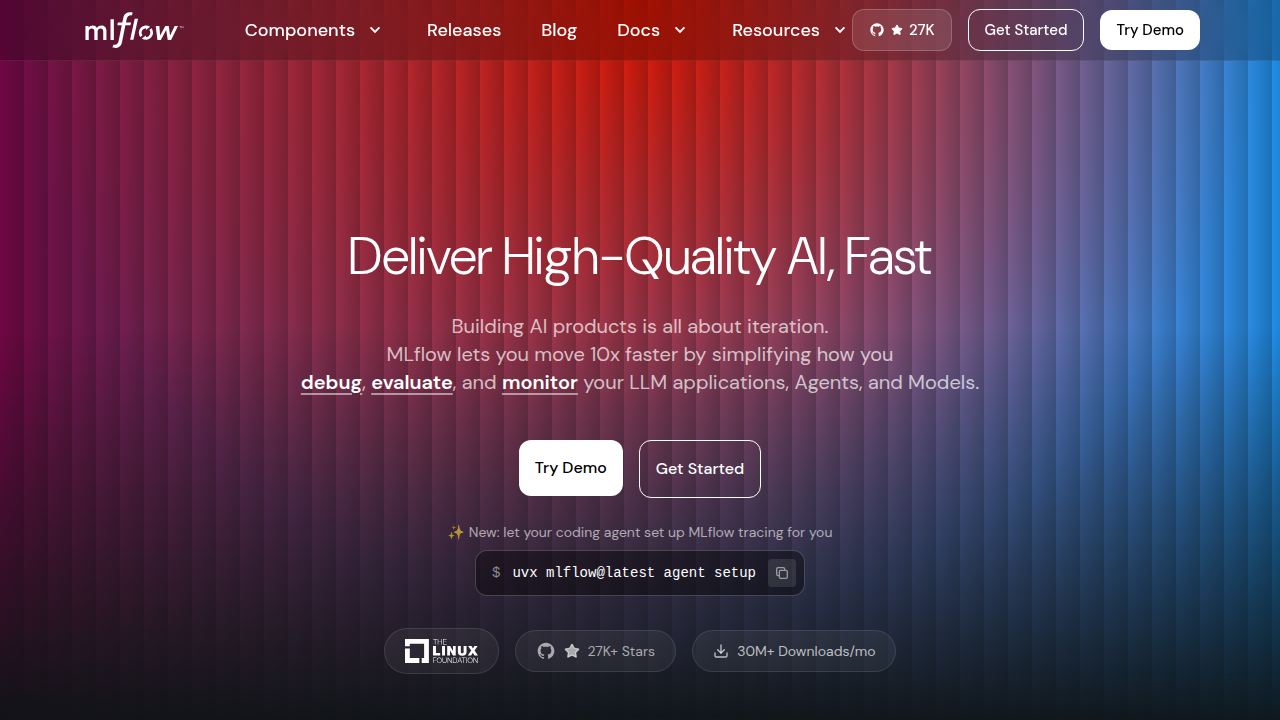
8 MLOps Best Practices You Should Implement in 2026.
- Automated Training and Testing: Instead of running things by hand, MLOps sets up automatic systems. When new data comes in or code changes, the system can automatically train new models and test them to make sure they’re still working well. This includes checking the quality of the data before it’s used MLOps Pipeline Automation Best Practices in 2026. These tests ensure that components work together correctly CI/CD Best Practices for Multi-Stage MLOps Deployments.
- Deployment Pipelines: This is about how an AI model goes from being ready to actually being used. MLOps uses "pipelines" that automatically put the model into the system, checking along the way to make sure it works with everything else. This helps with continuous delivery, meaning new models can be put into action quickly and safely MLOps: Continuous delivery and automation pipelines in ….
- Monitoring and Rollback: Once a model is running, MLOps doesn’t stop there. It includes systems to watch the model constantly, making sure it’s performing as expected and isn’t making bad predictions. If something goes wrong, MLOps also has plans to quickly switch back to an older, working version of the model MLOps Best Practices: Complete 2026 Guide. This ensures high reliability for your AI systems Production MLOps: best practices for high-reliability AI ….
How Lightning AI Fits into MLOps
Lightning AI helps a lot with these MLOps needs. Its clear component model makes it easier to version code and ensures that different parts of your AI project are reusable and understandable. Its support for distributed training means that the complex parts of scaling your training are handled, which makes automating training pipelines much simpler. By taking away repetitive tasks, Lightning AI improves the developer experience, letting your team focus more on the unique aspects of your AI models. It streamlines the building and testing phases, which are crucial for MLOps.
To really stay ahead in the fast-moving world of AI and software engineering, you need to keep learning.
The AI Newsletter Worth Reading
Knowing about tools like Lightning AI and practices like MLOps is just one part of understanding the bigger picture. If you’re looking to dive deeper into how different AI platforms come together, it’s worth learning about how to evaluate and integrate generative AI platforms for developer teams.
Understanding how Lightning AI fits into the larger world of tools is super important. Think of it this way: even the best chef needs good ingredients and different kitchen tools to make a great meal. In the same way, while Lightning AI helps a lot with building and managing your AI models, it usually works best when teamed up with other helpful tools.
Tooling Ecosystem: Integrations, Common Libraries, and Benchmarking Workflows
Your AI models don’t live in a bubble. They need to talk to other systems that handle data, keep track of features, watch how models perform, and remember how different tests went.

Lightning AI is designed to connect smoothly with many of these important tools. This helps a software development engineer build a complete and strong AI system.
For example, when you get data ready for your AI model, you often need special tools to clean it up and make it perfect. Lightning AI has built-in ways to work with popular labeling tools, which means you can handle these steps directly within your project Lightning AI Review – MLOps Platforms. This makes it easier to move from preparing data to training your model. You can find a list of how Lightning AI connects with many other software programs on its Lightning AI Integrations page. This kind of integration is key in 2026, as more teams are looking for platforms that can connect easily with their existing setup Top AI Integration Platforms for 2026.
Here are some types of complementary tools Lightning AI works with:
- Data Processing Tools: These help you clean, change, and get your raw data ready for the AI model to learn from.
- Feature Stores: Imagine a library where all the special facts (features) your AI model uses are kept tidy and ready. These stores make sure all your models use the same, correct information.
- Monitoring Tools: Once your AI model is working, these tools keep a close eye on it to make sure it’s still making good predictions and not running into problems.
- Experiment Tracking: When you’re trying out different ways to build your AI model, this helps you keep notes on what you did, what worked, and what didn’t. This is like a scientist’s notebook for your AI tests.
Making sure all these parts work well together is part of modern engineering technology trends 2026, which shows how AI and platform engineering are changing how we build software.
Designing Benchmarking Workflows
After setting up your tools, you need to know if your AI model is truly good. This is where benchmarking comes in. Benchmarking means comparing your AI model’s performance against certain standards or other models to see how well it works. It’s like testing different cars to see which one is fastest, uses less gas, and is cheapest to buy.
When you benchmark AI models, you usually look at three main things:
- Model Performance: How accurate are its predictions? Is it making correct guesses most of the time?
- Resource Efficiency: How much computer power or memory does it use? An efficient model does its job without wasting precious computer resources.
- Cost: How much money does it cost to train and run the model? Using too much computing power can get expensive.
Lightning AI helps a lot with creating these tests. Its structured way of training and deploying models makes it easy to try out different versions and compare them side-by-side. This allows you to quickly see which version of your lightning ai model performs best, uses fewer resources, and is most cost-effective. By doing so, you can choose the best model to augment AI efforts, ensuring your projects are both powerful and practical. If you want to see how to train, deploy, and scale AI models, a helpful resource is this How to Train, Deploy & Scale AI Models with Lightning AI tutorial. This process of careful testing helps software development engineers make smart choices about their AI tools.
While making smart technical choices about AI tools is crucial, it’s just as important to make responsible choices. As AI becomes a bigger part of our lives in 2026, understanding ai ethics, rules, and how to follow them is key. This helps software development engineers build AI systems that are fair, safe, and trustworthy.
Ethical practices, governance, and compliance for AI teams
Building AI isn’t just about code and data. It’s also about making sure the AI behaves well and doesn’t cause harm. This is where AI governance comes in. It’s like having a set of rules and a plan to make sure your AI projects are done the right way. Many groups, from government agencies to local counties, are setting up these rules to guide how AI is used responsibly

Artificial Intelligence Governance Framework.
Mapping Governance Responsibilities
For AI governance to work, everyone on the team needs to know their part. This means different groups have different jobs:
- Engineering Teams: The people who build the AI, like those using
lightning ai, are responsible for making sure the model works as expected and is technically sound. They also need to think about potential biases in the data or how the model could be misused. - Product Teams: These teams decide what the AI will do and how it will help users. They need to make sure the AI’s goals align with ethical standards and don’t lead to unfair results.
- Legal Teams: Lawyers help ensure the AI follows all the laws and regulations about data privacy, fairness, and safety.
- Executive Teams: Leaders set the overall vision for how the company uses AI. They make sure that ethical practices are a top priority and that resources are available to follow them.
Having clear roles and responsibilities helps ensure that AI systems are developed with company values and risks in mind [GAO-21-519SP, ARTIFICIAL INTELLIGENCE: An Accountability Framework for Federal Agencies and Other Entities].
Practical Compliance Checkpoints
To keep AI projects on the right track, teams need practical steps to check their work. These checkpoints help ensure compliance and build trust:
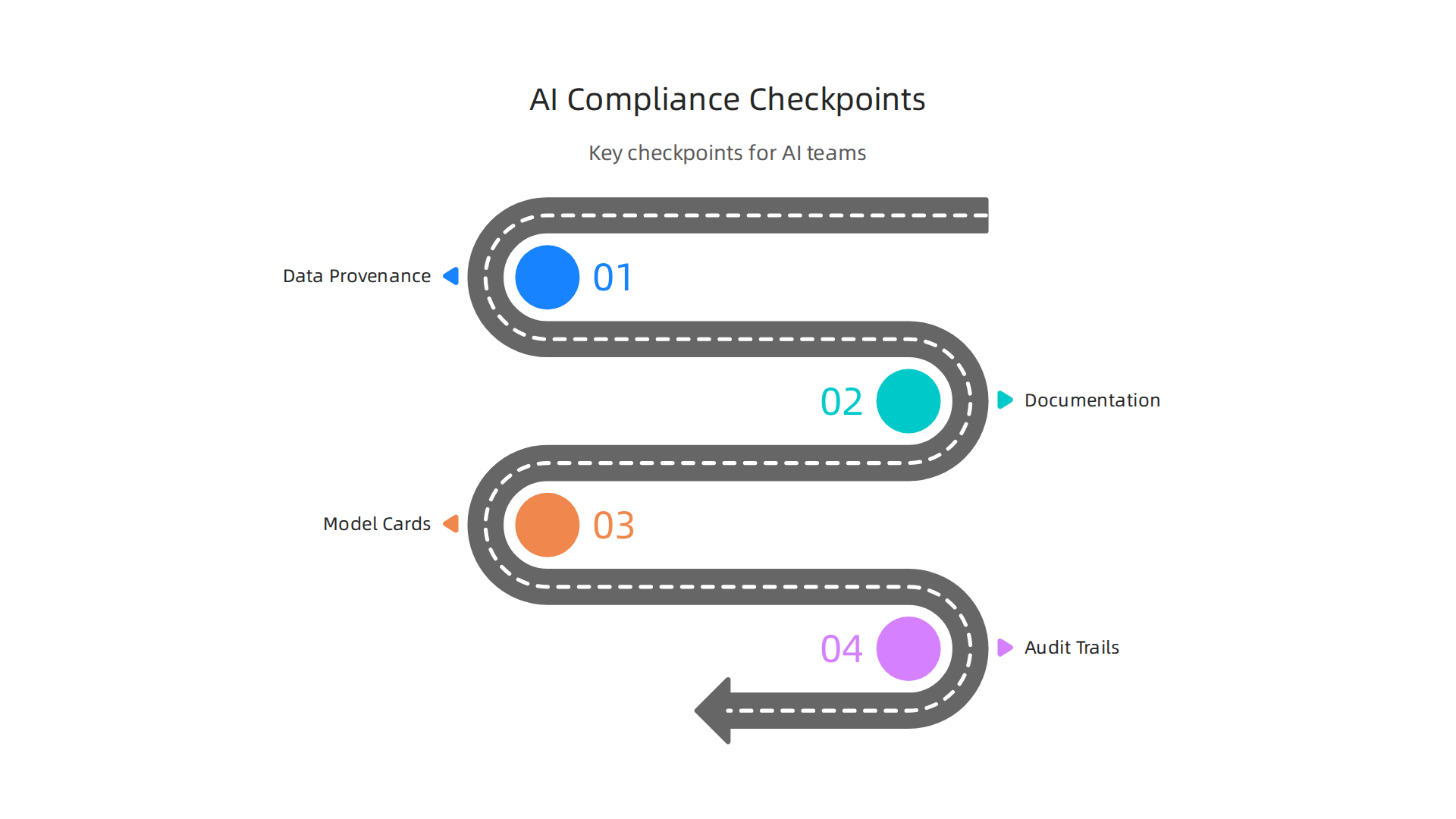
- Data Provenance: This means knowing exactly where your data comes from. Was it collected fairly? Does it represent different groups of people? Tracking data sources helps prevent bias and ensures transparency.
- Documentation: Keeping good records of how an AI model was built, what data it used, and how it was tested is very important. This helps others understand the model and find problems if they arise.
- Model Cards: Imagine a nutrition label for your AI model. A model card explains what the AI does, how well it performs, what its limits are, and any risks it might have. This simple summary helps everyone understand the AI better.
- Audit Trails: An audit trail is a record of every important action taken with the AI model, from training to deployment. It helps trace back any issues and shows that the team followed the rules.
Platforms like lightning ai can help engineers maintain these records by providing structured ways to manage projects and track experiments. Following frameworks like the Artificial Intelligence Risk Management Framework helps guide teams in handling these risks. By focusing on these areas, software development engineers can confidently augment AI capabilities in a way that is responsible and builds public trust [CIO 2185.1C, Accelerating Responsible Use of Artificial …].
If you’re interested in how to best evaluate and integrate new AI platforms into your work, learning about these practical steps is a great starting point. You can find more helpful information on how to evaluate and integrate generative AI platforms for developer teams.
For even more clear, daily insights into AI and broader technology developments, consider checking out The AI Newsletter Worth Reading.
Responsible development: testing, bias detection, and validation strategies
After setting up strong AI governance rules, the next big step is to make sure your AI actually follows them. This means focusing on smart testing, finding and fixing any unfairness, and always checking that the AI works as it should.

For software development engineers, these steps are key to building reliable and ethical AI systems.
Testing for Machine Learning Models
Building an AI model is different from building regular software. So, the testing needs to be different too. In 2026, many teams use a few kinds of tests to make sure their AI is working well:
- Unit Tests for Data and Training: Think of these as small checks. They look at the pieces of data you feed into the AI. Are they clean? Are they in the right format? These tests also check the steps your AI takes to learn, or "train," from the data. This helps catch problems very early on. Companies even have special frameworks to test these AI workflows Top Frameworks for AI Workflow Unit Testing: 2026 Comparison.
- Integration Tests for Models in Systems: Once your AI model is trained, it needs to work with other parts of your computer system. Integration tests make sure the AI "talks" correctly to other software. For example, if your AI suggests a product, does that suggestion show up correctly on the website?
- Production Validation: This is the final check when the AI is actually being used by people. It’s about watching the AI in the real world to make sure it keeps doing its job well over time. This includes making sure it doesn’t slow down, gives correct answers, and stays safe. An AI/ML Model Validation Testing Guide for 2026 can help teams navigate these steps.
Tools like lightning ai help software development engineers manage these different types of tests. They provide ways to organize your data, track your training experiments, and check how well your models perform throughout their lifecycle.
Spotting and Fixing Bias
One of the biggest worries in ai ethics is bias. Bias means the AI might treat certain groups of people unfairly because of the data it learned from. Here’s how teams work to prevent this:
- Checking Datasets for Bias: The data used to train AI models is super important. If the data only shows one type of person or situation, the AI will learn to favor that. Teams carefully look at their datasets to make sure they are fair and include many different groups of people. This helps the AI learn to be unbiased.
- Picking the Right Metrics: How do you know if an AI is fair? You need to measure it. Teams choose special ways to score the AI’s performance, making sure it performs well for all groups, not just the majority. For example, instead of just looking at overall accuracy, they might check accuracy for different age groups or backgrounds.
- Continuous Validation: Bias can creep in over time. As the world changes, so does the data that comes in. That’s why teams keep checking their AI models regularly, even after they’re in use. This ongoing validation helps them catch new biases quickly and fix them.
By constantly testing and checking for fairness, teams can truly augment AI capabilities responsibly. This means not just making AI smarter, but also making it more just and trustworthy for everyone. If you’re looking to enhance your abilities in this rapidly changing field, understanding these validation strategies is crucial. Many online certifications for software engineering keep you ahead in 2026.
Operational security, data privacy, and scaling concerns
After making sure your AI is fair and works correctly, the next big steps are keeping it safe and making it run smoothly for everyone. For any software development engineer, this means thinking about how to protect the AI, keep user data private, and make sure the system can handle a lot of work without breaking the bank or slowing down. These are important parts of building good ai ethics.
Keeping Your AI Safe
When AI models are used, they connect to many parts of a computer system. Think of these connections as "endpoints." It’s like doors that data goes in and out of. You need to guard these doors carefully to stop bad actors from getting in. This means:
- Protecting AI Endpoints: Make sure only trusted programs and people can send information to or get information from your AI models. It’s like putting a strong lock on every door.
- Controlling Data Access: AI models often use sensitive data. It’s vital to control who can see and use this data, and for what reasons. This protects user privacy and stops data from being misused. Many tools help
software development engineers manage and test these access patterns to find problems early, as explained in AI Testing Tools Every ML Engineer Should Know in 2026. - Managing Secrets: AI systems need "secrets" like special keys or passwords to work. These must be stored very safely, away from common sight. If these secrets get out, it could cause big problems.
Protecting User Privacy
User privacy is a huge part of ai ethics. People need to trust that their information is safe when they use AI. There are smart ways to use data for AI without showing personal details:
- Differential Privacy: This method adds a little bit of "noise" or random data to your information. It’s like blurring a photo just enough so you can’t tell who a person is, but you can still see it’s a crowd. The AI can still learn from the general patterns, but no one can figure out specific details about any single person.
- Federated Learning: Imagine your phone has personal data, but you don’t want it to leave your phone. With federated learning, the AI model comes to your device to learn from your data, instead of your data going to the cloud. Only the lessons learned are sent back, not your private information.
- Trade-offs for Privacy: While these methods are great for privacy, they can sometimes make the AI model a little less accurate. It’s a balance between keeping data super private and making the AI super smart.
Software development engineers must consider these choices carefully.
- Trade-offs for Privacy: While these methods are great for privacy, they can sometimes make the AI model a little less accurate. It’s a balance between keeping data super private and making the AI super smart.
Scaling AI: Managing Cost and Speed
When many people use an AI system, it needs to be able to handle all that work. This is called scaling. You also want it to respond quickly and not cost too much to run.
- Managing Cost: Running powerful AI models can be expensive. Teams look for ways to make the AI work efficiently, using fewer computer resources when possible. This helps keep costs down, especially as AI use grows.
- Handling Latency: Latency means how long it takes for the AI to respond. If an AI is slow, people won’t want to use it. Teams work to make sure AI models give answers very quickly, even when many requests come in at once. Tools like
lightning aihelp here by allowingsoftware development engineers to build and deploy models that can scale efficiently and manage resources to control costs and keep response times low. For building and deploying machine learning models efficiently, understanding platforms like AWS Sagemaker in 2026 Build Train and Deploy Machine Learning Models is key.
By focusing on these areas of security, privacy, and scaling, companies can truly augment AI in a responsible and useful way. It makes AI not just powerful, but also safe, trustworthy, and ready for the real world. If you’re looking for more ways to stay updated on AI trends and best practices, consider subscribing to The AI Newsletter Worth Reading for clear daily updates.
To make sure AI stays powerful, safe, and ready for what’s next, companies need to focus on their teams.

This means making sure their software development engineers have the right skills, hiring smart, and planning for the future of AI. It’s all about future-proofing your team so they can build great things.
Skills for AI-First Engineering Teams
In 2026, engineers need a special set of skills to work well with AI. It’s not just about coding anymore.

- Learning AI Tools: Engineers need to know how to use popular AI tools and frameworks. This includes understanding platforms like
Lightning AIor PyTorch Lightning, which help build and train machine learning models more easily. Using tools like these can make building AI models in production much smoother than using raw PyTorch, as explained in a guide for Lightning vs raw PyTorch for production AI in 2026. - Understanding Data: AI runs on data. So, engineers must be good at working with data, cleaning it, and understanding what it means. They need to make sure the data is fair and unbiased.
- MLOps Know-How: This is about how to build, test, and run AI models in the real world. It means knowing about things like automated testing, version control for models and data, and keeping an eye on how models perform once they are live. These skills are key for reliable
augment AIsystems. Many teams use MLOps Pipeline Automation Best Practices in 2026 to make their work smoother. - AI Ethics: Every
software development engineershould also think aboutai ethics. This means knowing how to build AI that is fair, private, and doesn’t cause harm. It’s a big part of making AI trustworthy. - Continuous Learning: The world of AI changes fast. Engineers must always be learning new things and adapting to new tools and ideas. If you’re a
software development engineerlooking to keep your skills sharp, check out resources on software developer skills 2026.
Smart Hiring and Team Setup
Building the right team for AI in 2026 is super important. Companies should look for people who not only code well but also understand the whole journey of an AI project, from start to finish.
- Teamwork is Key: AI projects often need people with different skills to work together. This means bringing in data experts, engineers, and even people who understand how AI will affect users.
- Focus on Problem Solving: Instead of just hiring for a specific tool, look for people who are good at solving problems and thinking creatively. This helps teams deal with new challenges in AI.
- Open Minds: Teams should be set up so that everyone can share ideas and learn from each other. This helps to build AI responsibly and to spot problems early.
By hiring carefully and helping teams grow their skills, companies can make sure their AI efforts are strong for years to come. This way, they can continue to augment AI in ways that truly help people.
Summary
This article explains why modern engineering teams must pair smarter AI tooling with stronger ethics to build reliable, scalable systems in 2026. It uses Lightning AI as a practical example to show how component models, distributed training, and developer ergonomics speed production work while fitting into MLOps pipelines. The piece covers core MLOps practices—versioning, automated training, deployment pipelines, monitoring, and rollback—and shows how tooling eases these tasks. It also details integrations with data processing, feature stores, monitoring, and experiment tracking, and how to benchmark models for performance, efficiency, and cost. The article highlights governance and compliance: mapping responsibilities, keeping provenance and audit trails, and using model cards. It outlines testing strategies, bias detection, privacy-preserving options like differential privacy and federated learning, and operational security best practices. Finally, it argues teams must hire and train for new skills so engineering organizations can responsibly augment AI in production.