

Why open-source AI is a turning point for IoT developers
Imagine a world where your everyday things, like your fridge or your car, are smart enough to think and make choices.

This is the world of the Internet of Things (IoT), and it’s getting even smarter with artificial intelligence (AI). In 2026, a big change is happening: open source AI is making it easier than ever for the people who build these smart things to add powerful AI features.
Before, getting AI into IoT devices was often hard and costly. Developers had to build AI models from scratch or pay a lot for special tools. But with open source AI, many AI tools and models are now free to use and change. This is a game-changer because it helps speed up how fast we can make smart devices better. Think of it like a shared AI toolkit that everyone can use and improve. This means more new ideas can become real, and faster too. For example, an IoT software development company can now quickly grab an open source AI model, tweak it, and put it into their new smart home device without spending tons of money or time building it from the ground up. This really helps to lower the walls that used to stop innovation.
While open source AI brings many exciting chances, engineers still face some tough challenges. IoT devices are often small and run on very little power. They might not have a lot of storage or computing speed, so putting big, complex AI models on them can be tricky.
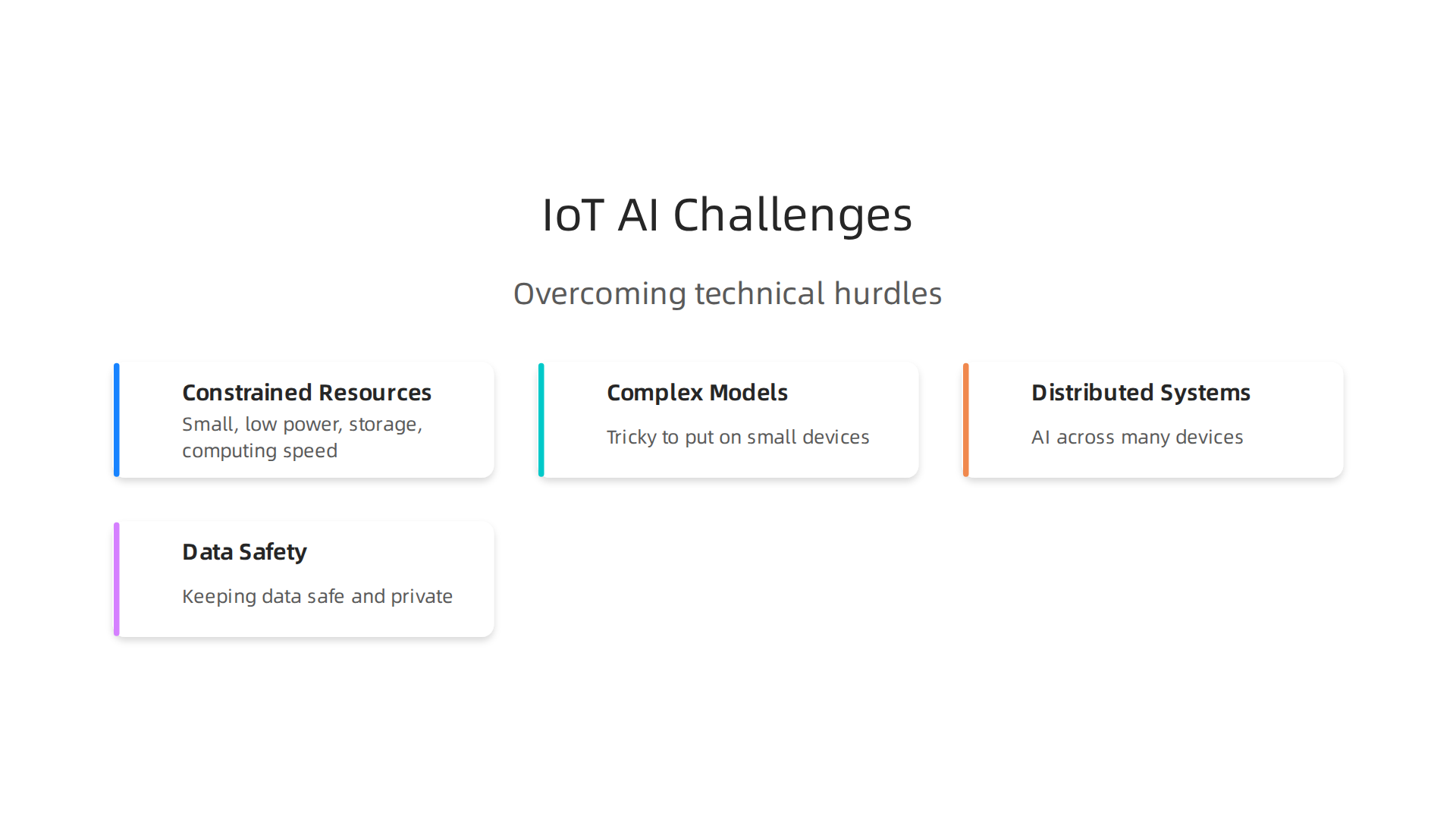
This means developers need to be very clever about making AI models smaller and more efficient. Also, getting AI to work smoothly across many different devices that are all connected and talking to each other, often called "distributed systems," adds another layer of difficulty. Keeping data safe and private when it’s being collected and shared by many IoT devices is also a big concern that developers must address. Even with services like AWS IoT helping to manage connections, figuring out how to make these devices truly smart in a safe and useful way takes a lot of skill.
Understanding these challenges is key to making the most of open source AI. It’s about finding smart ways to use these new tools to build amazing things, while also making sure they work well and keep our information safe. For more ways to bring AI into your projects, check out how to apply AI in software development 2026 strategies for engineering teams.
If you want to stay updated on the latest AI trends and how they impact software engineering, make sure to get The AI Newsletter Worth Reading.
Even with the tough challenges, open source AI gives big benefits for IoT and edge devices.
These are devices that need to be smart but don’t have a lot of power or space. Think about a small smart sensor or a simple robot arm. For these kinds of devices, open source AI is a huge help.
First, it saves money. When you use open source tools and models, you don’t have to pay for expensive licenses. This means smaller companies or teams can get started with AI more easily. In fact, many companies are now choosing open source models like Llama 3.x to save money and for more control over their AI projects in 2026, according to a report on Enterprise AI Adoption Trends 2026. This is great for an IoT software development company that wants to build smart things without a huge budget.
Next, open source AI gives you lots of freedom. You can change the AI code to fit your exact needs. This is super important for IoT devices because they all work a bit differently. You might need an AI model to be extra small or to use very little power. With open source, you can tweak it until it’s just right. This also means you’re not stuck with one company’s tools (this is called vendor neutrality). You can pick and choose the best parts from different places to build your unique AI toolkit.
Another big plus is the community. When many people work on an open source AI project together, they share ideas and fix problems faster.

This teamwork helps create better tools and models. These shared tools, or "toolchains," make it easier to test new ideas quickly. This is especially good for big groups of connected devices, often called "device fleets." For example, standard ways to share AI models, like ONNX (Open Neural Network Exchange), help different devices understand each other’s AI models better. This speeds up how fast new AI features can be added to many devices at once.
In 2026, many organizations are already using open source AI. About 63% of organizations use some form of open source AI, showing how popular and useful it has become for building new technologies, as highlighted in a report on Open-Source AI Adoption 2026. This strong adoption shows that open source AI is not just a trend, but a real way to build the future of smart devices.
To learn more about choosing the right tools and cloud platforms for your engineering needs, consider reading about Strategic Choices for Developer Tools and Cloud Platforms in 2026.
Building on the idea of smart devices, an iot software development company needs specific tools for open source AI to run smoothly on small devices. These tools are often called "toolchains" and they include frameworks, runtimes, and model formats. They are like the special instruction sets that tell the AI how to work on different kinds of hardware.
Open-source AI toolchains for IoT: frameworks, runtimes, and model formats
To get open source AI working well on tiny IoT devices, developers use special programs and ways of packaging AI models. Two popular choices for running AI models on devices are TensorFlow Lite and ONNX Runtime. TensorFlow Lite is made by Google and is great for phones and smaller embedded systems. ONNX Runtime, from Microsoft, is another flexible choice that works across many different types of devices and is very good at executing models efficiently, according to experts discussing Edge AI: Running AI Models On-Device in 2026. These runtimes are designed to be lightweight, meaning they don’t use up too much power or memory, which is perfect for IoT devices.
When we talk about how AI models are saved, we call them "model formats." A very common one is ONNX, which helps different AI tools understand each other’s models. For even smaller models or special cases, there are other formats like TensorFlow Lite’s FlatBuffer schema. If you’re using larger language models (LLMs) on edge devices, the GGUF format combined with the llama.cpp engine has become very popular in 2026 for running these powerful AI models right on a device’s main processor, as noted in a report on Edge AI in 2026: Running Models Where the Data Lives.
One key way to make AI models fit on small devices is called "quantization." This means making the numbers inside the AI model smaller and simpler. Imagine shrinking a big detailed picture into a smaller, simpler drawing. It takes up less space and works faster, even if it loses a tiny bit of detail. Tools like ONNX Runtime 1.19 now support special standardized formats, such as Open Edge ML (OeML), that help encode these smaller, faster models, simplifying their use on edge devices, according to a look at Optimizing Local Inference: How SLMs are Redefining the Edge ….
Choosing the right open source AI tools for your project means thinking about a few things. You have to balance the size of the AI model, how fast it needs to work, how much memory it uses, and how much power it consumes. For tiny sensors, you’d pick the smallest, most power-efficient options. For a more powerful edge device, you might be able to use a slightly larger model that gives more accurate results. An iot software development company needs to carefully consider these trade-offs to build an effective ai toolkit. For more on how these tools fit into larger systems, you can learn about Integrating Top AI Tools Into Cloud-Native Applications. Finding the right balance ensures your smart devices work as expected without draining batteries too fast or being too slow to respond.
To stay on top of the latest developments in AI and how it impacts software engineering, consider getting The AI Newsletter Worth Reading. It offers clear daily updates from The Deep View Newsletter.
Choosing the right open source AI tools for IoT is only half the battle. Once those tools are in place, keeping everything secure and private is very important.

Smart devices collect and use lots of data, and if this data or the AI brain on the device isn’t protected, bad things can happen. An iot software development company must think about security from the start.
Security, privacy, and compliance considerations for open-source AI in IoT
When many smart devices run open source AI in different places, new security worries pop up. Think about a fleet of devices, like sensors in a factory or smart home gadgets. Each one is a possible weak spot.
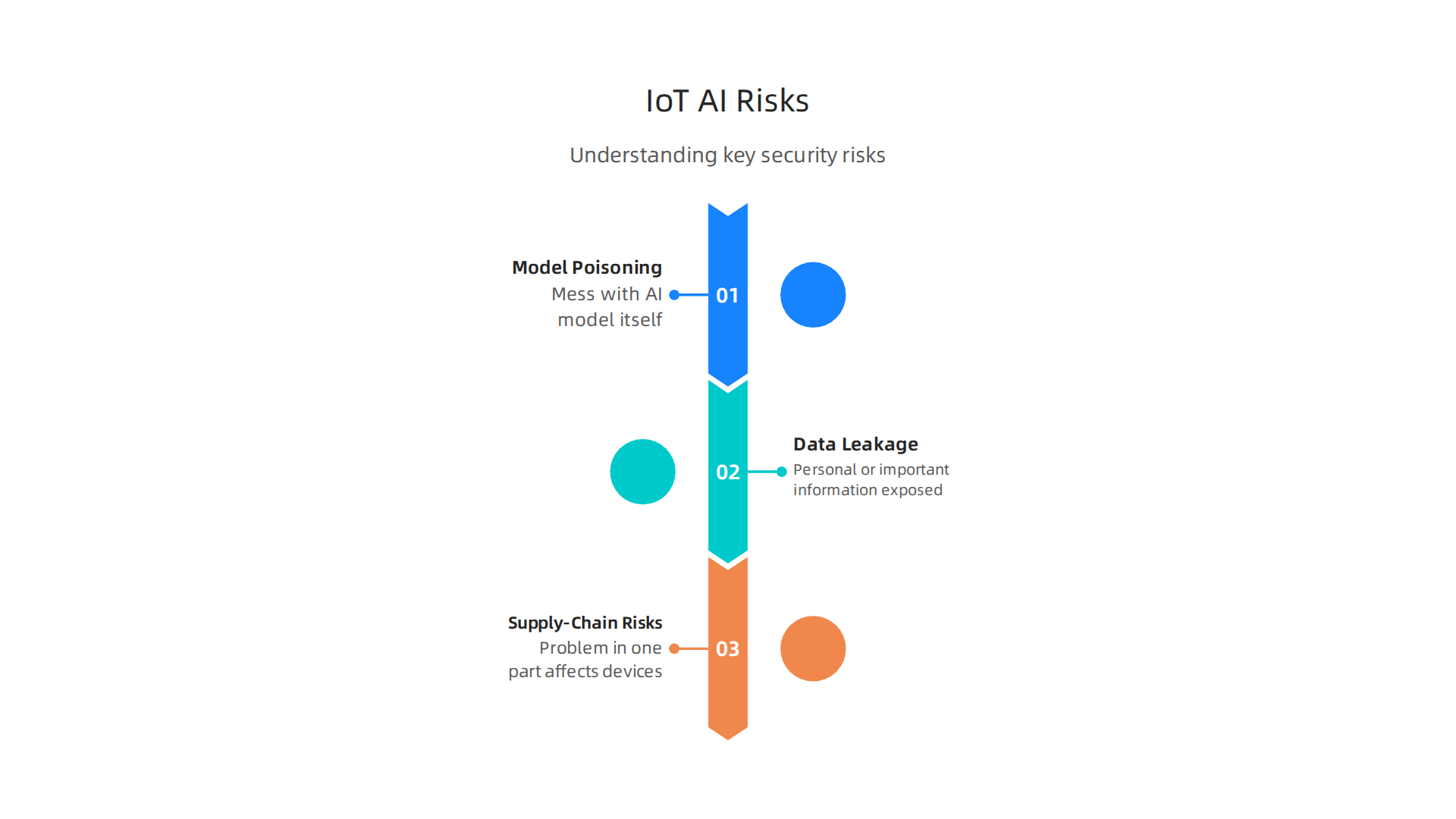
Here are some of the main dangers:
- Model poisoning: Someone could try to mess with the AI model itself, either while it’s being built or when it’s updated on the device. This could make the AI do wrong things or even stop working.
- Data leakage: IoT devices often handle personal or important information. If the device isn’t secure, this data could leak out to people who shouldn’t see it. For example, a smart camera might accidentally share video it shouldn’t.
- Supply-chain risks: Because
open source AIuses many different parts from different places, a problem in one of those parts could affect all your devices. This means checking every piece of software and hardware used in yourai toolkitis critical, a challenge detailed in a security threat analysis for artificial intelligence of things on devices.
To keep devices safe, an iot software development company needs strong controls. For example, devices should use things like "Secure Boot," which checks that only trusted software runs when the device starts. Encryption can protect data stored on the device, like "full-disk encryption." Also, "trusted execution environments" create a super-safe place on the device for sensitive AI tasks. These protections are key, especially for AI running on the device itself and for how updates are sent to devices, as highlighted in guidance on securely deploying AI at the network edge – ITSP.80.101.
Privacy is another big concern. Devices often process private information like voices or faces. To protect this, it’s best to handle sensitive data right on the device if possible, rather than sending it to the cloud. This is called "on-device inference." For example, a device might only send a "wake word" like "Alexa" to the cloud, but process your full voice command locally. Other methods like "redaction" and "masking" can remove private details from data before it leaves the device. Using unique, anonymous IDs instead of real personal information is also helpful. Some advanced systems even turn raw physical presence into anonymous data right on the device, removing the risk of leaking sensitive biometric data.
Staying compliant with rules and laws is also a must. Many governments, like those in Europe, have strong rules about how smart devices handle privacy, requiring a "privacy-by-design" approach. Organizations like NIST also release guidelines, such as their IoT Product Cybersecurity Guidelines, which help companies build secure IoT devices. For teams working with cloud-connected devices, understanding how to manage sensitive information is crucial, so learning about AWS Secrets Manager Best Practices for Cloud Security can be very helpful. Making sure your open source AI solutions follow these rules helps build trust and keeps your devices safe and working correctly.
When you decide to use open source AI for smart devices, you also need to figure out where that AI will do its work. Will it be right on the device, nearby, or far away in the cloud? How you set this up is called a "deployment pattern," and picking the right one is key for how well your IoT system runs.
Let’s look at the main ways to use open source AI with your smart devices.
Deployment Patterns: Edge, Fog, and Cloud Integration for Open-Source AI
Thinking about where your open source AI lives helps you make good choices for your smart devices. Each choice has its own good points and things to watch out for.
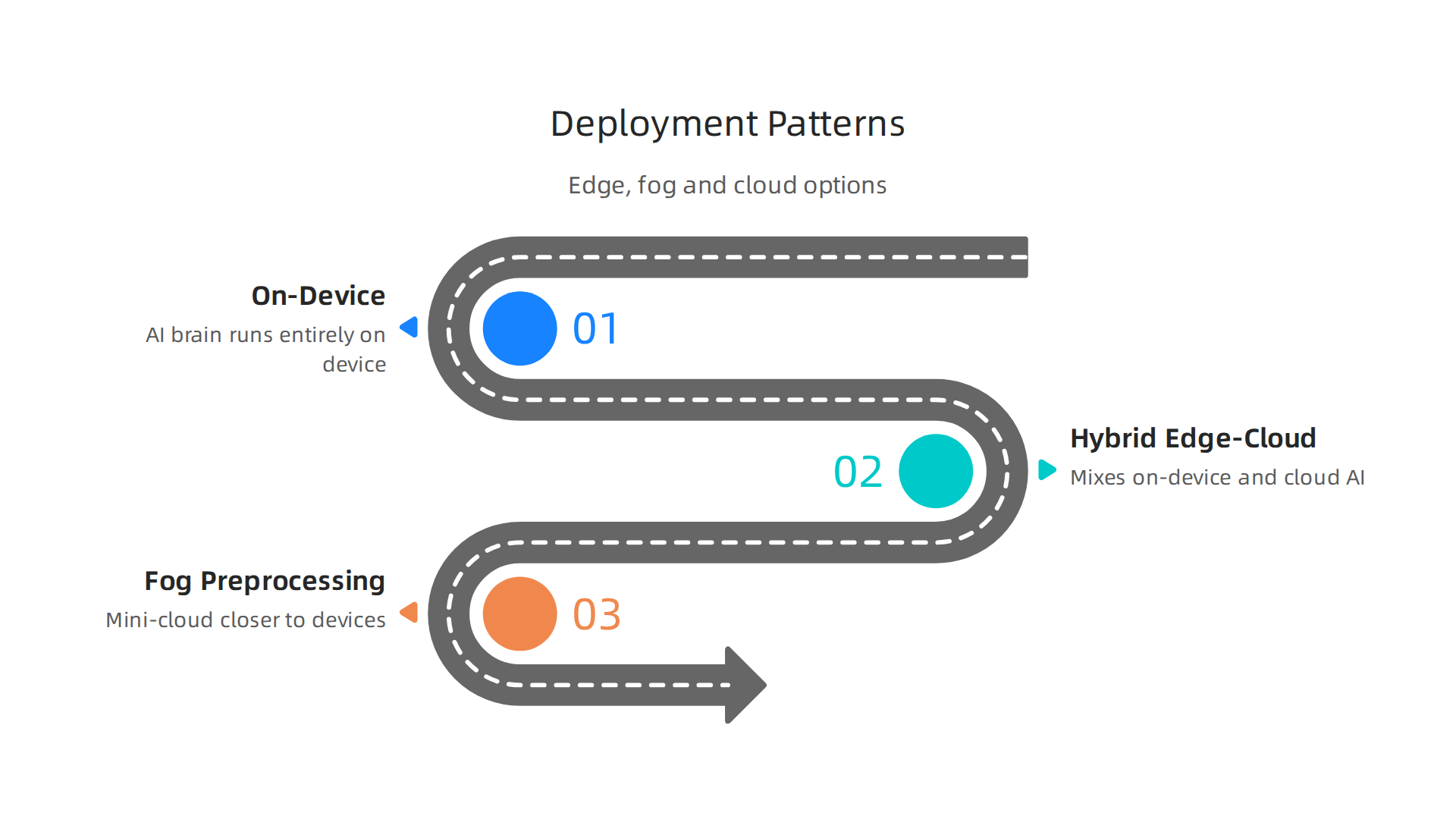
1. Fully On-Device AI (Edge AI)
This means the AI brain runs entirely on the smart device itself. The device collects data, and its own small computer processes it right there. Think of a smart security camera that can tell the difference between a person and a pet all by itself, without sending video to the internet.
- Why it’s good:
- Fast decisions: The AI can react super quickly because it doesn’t need to send data far away. This is called low latency, and it’s very helpful for things like medical IoT devices that need to respond fast, sometimes reducing delays by a lot Deploying Low-Latency Edge AI in Medical IOT Networks.
- Saves internet data: It uses much less internet bandwidth because it’s not constantly sending raw data to the cloud. Some studies show edge AI can greatly reduce bandwidth use Volume 12, Issue 9, September 2024.
- Better privacy: Sensitive information stays on the device.
- When to choose: When quick reactions are needed, internet connection is poor, or data privacy is very important. Many companies are making their
ai toolkitwork well for these small devices. - Things to think about: The device needs enough power and memory for the AI. Updating the AI model (called an Over-The-Air or OTA update) needs to be handled carefully.
2. Hybrid Edge-Cloud Inference
This way mixes both on-device AI and cloud AI. Some simple AI tasks happen on the device (the "edge"), and then more complex tasks or deeper analysis happen in the cloud. An example is an aws iot device using AWS IoT Greengrass to run AI locally, but still connecting to the cloud for other tasks Pattern 3: Real-time inference at the edge – AWS Documentation.
- Why it’s good:
- Best of both worlds: You get some speed and privacy from the edge, plus the huge computing power of the cloud for harder tasks. This can reduce how much data is sent and still allow for advanced features Hybrid Edge AI and Centralized Processing for IoT.
- Flexible: You can decide what runs where based on what makes the most sense.
- When to choose: For tasks that need some quick local feedback but also benefit from big-picture analysis or more powerful AI models in the cloud.
3. Fog-Layer Preprocessing
The "fog" is like a mini-cloud that sits closer to your devices than the main cloud. Imagine a small computer in a factory that collects data from many sensors. It does some AI work on that data, then only sends the important bits to the main cloud.
- Why it’s good:
- Helps many devices: It can handle data from lots of devices nearby, reducing the load on the main cloud.
- Better than pure cloud: It’s faster than sending everything to the far-off cloud, but can be more powerful than a single device.
- When to choose: For larger setups like smart factories or cities, where many devices produce data that needs some local smarts before going to the cloud. An
iot software development companymight suggest this for big projects.
Choosing the Right Pattern
Picking the best pattern for your open source AI in IoT depends on what you need most:
- How fast does it need to react? (Latency)
- How much internet data can it use? (Bandwidth)
- How sensitive is the data? (Privacy)
- How much power does the device have? (Battery life, processing ability)
- How many devices are there? (Scalability)
Operational Implications
No matter which pattern you choose, managing your open source AI deployments has some common challenges:
- Networking: How reliable is the internet connection? Will sending data take too long or cost too much?
- Latency: For some applications, even a tiny delay can be a big problem. Edge computing often gives the lowest latency.
- Over-The-Air (OTA) Updates: You’ll need a good plan to update the AI models and software on your devices once they are out in the world. This is super important for security and to add new features to your
ai toolkit. Without good OTA updates, your devices could become outdated or unsafe.
Learning about these different ways to deploy AI can help you make smart choices for your projects.
For those who want to stay on top of all the latest AI developments, we have a recommendation.
The AI Newsletter Worth Reading delivers clear daily AI updates to help you navigate this fast-changing world.
After picking the right deployment pattern for your open source AI in smart devices, the next big step is making sure everything runs smoothly and reliably over time. This is where MLOps, or Machine Learning Operations, comes into play. MLOps is a set of best practices for building, deploying, and managing AI models. When you’re dealing with many small, simple devices, MLOps needs special care.
Operational Best Practices: MLOps for Constrained Devices
MLOps helps you manage the entire life of your open source AI models, from when you create them to when they are working on your devices. For smart devices, this means doing things a bit differently because these devices often have limited power, memory, and internet access.
What is MLOps for Edge AI?
MLOps for edge AI focuses on getting your AI models to work well on devices that are "at the edge" of the network, meaning they are close to where the data is collected. It’s about automating the steps to test, deploy, and keep an eye on your AI models, especially when they are part of a larger ai toolkit used across many smart devices. It’s crucial for things like security and making sure your devices keep working correctly in 2026. For a deeper dive into these practices, you can explore guides on augment AI development with lightning AI MLOps and ethical best practices for engineers.
Continuous Integration/Continuous Deployment (CI/CD) for IoT
CI/CD is like an automated assembly line for your software.
- Continuous Integration (CI) means developers regularly combine their code changes into a main project. Automated tests then run to make sure the new code hasn’t broken anything.
- Continuous Deployment (CD) means that once the code passes all tests, it’s automatically sent out to the devices.
For IoT devices, this often involves "Over-The-Air (OTA) updates," which means updating the software or AI models wirelessly. This process needs to be very careful because if an update goes wrong on many devices, it can be hard to fix. Tools like the Open Edge ML consortium are even working on standardized formats for edge models to make this easier, according to 2026 reports Optimizing Local Inference: How SLMs are Redefining the Edge …. Some companies also make their CI components open-source to help with fast deployment of edge AI solutions An Agentic Framework for Rapid Deployment of Edge AI Solutions in ….
Model Versioning and Management
Imagine you have many smart devices, and over time, you create better open source AI models. How do you keep track of which model is on which device? That’s where model versioning comes in.
- You give each AI model a unique version number.
- This helps you know exactly what AI is running where.
- It’s important because some older devices might only be able to run simpler models, while newer ones can handle more complex AI.
- Standard formats like ONNX (Open Neural Network Exchange) and TensorFlow Lite are widely used for sharing and deploying these models, especially on mobile and embedded devices Standards & Specifications – EDGE AI Working Group Wiki. This helps ensure your
ai toolkitworks across different hardware.
Monitoring and Rollback Strategies
Once your open source AI is out in the world, you need to watch it closely.
- Monitoring means keeping an eye on how well the AI is performing, if it’s making errors, and if the data it’s seeing looks normal. Key metrics might include the time it takes to get the first answer or how much memory it uses Edge AI Inference [2026]: LLMs on WASM, Mobile, IoT – Tech Bytes. Open-source platforms like Pipette are even available to benchmark AI models on devices Pipette Benchmarks On-Device AI.
- Rollback strategies are your backup plan. If a new AI model causes problems, you need a quick way to switch back to a previous, working version. This is like having an "undo" button for your deployments, which is very important for stability and security. Cybersecurity for IoT products is a big deal in 2026, with guidelines from places like NIST helping to secure these devices News & Updates.
Smart Telemetry and Observability
Telemetry is the data your devices send back about how they are working. Observability is how well you can understand what’s happening inside your system by looking at that data.
- For constrained devices, you can’t send all the raw data to the cloud. It would use too much internet bandwidth and might expose private information.
- The trick is to send only the most important data points. This means summarizing data on the device itself before sending it, or making sure private information (like personal details) is removed or changed so it can’t be traced back to someone Edge AI Telematics for Fleet Safety: 2026 Playbook.
- By focusing on "privacy-aware observability," you get enough information to fix problems without putting user privacy at risk. This balance is key for any
iot software development companytoday. Ensuring secure deployment also means using things like Secure Boot and trusted execution environments where available Securely deploying AI at the network edge – ITSP.80.101.
By following these MLOps best practices, you can make sure your open source AI systems on smart devices are strong, safe, and easy to manage, even as they grow.
Building teams and governance models for open-source AI projects
After learning how to manage your AI once it’s on smart devices, the next big step is figuring out how companies work together to create and share these open source AI projects. This means building good teams and having clear rules, also known as governance models. In 2026, more companies are using AI, with over half already putting physical AI into use. This makes working on open source AI projects more important than ever.
Roles and How People Work Together
When a company wants to join an open source AI project, it needs to know who does what.
- Contributors are like the builders. They are the people who write code, create new features, and fix problems. They contribute their work to the project.
- Maintainers are like the project managers. They oversee the work, make sure new contributions fit with the project’s goals, and guide the overall direction.
For things to run smoothly, companies need clear ways for people to add their work. This is called a contribution workflow. It often involves steps where new code is checked by others before it’s added to the main project. With more AI tools helping developers, there are even discussions about how to handle contributions made with AI assistance, making sure they follow project rules in 2026. Some open-source projects have clear guidelines about how contributors should share if they used AI tools for their work, as noted in a report on Open-Source Governance Orientations for Managing AI-Generated Contribution Volume.
Setting the Rules: Governance Choices
Good governance is like having a clear rulebook for your open source AI project. This helps everyone understand what they can and cannot do.
-
Licensing
Open-source licenses are like contracts that tell everyone how they can use, change, and share the AI code. Choosing the right license, like the MIT License or Apache-2.0, is very important. It ensures that everyone respects the rules and that the software stays truly open. For companies, understanding these licenses is key to making sure they are following the rules when they use or contribute to anai toolkit. You can learn more in this Complete Guide to Open Source & AI Licensing 2026. -
Contributor Agreements (CLAs)
Sometimes, companies ask contributors to sign a Contributor License Agreement (CLA) or a Developer Certificate of Origin (DCO). These agreements make sure the project has the right to use the code, even if many people have worked on it. This helps protect the project legally. The AI Alliance, for example, requires clear ways for people to contribute and often uses DCOs to handle intellectual property rights, while also ensuring transparency about where the code comes from, as described in their AI Alliance Program Governance. -
Security Review
Sinceopen source AImodels can be used in many places, including devices for aniot software development company, checking them for security problems is a must. This means looking closely at the code for any weaknesses that bad actors could use. Security frameworks for AI models are getting more attention in 2026 to help protect against these risks. A recent Hikvision 2026 Cybersecurity White Paper highlights the importance of protecting AI models during digital changes.
Working with the Community and Protecting Your Ideas
Being part of an open source AI project means working with a wider community. This involves sharing ideas, getting feedback, and helping others. Good community engagement can make your project stronger.
It’s also important for companies to find a balance between sharing their work openly and keeping their special ideas private. They can contribute to open source in ways that benefit everyone, while still holding onto their own unique developments.
Showing the Value: Measuring ROI
Companies get many good things from participating in open source AI. They can save money by using ready-made tools instead of building everything from scratch. They can also innovate faster by working with a global community of developers. Plus, it helps them find talented people who want to work on exciting, collaborative projects.
To see if their efforts are paying off, companies track things like how much faster they develop new features or how many new ideas come from the community. This helps them understand the return on investment (ROI) for their open source AI work.
Staying updated on the fast-changing world of AI is crucial for any software professional.
Get clear daily AI updates from The AI Newsletter Worth Reading.
Summary
Open-source AI is reshaping how developers build smart IoT devices by lowering costs, increasing flexibility, and speeding innovation through shared models and community toolchains. This article explains the technical and operational realities: which runtimes and model formats (like TensorFlow Lite, ONNX, GGUF/llama.cpp) work best on small devices, why quantization and other optimizations are essential, and how to choose between on-device, fog, or cloud inference. It covers practical MLOps concerns for fleets of constrained devices—CI/CD, OTA updates, model versioning, telemetry and rollback strategies—and lists the main security, privacy, and compliance risks such as model poisoning, data leakage, and supply-chain exposures. You’ll also learn governance and contribution patterns for open-source projects, licensing and CLA choices, and how to pick cloud and developer tools to support a safe, scalable AI-enabled IoT system. After reading, engineers and product leaders will be better equipped to select toolchains, design deployment patterns, secure their device fleets, and run effective MLOps for edge AI.