
Why this guide matters for engineering teams and founders
In 2026, the world of artificial intelligence is truly amazing. AI startups are popping up everywhere, and a lot of money is being invested in them. For example, in the first three months of 2026 alone, around $255.5 billion was put into AI startups. This huge amount was more than all the money invested in AI in the whole year of 2025! In fact, about 80% of all venture capital money in early 2026 went to AI startups, and now there are over 70,000 of them all over the world. This shows just how fast things are changing in the AI space The Numbers Behind the Global Rise of AI Startups (Up-to-…).
For engineering teams and company founders, this speed can feel like a lot to handle.

It’s hard to know which of these many AI startups are truly important. You need to understand new ideas, like the difference between agentic AI vs generative AI, and how each might help your business. You also need to figure out which AI labs are doing the most exciting work.
What makes this even more interesting is how AI startups are using things like no code development platforms. These tools let people build software applications very fast, sometimes without writing any code at all. This mix of powerful AI and easy building tools is changing how we think about making new products. If you want to learn more about this, check out how how building without code is transforming software development in 2026.
This guide is here to help you make sense of it all. We will give you clear ways to evaluate new AI ideas, look at different software designs, understand the teams behind these products, and spot potential risks. Our goal is to provide you with practical steps and research tasks, so you can make smart choices for your engineering team or startup.
The world of AI is always evolving. To stay on top of the latest changes and get smart insights every day, consider subscribing to The AI Newsletter Worth Reading.
Why AI startups and no-code platforms matter for engineering teams in 2026
The rapid changes and huge investments in artificial intelligence mean engineering teams and company founders must clearly understand how AI and no-code tools can give them a real advantage.
In 2026, staying ahead means knowing how to use these powerful new technologies.
One major strategic opportunity is speed-to-market and quick prototyping. With many new AI startups emerging, no-code development platforms let engineering teams build and test ideas much faster than before. You can quickly make a basic version of a product, get feedback, and make changes without spending a lot of time writing complex code. This speed is super important when the market moves so fast. Tools from various AI labs are becoming easier to integrate, making this process even smoother.
Another huge benefit is unlocking new verticals or business areas. AI capabilities, especially when combined with easy-to-use no-code tools, allow businesses to create completely new kinds of products or enter markets that were too hard to reach before. Think about how complex tasks, like sorting through tons of data or making personalized content, become simpler with the right AI. Whether you are looking at agentic AI vs generative AI for specific tasks, these technologies help businesses find new ways to grow. Indeed, many companies are already making AI a top priority in their business plans, with 83% of them focusing on AI, according to recent research 137 AI Statistics and Trends for 2026.
But with great power comes great responsibility. Engineering leaders face some tough choices when bringing in these new tools. The first is finding a balance between control and speed. No-code platforms can be super fast for building apps, but sometimes they do not give you as much fine-tuned control over the underlying code as traditional programming. You might build something quickly, but then find it hard to change a tiny detail exactly how you want it. This is a key thing to think about for any team looking at new solutions. To help make these choices, it’s good to have a strategic guide for engineering teams when using no-code app builders.
Then there is the balance between technical debt and iteration velocity. "Technical debt" is like messy code or systems that were built quickly but might cause problems later. While no-code tools allow for fast changes and updates (high iteration velocity), a system built too quickly without proper planning can sometimes lead to more technical debt down the road. This means it might be harder or more expensive to update or fix things later. Smart engineering teams need to weigh this trade-off carefully. They want to be fast now, but also make sure their products are strong and easy to maintain for the future. Making smart choices for strategic choices for developer tools and cloud platforms in 2026 is crucial for long-term success.
Choosing the right AI startup idea: technical viability vs market fit
After thinking about how fast AI and no-code tools can help, the next big step for aspiring founders and engineering teams is picking the right idea for their AI startup. This means finding a sweet spot where a real problem meets a smart AI solution, and where people actually want what you’re making.
It’s about two main things: technical viability and market fit.
Technical Viability: Can we build it with AI?
First, you need to ask if your idea can actually be built using AI. This is called technical viability.
- Do you have the right data? Most AI solutions, especially those using machine learning (ML), need a lot of good data to learn from. If you do not have enough data, or if it is not very good, your AI might not work well.
- Is the AI technology ready? Some problems are harder for AI to solve than others. For example, some tasks might need very complex agentic AI vs generative AI models. You need to make sure the AI tools and methods available today can handle your idea. Check out the kinds of things that major AI labs are focusing on to see what’s possible in 2026.
- Do you have the right skills? Building AI solutions needs people who know about data science, machine learning, and software engineering.
It’s important to think about these things early on. You do not want to spend a lot of time and money building something that just can not work the way you hoped. Exploring platforms like those for augmenting AI development can help you see what tools are available to make your ideas possible.
Market Fit: Do people want it?
Even if you can build something amazing, it only matters if people actually need or want it. This is market fit.
- Who has this problem? You need to know exactly who you are helping. Is it individuals, small businesses, or big companies?
- Is the problem big enough? Will solving this problem save people a lot of time, money, or make their lives much better? If the problem is small, people might not care enough to use your solution.
- Will they pay for it? Even if it is a good idea, people might not pay if there are free options or if they do not see the value.
Finding market fit is key for any new AI startup. It’s about making sure your awesome AI solution helps real people with a real pain point.
Lightweight Ways to Check Your Idea
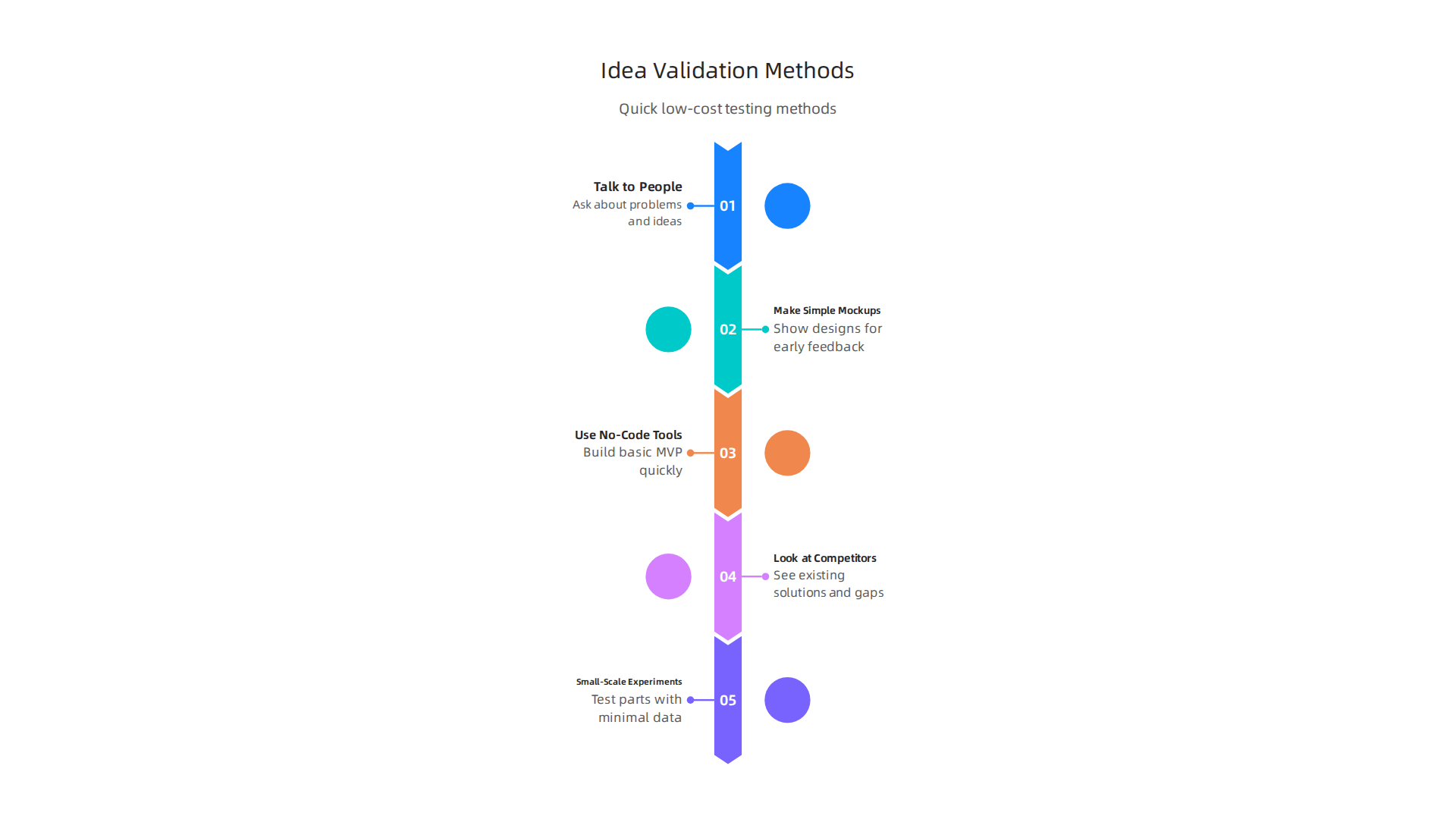
Before you build a huge, complex AI system, you can test your ideas in simple ways. This is called lightweight validation.
- Talk to people: The easiest way to check if your idea is good is to talk to the people who might use it.

Ask them about their problems and if your idea sounds helpful.
2. Make simple mockups: You do not need to build a working app right away. You can draw pictures or make simple click-through designs to show people what your idea would look like. This helps them understand and give you feedback.
3. Use no-code tools: Remember those no code development platforms we talked about? You can use them to build a very basic version of your product, called an MVP (Minimum Viable Product), very quickly. This lets you test the core idea without a lot of coding.
4. Look at competitors: See if others are trying to solve the same problem. How are they doing it? What are they missing?
5. Small-scale experiments: Sometimes, you can test a part of your AI idea with a small amount of data or a simpler model to see if the core technology works.
By doing these checks early, engineering teams can save a lot of effort. It helps you decide if your AI startup idea is worth moving from a simple prototype to a full, viable business, as experts suggest for successful startup journeys How to Move Your Startup From Prototype to a Viable Business.
To stay updated on the latest AI trends and insights that can help validate your next big idea, consider subscribing to specialized newsletters.
The AI Newsletter Worth Reading
After you have a great AI startup idea that you know people want, the next big step is figuring out how to build it. This means choosing the right technical architecture. This is like deciding on the best blueprint for your house before you start building. For AI startups, this choice affects how fast your AI works, how much it costs, and how easy it is to keep running.
Model-as-a-Service (MaaS)
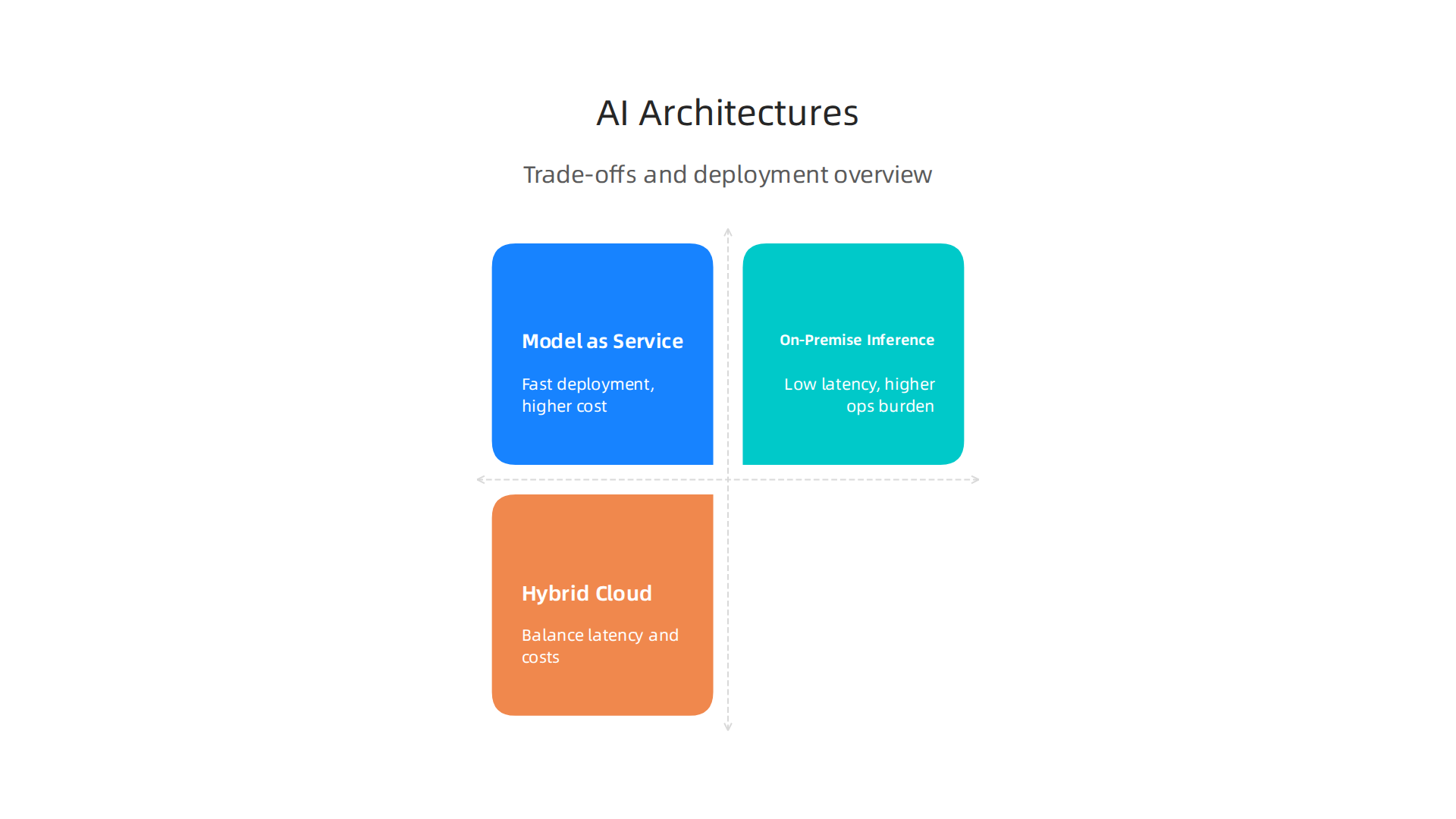
One common way to build AI solutions is called Model-as-a-Service, or MaaS. Here, your AI models run on big computers in the cloud. Think of it like renting a powerful computer brain from companies like AWS, Google Cloud, or Azure.
- Pros: It is easy to start. You do not need to buy expensive computers, and it can handle many users at once. This is great for new AI startups that need to grow fast.
- Cons: Sometimes, sending data to the cloud and getting results back can take a little time (this is called latency). Also, using cloud services can become expensive as more people use your product. Keeping your data private in the cloud also needs careful planning. For more on choosing your cloud setup, consider learning about Strategic Choices for Developer Tools and Cloud Platforms in 2026.
Embedded/On-Premise Inference
Another way is to run your AI models right where they are needed. This is called embedded or on-premise inference. The AI might run on a user’s phone, a special device, or on servers you own in your own building.
- Pros: It is very fast because the data does not have to travel far. It also helps keep user data very private since it stays local.
- Cons: Setting up and managing your own computers can be costly and difficult. It is also harder to scale up quickly if suddenly many more users want to use your AI.
Hybrid Cloud Approach
Many AI startups choose a mix of both. This is called a hybrid cloud approach. You might run some parts of your AI in the cloud and other parts locally. For example, a heavy AI model might be in the cloud, but a smaller part that checks information quickly runs on a user’s device. This can help balance speed, cost, and data privacy. It lets you get the best from both worlds, but it can also be more complex to manage and keep track of. Looking into MLOps Platforms: The 2025 CTO’s Guide to Cost, Benefit … can offer insights into these mixed strategies.
Understanding the Trade-offs
When picking an architecture, AI startups must think about these key things:
- Latency: How quickly does your AI need to respond? If it is for self-driving cars, every millisecond counts. For a photo organizer, a few seconds might be fine.
- Cost: How much money do you want to spend on computers and services? Cloud services often start cheap but can get expensive as you grow. Running your own servers has a high upfront cost but might be cheaper later. Scaling your AI startup efficiently means looking at strategies for cost efficiency and growth.
- Observability and Maintainability: Can you easily see if your AI is working right? Can you fix problems quickly and update the AI when needed? This is where good MLOps (Machine Learning Operations) practices come in. MLOps helps you build, deploy, and manage AI systems reliably. Following MLOps Principles ensures you can keep your AI healthy and performing well over time. This includes things like monitoring, testing, and making sure your AI models are updated safely.
When you have chosen the right overall setup for your AI, the next step for AI startups is to focus on the smaller, but equally important, details. This means figuring out how your AI model will actually live and work in the real world. It includes how it gets to users, how it is updated, and how it is kept running smoothly every day. Getting these model infrastructure and deployment patterns right helps your product work well and keeps your users happy.
Model infrastructure and deployment patterns
After picking your overall AI setup, it is time to think about the nitty-gritty of how your AI model will live and grow. This includes how it is deployed, updated, and kept running smoothly. For AI startups, getting this right helps your product work well and keep users happy.
Model Hosting and Deployment
Your choice of where to host your AI model directly affects its deployment. If you picked a Model-as-a-Service approach, your AI models are hosted by a cloud provider. For embedded or on-premise inference, you manage the hosting yourself. A hybrid approach means you mix and match. Each choice influences how easily you can send your AI to users and handle different workloads. For example, platforms like AWS Sagemaker in 2026 can help you build, train, and deploy machine learning models efficiently.
Continuous Integration and Continuous Delivery (CI/CD) for Models
Making sure your AI models are always up-to-date and working well means using CI/CD practices. Think of CI/CD as an assembly line for your AI. It helps you quickly and safely build, test, and release new versions of your models. For example, setting up pipelines that automatically test, check, and deploy models is a key part of MLOps best practices. This kind of automation is crucial for production AI, making sure your software teams can deliver updates reliably
and often. To truly operationalize machine learning, you need these automated systems in place to quickly catch and fix issues before they reach users. This continuous approach helps AI startups stay agile and responsive. You can learn more about these methods in articles like 10 Actionable MLOps Best Practices for Production AI.
Inference Scaling Strategies
As your AI product gains more users, your models need to handle more requests without slowing down. This is called inference scaling. One common way is "autoscaling," where your cloud system automatically adds more power or copies of your AI model when traffic is high and scales them back down when it is low. This saves money and keeps your AI fast. Tools like Kubernetes, a system for managing groups of computers, can help with this. It allows you to run your AI models in containers, which are like small, self-contained packages that can be easily moved and scaled across different servers. Such orchestration is a key part of a cost-effective MLOps stack for startups.
Operational Priorities for AI Startups
Keeping your AI running smoothly over time requires constant attention to a few key areas:
- Monitoring: You need to watch your AI models closely to see if they are working correctly. This includes looking for "data drift," which happens when the new data your AI sees is different from the data it was trained on. Monitoring helps you spot problems early.
- Retraining Cadence: AI models can become less accurate over time as new information emerges. This means you need a plan for how often to retrain your models with fresh data. This "retraining cadence" ensures your AI stays smart and useful.
- Model Versioning: Just like you save different versions of a document, you need to save different versions of your AI models. This way, if a new version causes problems, you can easily go back to an older, stable version. It also helps you keep track of changes and improvements. These steps are part of an end-to-end MLOps pipeline for enterprises and are important for any AI startup aiming for long-term success.
Want to keep up with the latest in AI and technology?
The AI Newsletter Worth Reading delivers clear daily AI updates directly to your inbox.
For AI startups, building smart models is only possible with good data. Think of data pipelines as the busy roads that carry all the information your AI needs to learn and grow. These pipelines help you get data, clean it up, and get it ready for your AI models. This process includes steps like data ingestion and validation to make sure the data is good enough to use, which is key for successful machine learning in 2026.
Data pipelines, labeling, and cost-effective datasets
Good AI depends on good data. For AI startups, figuring out how to get and manage data without spending a lot of money is a big deal. This starts with your data pipelines, which are like systems that collect, clean, and prepare data for your AI models. These systems need to be able to handle data coming in from many places. It’s also smart to include ways to check the quality of your data as it flows in, ensuring your AI learns from accurate information. You can learn more about these processes, including data validation and feature stores, in best practices for scalable ML deployment.
When it comes to getting labeled data, which is data with "answers" your AI can learn from, cost is often a problem. Instead of hiring a huge team, AI startups can use smart, low-cost ways. This might include using open-source datasets that are already available for free or using crowdsourcing platforms where many people help label small parts of data at a low cost. You could also make simple internal tools to help your team label data more efficiently. Tools like DVC (Data Version Control) can help keep track of different versions of your data, much like you track code changes, which can be part of a low cost MLOps system at a startup. This helps ensure your AI always trains on the right information.
Early on, it’s also important for AI startups to think about data governance. This means having clear rules for how you collect, store, and use data. It includes making sure data is secure, private, and correct. Things like data versioning are crucial. This helps you track every change to your data, so if a problem comes up, you know exactly what happened. It also helps with understanding data lineage, which is knowing where your data came from and how it has changed over time. Planning for these basics from the start can save a lot of headaches later on and help you build strong, reliable AI products. For a deeper dive into making smart choices about your AI tools, especially those that don’t require heavy coding, check out articles on Top No Code Machine Learning Platforms and Prompt Engineering Tips for 2026. This can be especially helpful for AI labs looking to move quickly and efficiently.
No-Code & Low-Code Platforms: When to Use Them in AI Product Development
For many AI startups, especially when they are just starting out, speed is everything. This is where no-code and low-code platforms become very helpful. These tools let you build apps and systems with little to no actual coding. Instead, you use visual interfaces like drag-and-drop features. This means you can create things much faster, saving time and money.
When No-Code Works Best for AI Startups
No-code development platforms are great for certain tasks. They shine when you need to:
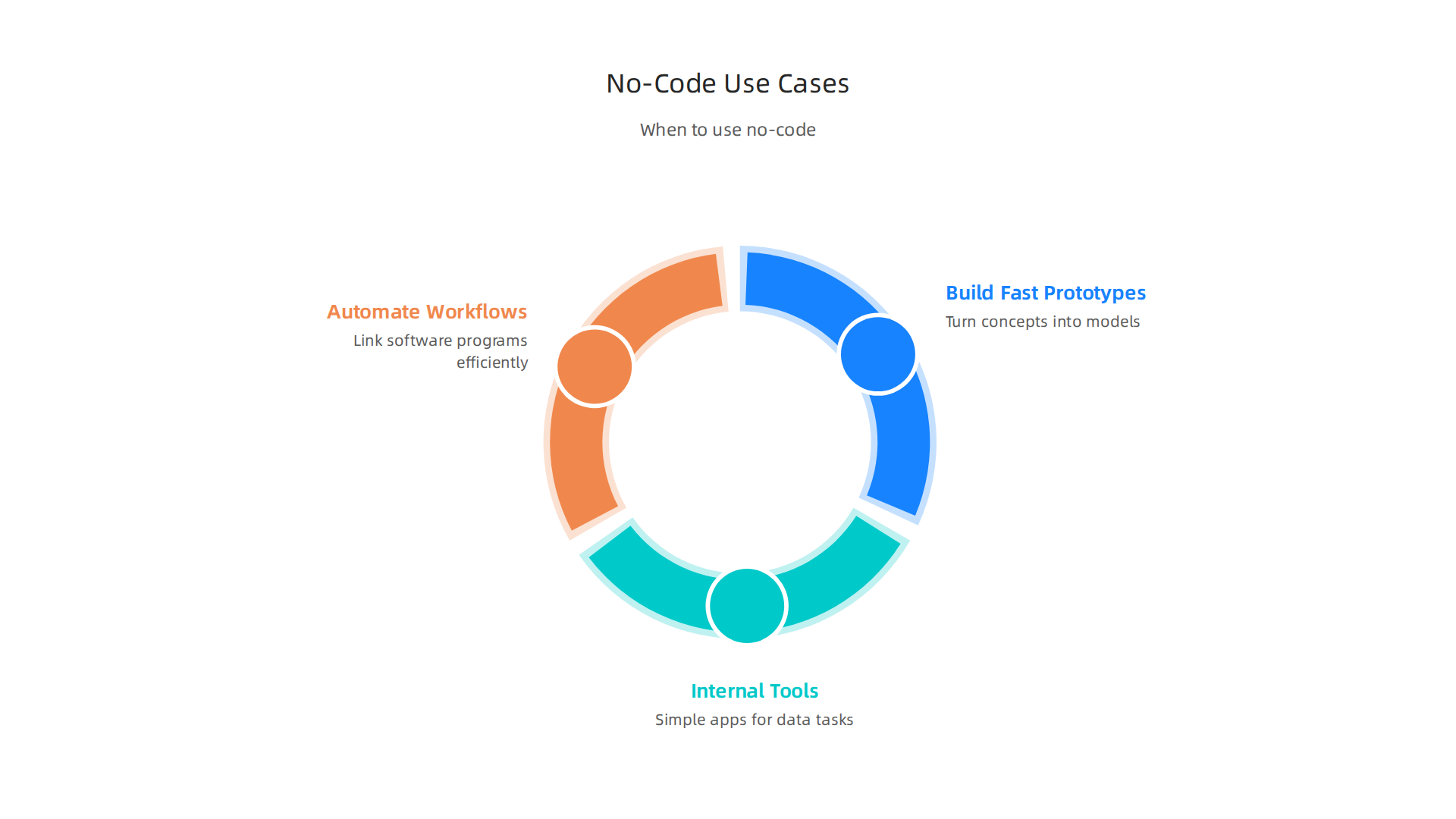
- Build fast prototypes: Want to test an idea quickly? No-code tools let you turn your AI concept into a working model in hours, not weeks. This is perfect for AI labs wanting to show off new ideas or test them with users. Tools like Figma Make can even turn your designs into working app prototypes quickly in 2026 What are the best no-code prototyping tools?.
- Create internal tools: Many AI startups need simple apps for their team. Maybe it’s a tool to manage data, track project progress, or automate small tasks. No-code solutions are perfect for these simple internal tools, as they can be made without needing a lot of coding help from your main engineering team. You can find many options among the Best 21 Low-Code and No-Code AI Tools in 2026.
- Automate workflows: If your AI system has steps that repeat often, no-code tools can help automate them. This makes your work more efficient. Examples include tools that link different software programs together to handle data or send out reports automatically. Some of the Top 11 No Code AI Workflow Automation Tools in 2026 can help with this.
Using these platforms helps improve the developer experience 2026 by letting teams focus on the complex AI parts rather than simple front-end coding. You can also explore a more detailed No-code App Builder Strategic Guide for Engineering Teams for deeper insights.
When to Be Careful with No-Code
While no-code is great for speed, it’s not always the best choice for everything. Sometimes, relying too much on no-code can lead to problems later on. This is often called "technical debt," meaning you might have to spend more time and money fixing things in the future.
Here’s when to think about moving away from no-code:
- Complex features: If your AI product needs very special features or has a lot of unique parts that no-code tools can’t easily handle, you might hit a wall. No-code platforms are often designed for common uses, not for highly custom ideas.
- Scaling up: As your AI startup grows and gets more users, your system will need to handle a lot more work. Some no-code tools might not be built to handle this kind of growth, which can make your app slow or unreliable.
- Deep AI integration: If your product needs to deeply connect different AI models or use very specific kinds of data processing, off-the-shelf no-code tools might not give you enough control. This is especially true for complex agentic AI versus generative AI applications that require precise control over every part of the system.
Transitioning to Custom Code
It’s smart for AI startups to start with no-code for quick wins and testing. But as your product proves its value and starts to grow, you should plan to move some parts to custom code. This switch allows you to:
- Have full control over your product’s features and how it works.
- Make sure your AI system can handle many users and lots of data.
- Build exactly what you need without being limited by what a no-code platform offers.
This approach balances speed with long-term stability and growth for your AI product.
To stay on top of daily AI updates and broader technology developments, consider reading The AI Newsletter Worth Reading.
When you’re building an AI startup, having the right team is just as important as having a great idea. At the very beginning, most ai startups start small, often with just a few key people.

These first hires usually need to be generalists. That means they can do many different jobs, like coding, designing, and even talking to early customers.
Core Hires for Lean AI Teams
For a very new AI startup or an AI lab creating an early product (called an MVP or Minimum Viable Product), a small team is common. You might see:
- Founder / Product Owner: This person sets the vision for the AI product and decides what features are most important.
- Technical Lead or Full-Stack Developer: This person builds the main parts of the product from start to finish. They need to be good at many kinds of coding.
- UI/UX Designer (Optional): Sometimes, a designer helps make the product easy and nice to use. This role might start part-time MVP Development Team Structure: Roles, Cost & Hiring ….
These early teams are often flat, meaning everyone works closely together without many layers of management. This helps them make fast decisions and share ideas quickly What’s the Best Organisational Structure for a Tech Startup?.
Generalists vs. Specialists
At first, generalist engineers are very valuable. They can switch tasks easily and understand many parts of the AI system. This is helpful when you’re still figuring things out and need flexibility. For instance, someone who can work on the AI model itself and also build the app where users interact with it (whether it’s agentic AI vs generative AI) is a huge asset.
But as your AI startup grows and your product becomes more complex, you’ll start needing specialists. These are people who are experts in just one area. For example, you might need a specialist for:
- Data Science: To make sure your AI models are trained with the best data.
- Machine Learning Engineering: To build and manage the actual AI models.
- Front-end Development: To create a really polished user interface.
The key is to know when to bring in these experts. Often, this happens when your product moves past the testing phase and starts getting more users.
Upskilling and Avoiding Bottlenecks
To keep your team strong, it’s important for everyone to keep learning new things. The world of AI changes fast, so ongoing learning is key. Many online courses and certifications can help engineers learn new skills or get better at existing ones, like building with no code development platforms or managing cloud services.
One big challenge for small teams is avoiding "bottlenecks." This is when only one person knows how to do a specific, important task. If that person is busy or leaves, work can stop. To prevent this:
- Share knowledge: Encourage team members to teach each other.
- Document work: Write down how things are done so others can follow.
- Cross-train: Let different people learn different skills. This means more than one person can handle a key job.
This way, your AI startup stays flexible and can keep growing without hiccups.
Want to stay informed about the latest in AI and tech every day?
Get clear daily AI updates from The AI Newsletter Worth Reading.
Building a strong team is just one part of getting an AI startup off the ground. Once you have your core team, the next step is to make your ideas real and see if people actually want what you’re making. This is where creating a Minimum Viable Product (MVP) and testing it comes in.
An MVP is like a very basic version of your AI product. It has just enough features to show what it can do and to let people try it out. The goal is to learn quickly without spending too much time or money. This helps AI startups figure out if their idea is good before building the whole thing.
Different Types of Prototypes for AI Products
When you’re building an AI product, you often create different kinds of prototypes to answer different questions. Think of them as steps:
- Tech Feasibility Prototype: This first kind of prototype asks: "Can our AI even do this?" It’s all about testing the core technology. For example, if you’re building an AI that recognizes images, this prototype would test if the AI can actually tell a cat from a dog. You’d measure things like how accurate the AI is and how fast it works.
- User Value Prototype: Once you know the AI can work, this prototype asks: "Do people want to use it? Does it solve a real problem for them?" Here, you’re looking for early users to try a simple version of your product. You’ll gather their feedback to see if they find it helpful or fun.
- Retention Prototype: This prototype comes later and asks: "Will users keep coming back to our AI product?" It tests if the product is sticky. You’ll track how often people use it, how long they stay, and if they recommend it to others.
Making these prototypes can be faster than ever in 2026 thanks to new tools. Many no-code AI tools for startups and platforms can help you build and test ideas quickly, even turning designs into working apps without writing much code. Tools like Figma Make can even turn simple ideas into interactive web app prototypes, integrating with your existing designs according to a 2026 report on no-code prototyping tools.
If you’re interested in learning more about these builders, check out this no code app builder strategic guide for engineering teams.
Measuring What Matters for Early AI Products
To understand if your AI product is a success, you need to measure the right things. These are called Key Performance Indicators (KPIs).
- For Tech Feasibility: You’d look at technical metrics. How accurate is your AI model? How quickly does it respond? How many errors does it make?
- For User Value: You’d focus on user feedback. Are people happy with the product? Do they say it helps them? You might also track basic usage, like how many people sign up to try it.
- For Retention: You’d measure engagement. How many users come back the next day or week? How much time do they spend using your product? Are they finishing important tasks with it?
By looking at these numbers and listening to users, AI labs and startups can figure out if they have "product-market fit." This means your product meets a strong need for many people. For AI products, this also means making sure the AI works well for different users and provides real value, whether it’s an agentic AI vs generative AI solution.
It’s important to run small experiments often. Change one thing in your prototype, see how users react, and then decide what to do next. This way of working helps you learn and improve your AI product step by step.
After figuring out if your AI idea works and if people want it, there’s another very important step: making sure your AI product is safe, fair, and follows the rules. This means thinking about risks, ethics, and compliance right from the start. For AI startups, this isn’t just about being good; it’s about avoiding big problems later on.
Risk, ethics, and compliance considerations for AI startups
In 2026, rules for AI are becoming clearer and stronger all over the world. Many places, like the European Union and several US states, now have laws that tell AI startups and other companies how they must use AI safely and fairly. These laws focus on things like risk management, telling people how AI works, and making sure the data used is good. For example, the EU AI Act has strict rules for "high-risk" AI systems, which are ones that can affect people’s jobs, safety, or basic rights AI Act | Shaping Europe’s digital future – European Union. Also, US states like Colorado and California have put in place their own rules for AI governance US AI regulations 2026: the state laws you must comply with.
Here are some key things AI startups should do:
- Protect User Data: Your AI products will likely use a lot of information. It’s super important to keep this data private and safe. Follow data privacy rules from the beginning. This helps keep trust with your users.
- Be Clear and Open (Transparency): Users should know when they are interacting with an AI system. If your AI makes important decisions, like approving a loan or job application, people need to understand how it works and what factors the AI used. New rules often ask for clear notices when high-impact AI is in use AI Regulation: How It Works, What It Requires, and ….
- Keep Good Records (Documentation): Write down how your AI was built, what data it used for training, and how you tested it for fairness and safety. This "paper trail" is very helpful if anyone ever asks questions about your AI. These kinds of records are becoming a must-have for AI products, especially those deemed high-risk 2026 AI Laws Update: Key Regulations and Practical ….
Ethical Risks and Simple Controls
Beyond just following rules, AI startups also need to think about ethics. This means making sure your AI is fair and isn’t used in harmful ways.

- Bias: AI learns from data. If the data has unfairness or "bias" in it, the AI will learn and repeat that bias. For example, if an AI is trained mostly on pictures of one type of person, it might not work well for others. This can lead to unfair results. Testing your AI with different groups of people can help you find and fix these biases.
- Misuse: Think about how your AI could be used in ways you didn’t plan, especially bad ones. Could someone use it to spread wrong information or make unfair choices? Building in safety checks and human oversight can help prevent misuse. By focusing on these things early, AI labs and startups can lower their risk and avoid problems later.
Balancing how well your AI works with doing things the right way is key. Learning to balance AI productivity with responsible AI practices for software teams is crucial for any AI startup aiming for long-term success. Staying updated on new laws and best practices is a constant job for AI startups.
To keep up with the fast-changing world of AI and its rules, it’s good to have trusted sources of information. For clear daily updates, consider reading The AI Newsletter Worth Reading.
Summary
This guide helps engineering teams and founders cut through the noise of a booming AI market by giving practical steps to evaluate ideas, choose architectures, and ship working products quickly. It explains why no‑code and low‑code tools matter for speed‑to‑market and when they create technical debt that warrants a transition to custom code. You’ll learn how to assess technical viability (data, skills, and model readiness) alongside market fit, and how to run lightweight validation with mockups, no‑code MVPs, and small experiments. The guide walks through architecture trade‑offs—Model‑as‑a‑Service, embedded inference, and hybrid approaches—and covers essential MLOps patterns like CI/CD, autoscaling, monitoring, and versioning. It also outlines cost‑aware data pipelines, labeling strategies, and early team structures that balance generalists and specialists. Finally, it highlights practical risk, ethics, and compliance steps startups must take to stay safe and scalable in 2026.